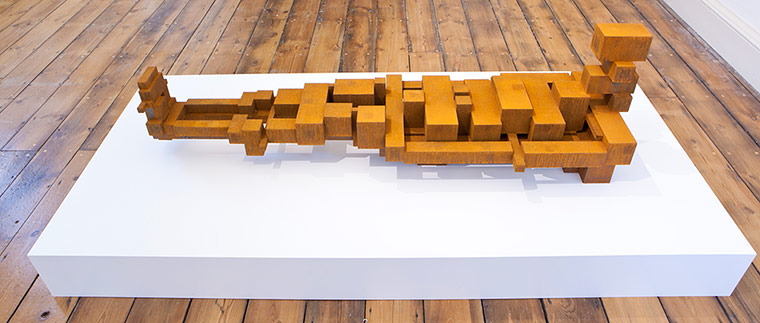
I believe that sculpture can powerfully evoke the nameless, the voiceless and the placeless. The most challenging social sculpture of our times is made by the quiet performances of the homeless within the shelter provided by the doorways of shops in our inner cities. This exhibition allows you to think about those bodies that have no place Photograph: Mark Bourdillon
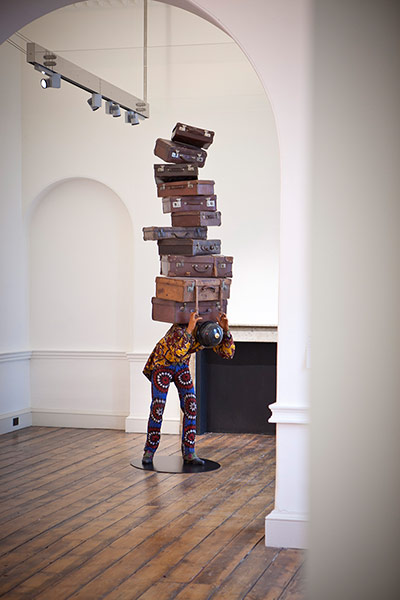
This 19th-century lone figure clothed in a Victorian suit made out of traditional African textiles carries the burden of his last possessions on his weakened back. The sculpture is off balance in a way that defies gravity, and his delicate poise highlights the difficult situation he finds himself in. The cases, stacked tall, weigh heavily. They represent all that is left from a previous life; any privileged person can become vulnerable at any time Photograph: Mark Bourdillon
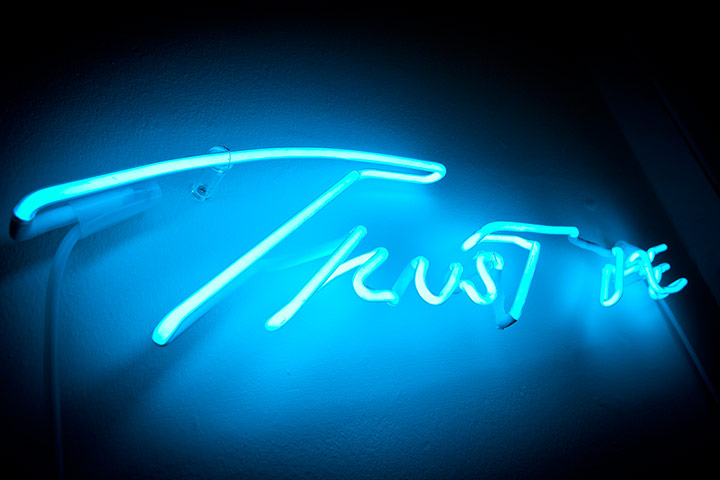
I've made new neons in answer to an old neon which relates to self-worth. Trust Me and Trust Yourself are words we often say to others and to ourselves. Sometimes such statements need to be reaffirmed. The use of neon makes it all the more positive Photograph: Mark Bourdillon
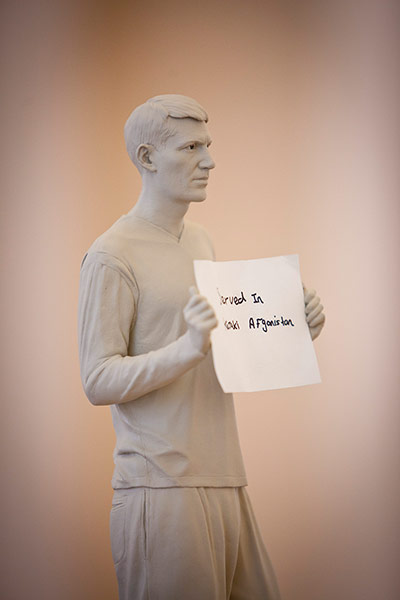
My commission is a small bronze sculpture 45cm tall of a young man called Craig O'Keefe. Craig became homeless after returning from war in Afghanistan, though eventually with the help of Veteran's Aid he was able to get work and rent a flat in London. In return he now is a volunteer tutor for Crisis. This story is told on the plaque below the bronze. I see all of my work as a portrait of people and the individual stories and experiences they go through Photograph: Mark Bourdillon
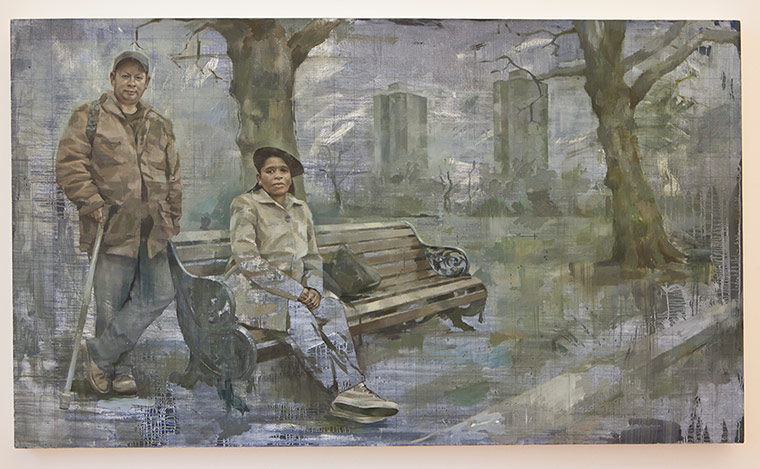
The Park Bench depicts two of Crisis's rough sleepers, Ben and Sharon, in an inner-city park. It heavily references the Gainsborough portrait Mr and Mrs Andrews, a classic period piece that celebrated the status and wealth of its 18th-century sitters. This painting echoes Gainsborough’s composition, inviting us to contrast the lack of status of homeless people in 21st-century London. I was struck by how different Victoria Park looked, with its grand, new, shiny benches and convenient absence of homeless people. It dawned on me that London's public spaces are probably being cleaned up for Olympic visitors Photograph: Mark Bourdillon
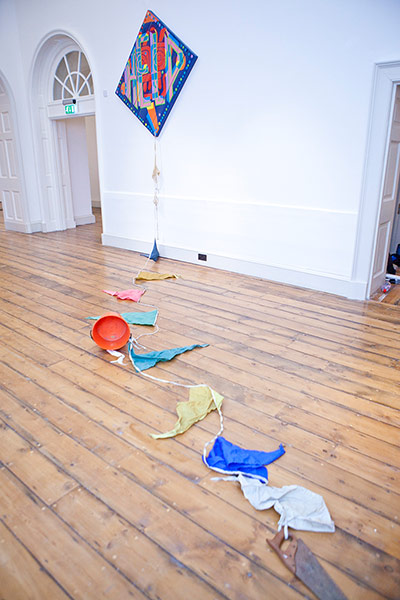
People fly kites alone; there is just one person at the bottom of the tail. Kites are about isolation and the elements. My kite has 'help' written on it. It is a cry for help by the person flying it. Homelessness is about isolation, because homes are not just roofs and walls: they represent networks, nurture and care. I make signs; the best art is propaganda. This is propaganda. We need to help homeless people because a home is not just a roof but a whole world of contacts and support, connections Photograph: Mark Bourdillon
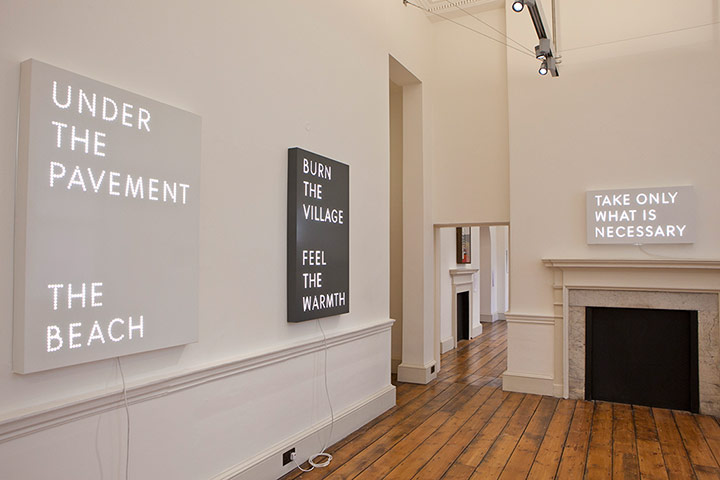
I've made a suite of three new lightbox signs. Each one uses an existing phrase, which speaks to the viewer on ideas of place, community, state and power. Take Only What Is Necessary is a quote from Francis of Assisi. I read it as a hope as much as an instruction: one step at a time, do what you can, please don't eat more than you need etc. Burn the Village, Feel the Warmth comes from an old African proverb that goes: ‘If the young are not initiated into the village, they will burn it down just to feel its warmth' Photograph: Mark Bourdillon
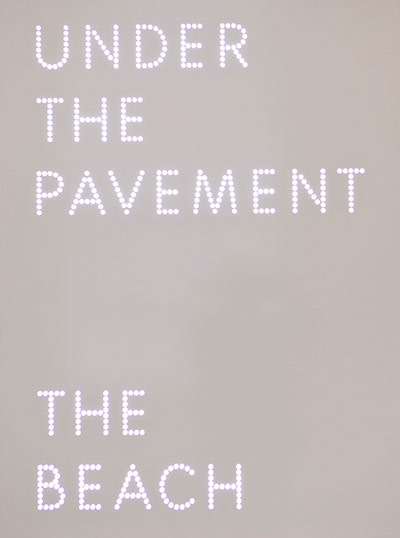
This third work comes from a rallying cry at the Paris riots in 1968. Students in Paris ripped up paving stones and threw them at the police, chanting "sous le pave: la plage" (under the pavement: the beach). The beach – the incarnation of a natural, non-designated space – was the opposite of the street, a relic of a designated, oppressive environment based on private property Photograph: Mark Bourdillon
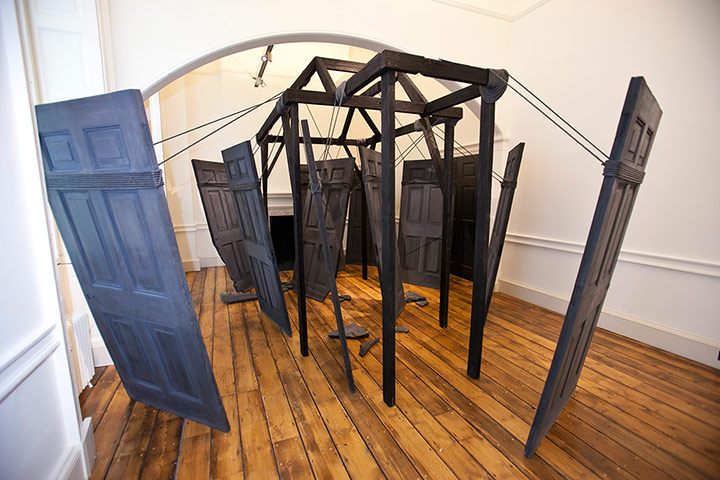
This sculpture features a series of cast doors, decontextualised and taken out of their doorways. It responds to the notion of a door as a structure that opens or closes off an entrance, often a signifier of separation, displacement or change. With all the traces left by time and history, each door carries its own story. Suspended and shattered, these doors no longer create boundaries between places; they are lost in space. They speak of the separation of people from other people, as well as of architecture and the memory it carries Photograph: Mark Bourdillon
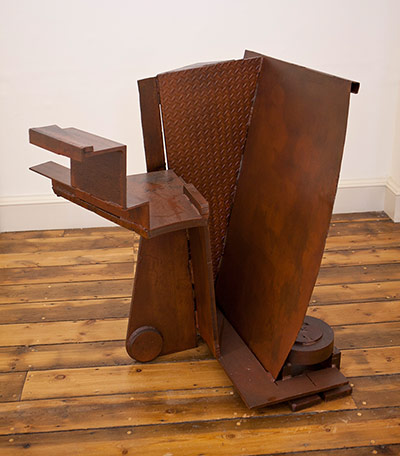
My sculpture does not call for an explanation. It speaks through the eyes. Down Centre was made simple and grounded. It eschews theatricality but, hopefully, speaks to you in the present Photograph: Mark Bourdillon