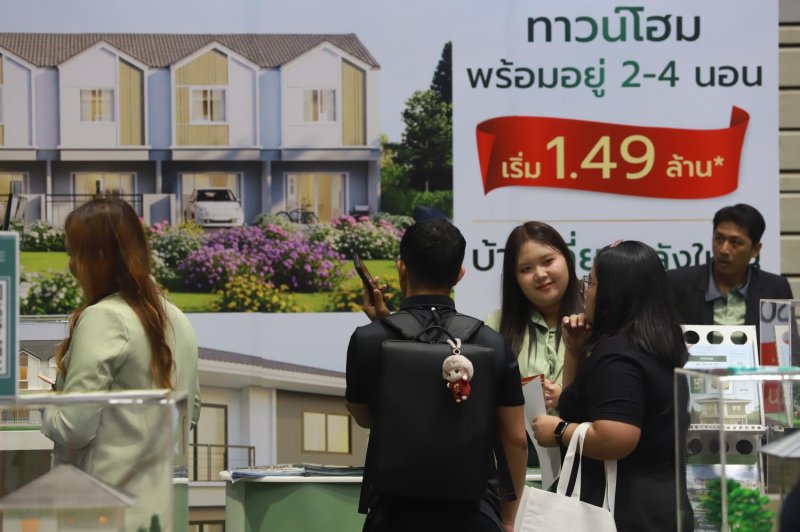
Mortgage lending is expected to remain weak this year as persistently high loan rejection rates continue to weigh on home transfers, while weak consumer confidence is prompting more buyers to withdraw from purchases despite having secured financing.
According to Kasikorn Research Center (K-Research), mortgage lending is expected to recover only gradually this year as fragile purchasing power, elevated household debt and cautious bank lending continue to weigh on Thailand's residential property market.
Outstanding mortgage loans at commercial banks grew 1% year-on-year during March and April 2026, marking the first expansion since late 2024 after months of contraction.
However, the rebound should be interpreted cautiously because it was partly driven by a low comparison base, as many homebuyers delayed purchases a year earlier while awaiting government property stimulus measures.
These measures included reductions in transfer and mortgage registration fees, as well as the temporary relaxation of loan-to-value (LTV) regulations, which later supported a modest improvement in market activity.
K-Research said new mortgage lending figures also overstated underlying housing demand because refinancing accounted for a growing share of loan disbursements.
Refinancing represented 35.2% of all new mortgage lending during the first four months of 2026, indicating that much of the lending growth reflected borrowers switching lenders or restructuring existing debt rather than purchasing new homes.
It also noted that average loan-to-value ratios declined for homes priced below and above 10 million baht, suggesting banks remain cautious in determining loan amounts despite the easing of LTV rules.
More conservative lending practices continue to limit access to financing for some borrowers, particularly amid slowing economic growth and weak household financial positions.
For the full year, K-Research expects mortgage lending by Thailand's banking sector to range between a 0.5% contraction and zero growth, compared with a 0.5% decline recorded in 2025.
The subdued outlook reflects weak domestic purchasing power, persistently high household debt and pressure on borrowers' debt-servicing capacity.
K-Research said the extension of relaxed LTV regulations until the end of June 2027 should help developers clear unsold housing inventory and provide some support for the property sector.
The measure reduces down-payment requirements and gives greater flexibility to financially stable buyers who retain adequate repayment capacity.
However, the extension alone is unlikely to trigger a meaningful recovery in mortgage lending because loan approvals depend primarily on borrowers' income and financial strength rather than LTV ceilings.
K-Research said that restoring consumer purchasing power and strengthening household balance sheets remain the most important factors for a sustained recovery in Thailand's housing finance market.
Pitipat Preedanont, president of the Thai Condominium Association, said mortgage rejection rates have remained exceptionally high during the first half of the year, with 40-50% of home loan applications being turned down.
"Even genuine homebuyers are unable to complete transfers because they cannot secure financing. Some units have been sold three or four times before a transfer is finally completed," he said.
"Mortgage rejections are currently the industry's biggest challenge," Mr Pitpat added.
Kessara Thanyalakpark, managing director of SET-listed Sena Development, said a growing challenge is self-rejection, where buyers cancel purchases shortly before transfer despite having secured mortgage approval.
Ms Kessara said self-rejection now accounts for around half of all failed property transfers, exceeding bank loan rejections at around 40%.
Restoring consumer confidence has become just as important as improving access to mortgage finance.
"The real issue is confidence," she said. "Until consumers feel secure about their financial future, mortgage approvals alone will not revive the housing market."