This is the fifth installment of a series.
On March 22, Bunyu Ogasawara, 69, left for a house call in a car driven by his wife Etsuko, 65. Ever since he opened the Ogasawara Clinic in 1989, Etsuko has driven for him whenever necessary. On this day, she visited a patient's house with her husband.
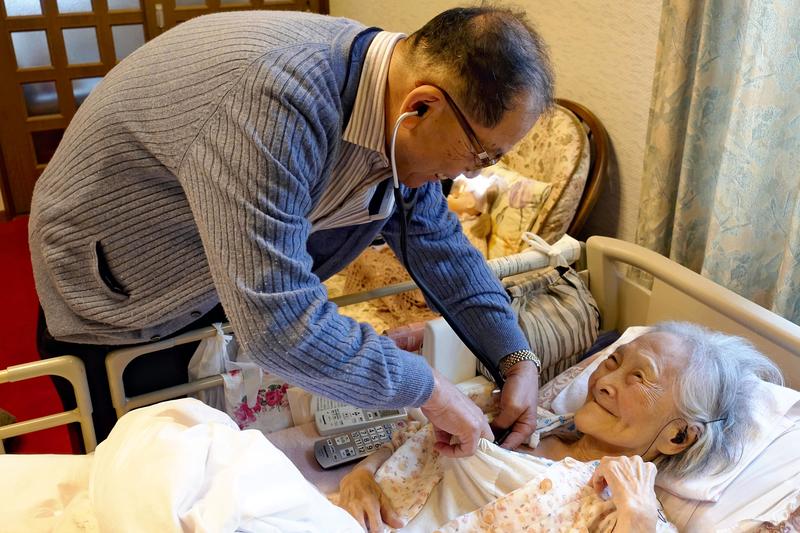
As soon as she saw the Ogasawaras, 90-year-old Matsuko Aoki, nicknamed Matchan, welcomed them effusively.
"Oh, doctor. And Etchan [Etsuko's nickname], thank you both for coming."
Her voice was as loud as a TV at high volume.
Last September, Matchan fell down and hurt her back. Due to the possibility of a fracture, she was hospitalized. "They [healthcare workers] did lots of things to me that I didn't like, so I came home after four days," she said.
Matchan lost her husband and has no children. She's been living alone, almost always on bed rest. Using the long-term care insurance system, she typically receives three home visits a day and one home visit bathing service a week.
At long-term care level 4, she requires assistance in all areas of life. She relies upon a housekeeper who takes care of her every need and whom she's known for a long time. Ogasawara Clinic began visiting care with 24-hour support last October.
In the beginning, she could not even move in bed.
"Somebody asked me, 'Aren't you lonely?' but I said, 'No, I'm not.' I guess I've got a lot of natural-born cheerfulness. What do you think?" Matchan said. Even with the stethoscope pressed against her chest, she can't stop talking.
Ogasawara could only smile wryly. "I can hear you laugh through the stethoscope," he said.
Many of the home care patients I visited for this series of articles were smiling. Why is that?
According to Kazuo Kojima, 48, who worked for the Ogasawara Clinic for 2-1/2 years until this April: "Home care means that doctors become 'guests' in the patient's living space, which means that the medical care centers around the patient."
Spaces where patients used to live, in other words their home ground, seem to bring about medical care where the patient is the main character.
A final month of fun
Ogasawara provides end-of-life home care. In his book "Nanto Medetai Gorinju (What a happy end to life)," there are many pictures of family members who see off parents and spouses departing this life with "smiles and peace signs."
"I was surprised too. Shall we visit the house of the person who first 'smiled with a peace sign?'"
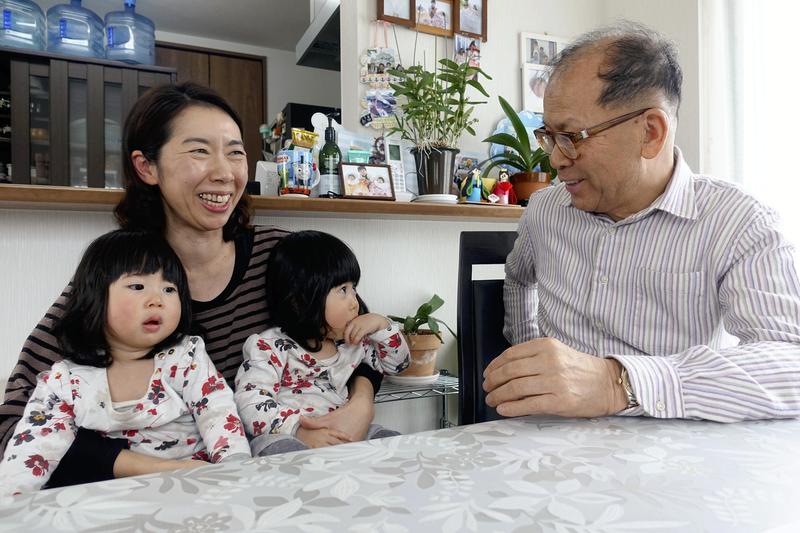
On March 20, Ogasawara visited Ayumi Ueo, 43, living in Ichinomiya, Aichi Prefecture.
In March 2009, Ayumi's mother was told she had a month to live at the hospital where she was being cared for. Her cancer had spread from her lungs to her brain. It was hard for Ayumi to watch her mother, who could not sleep or eat and constantly complained of pain.
"Isn't there anything that can be done?" Ayumi pleaded with the doctor. "She's going to die. It's no wonder it hurts" was the reply.
Ayumi found the Ogasawara Clinic while searching for another hospital to transfer her mother to. Once her mother left the hospital and returned home, she changed visibly. Her expression was calm, and she became able to sleep and eat.
She made requests such as "I want to eat katsudon [pork cutlet rice bowl]" and "Tomorrow I want to eat shumai dumplings." Ayumi said she "did my best to go shopping at the basement food section of a department store in Nagoya on the way home from work."
A month later, her mother passed away, just as the doctors had said. "I came home from shopping and thought, 'What ... ' and that was my mother's last breath." Tears rolled down her face.
Ayumi also sometimes thinks, "I should've done things differently." But overall her heart was calm.
"We used all the time we had left to be together. If she'd just suffered at the hospital, I think I probably would've blamed myself for all of it and closed off my heart."
Death is a parting and a journey. "The end was a fun month. I don't like putting it into words because it sounds shallow, but in my mother's case, I guess it was a journey. And, after all, if you're going to take a picture, shouldn't you flash a peace sign?"
Ayumi remembered her mother with a smile on her face.
Read more from The Japan News at https://japannews.yomiuri.co.jp/