This is the fourth installment of a series.
After graduating from the Nagoya University School of Medicine in 1973, Bunyu Ogasawara, now 69, worked in public hospitals in Gifu and Aichi prefectures. "We had two full-time doctors and about 100 hospitalized patients," he recalled.
This exhausting work ruined his eyesight, prompting Ogasawara to open a clinic.
Yasuhiro Sawano, 81, who is living in Ichinomiya, Aichi Prefecture, said, "I met Dr. Ogasawara around 30 years ago."
At first, it was Sawano who was the caregiver -- Ogasawara was feeling unwell and received chiropractic treatment from Sawano. But now Ogasawara is Sawano's doctor.
Sawano is unable to visit the hospital because of his leukemia, so Ogasawara has been making house calls since late January this year.
This is how the house call on March 19 began.
Ogasawara: "Are you alive?"
Sawano: "I'm still alive."
Their banter is startling to hear, but their faces are compassionate.
Sawano complained, "I keep on getting dizzy, you know, and It's rather unpleasant." The accompanying nurse gave him a shot.
Sawano also receives a blood transfusion in his home once every two weeks. "I wonder how long I can stay alive, huh doc? It doesn't seem like I have long," he said.
Ogasawara replied: "I think it was during my January visit that you said you wanted to live until March, and it's already March. How much longer do you think you have?" Sawano answered, "Three to five years."
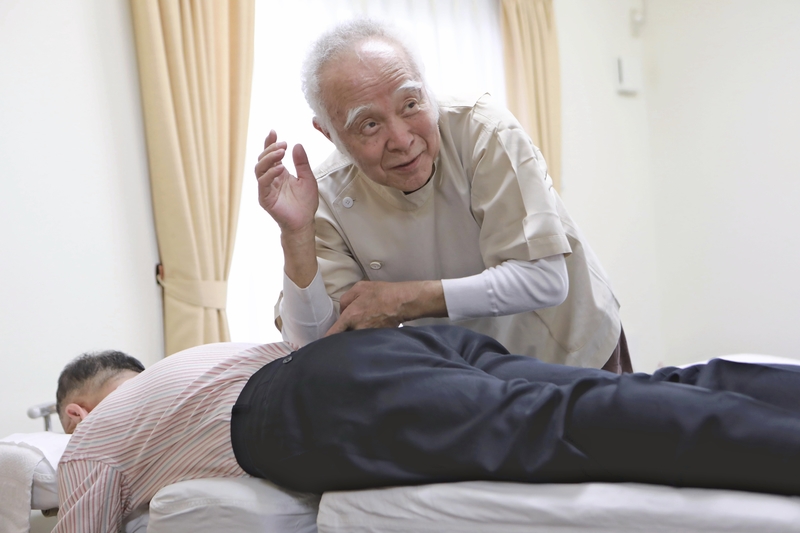
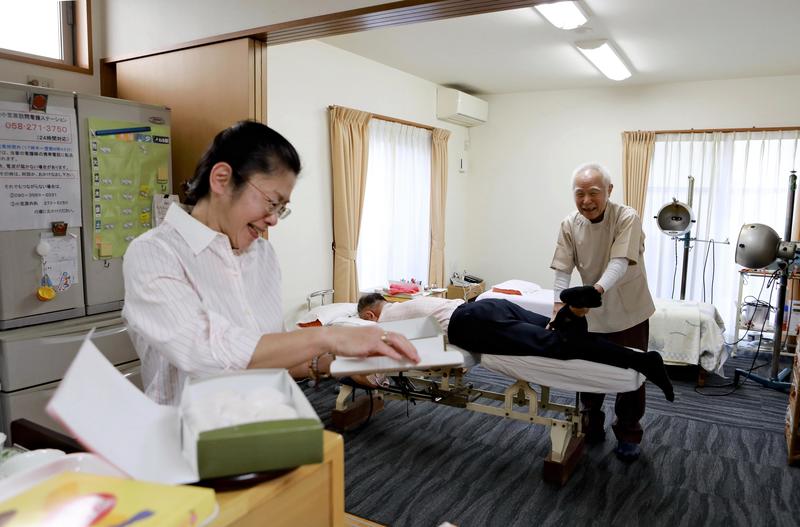
After his examination, Sawano slipped on a pair of scrubs. His eyes sparkled with a deep strength. He said, "Here, doctor," and Ogasawara lied face down on the treatment table that had been placed in the room. Sawano skillfully massaged Ogasawara's back with his elbows, but it seemed to be stiffer than he would have liked.
"What is this? How can you let it get this bad?" Sawano exclaimed.
Parents take different choices
Ogasawara visited Sawano in Ichinomiya on April 3, too. It had been almost 2-1/2 months since he had started making house calls for Sawano's leukemia treatments. Sawano, who managed a chiropractic clinic, had started offering treatments again in his home in mid-February. He said his "grip had strengthened" due to the blood transfusions.
Sawano spoke haltingly during the examination. "I can fix a strained back in one or two sessions. For a sprained ankle, I can take away most of the pain in a day."
Ogasawara asked, "What's your unfulfilled wish?"
"You know, mothers have said, 'Take care of my kids until they graduate.' Even though they're not my grandchildren." He seems full of concern for the high school volleyball players who come to him with injuries.
Sawano's wife died of cancer in February last year. His eldest daughter, Manami Shimizu, 56, suggested home treatment, but his wife chose to fight her illness in the hospital.
She was given anti-cancer drugs and an IV. Soon she lost her ability to move in bed, and then to take food into her mouth. She seemed only to understand that there was no more hope.
Manami, who tended to look down as she talked, spoke in a low voice, saying: "I saw that and thought: 'Is this how it's supposed to be?' I don't want that."
Last December, Sawano's condition worsened and he had trouble standing up. He said he lost heart at one point and thought, "I wonder if my time was up." He chose to stay at home instead of the hospital. Manami, who visits her father's home about three days a week and has carefully observed the progress of his examinations, is happy about how he's doing now. "I didn't think he'd be able to work this much again," she said.
We asked Manami if she is glad her father is staying home. After a while, she looked at Sawano and answered: "I'm not sure. I can't say yes yet."
Read more from The Japan News at https://japannews.yomiuri.co.jp/