Until last week it was impossible for Phillip Hughes to stop smiling. Whether lugging bananas around his country New South Wales farm, raising his bat for centuries or being recalled to the Test team, his teeth and eyes sparkled with happiness.
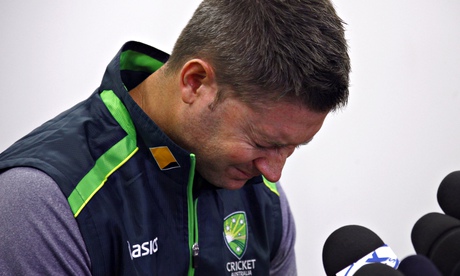
But now it is not just Australian cricket weeping following the death of the cheerful, cheeky 25-year-old forever stranded on 63 not out. “Our dressing room will never be the same,” the Test captain, Michael Clarke, said through tears on behalf of Australia’s players on Saturday. The finality of Tuesday’s short ball has been realised.
Players and spectators often complain the game never stops, but this week it has been cut like one of Hughes’s boundaries behind point. Instead of a crescendo towards Thursday’s first Test against India, the season has been stalled by a moment that has changed lives, minds and schedules. Grieving team-mates are uncertain about playing the first Test against India. A round of Sheffield Shield games was cancelled and India’s tour match against a Cricket Australia XI was scrapped. The funeral in Macksville on Wednesday is the priority for the deflated squad. “Cricket will go on, and will go on when we’re ready,” James Sutherland, Cricket Australia’s chief executive, said on Friday.
Many grassroots matches continued this weekend, starting with 63 seconds of silence. Some junior games invoked retirement scores of 63 instead of the usual half-century, while Hughes’s Test number of 408 was mown and painted on outfields. Club teams around the country taped on black armbands. The golfer Adam Scott wore one at the Australian Open. In the 63rd minute of the A-League football match between Western Sydney and Sydney the crowd burst into applause.
On Tuesday, the Sydney Cricket Ground switched from a place of dreams to a brutal nightmare. Instead of catches there was counselling, and nursing ahead of nets. The game’s toughest men have wept, cuddled and remembered. Playing for South Australia, Hughes was struck by a Sean Abbott bouncer that was meant to be part of the game’s routine. Seconds later Abbott was cradling the batsman’s head. Last month they were Australian team-mates.
Since that ball the SCG has been a stage for group mourning. The broader community is also feeling the sorrow. The New South Wales premier, Mike Baird, announced a state memorial service would be held at the stadium. Tributes of flowers and cards were left outside the grounds in Sydney and Adelaide, which was Hughes’s home after his switch to South Australia.
The scale of love was highlighted best by the #putoutyourbats hashtag sweeping through Twitter, with followers posting simple photographs of their bats. Sixty-three bats were placed in the front window of Cricket Australia’s office in Melbourne and another row sat outside Hughes’s old school in Macksville. More leaned against canteens, pavilions and stumps at club games. One banner at a junior fixture in Sydney said: “We will play on for Phil”.
At the age of 20 Hughes was in the Test team, registering twin centuries in his second game against South Africa with an unorthodox technique that made fans gasp and bowlers wince. A slog-swept six to bring up his first century was straight from the back paddock, but there were less agricultural elements in his collection.
He averaged 136.5 in a guest stint with Middlesex before the 2009 Ashes, but on that tour he was ruffled by Andrew Flintoff and Steve Harmison. Dropped from the Test team, he was on duty for a promotional function in the Leeds city centre, facing a virtual bowler on a big screen in front of the lord mayor. Despite the triviality and gimmickry of the activity, he complied without fuss and then eased back into the safety of the crowd. He was tiny and quiet, a country kid in and out of the big time.
That season he was named the Bradman Young Cricketer of the Year. Now Hughes is being remembered like Archie Jackson, a golden boy from the Great Depression also dismissed too soon. Jackson was considered The Don’s equal before dying of tuberculosis aged 23. Bradman was one of the pallbearers at Jackson’s funeral in Sydney.
Clarke has already had a prominent role in Hughes’s farewell, sitting with the family over two days as they watched the batsman’s last moments. He now lives without his “little brother” and spoke through sobs to deliver a message from his men. “We are going to miss that cheeky grin and that twinkle in his eye,” he said. “We loved him and always will.”
Hughes was supposed to turn 26 on Sunday. On Tuesday he was batting himself towards another Test recall. In the next match there will be a gap that will not be filled. Instead of his striking smile there will be more tears.