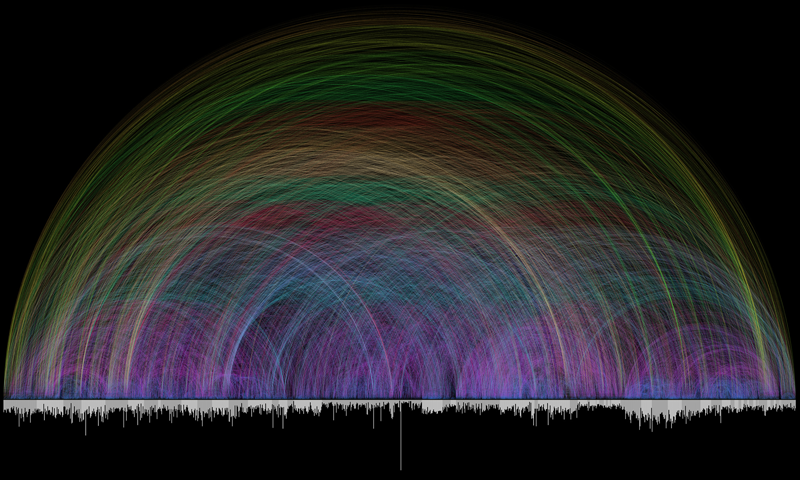
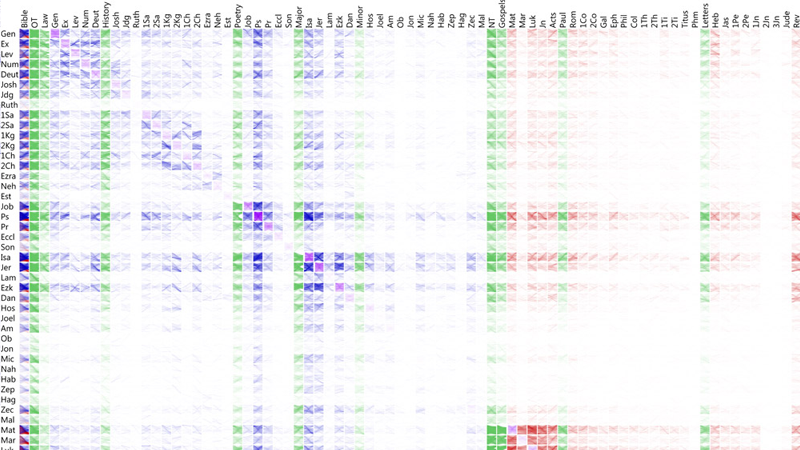
This is about how the bible speaks to itself - or the textual cross-references within it. The bar graph that runs along the bottom represents all of the chapters in the Bible. Books alternate between white and light gray and the length of each bar denotes the number of verses in the chapter. Each of the 63,779 cross references found in the Bible is depicted by a single arc - the color corresponds to the distance between the two chapters, creating a rainbow-like effect.Photograph: Christoph Römhild and Chris HarrisonThis visualisation also shows cross references in the Bible, but this time in an interactive tool you can use here. You can select any two books to see which chapters refer to each other - the tiny square images indicate which books have the strongest connections.Photograph: OpenBible.infoThis timeline visualises the who, what and where of events leading up to and through Easter. You can follow the lines to see the progress of particular individuals - for example focusing in on Friday shows how Jesus draws aside Peter, James, and John and entreats them to pray before Judas and a crowd arrive. Judas betrays Jesus with a kiss, Jesus is arrested, and the disciples flee, while Peter and John follow at a distance.Photograph: BibleGateway.com
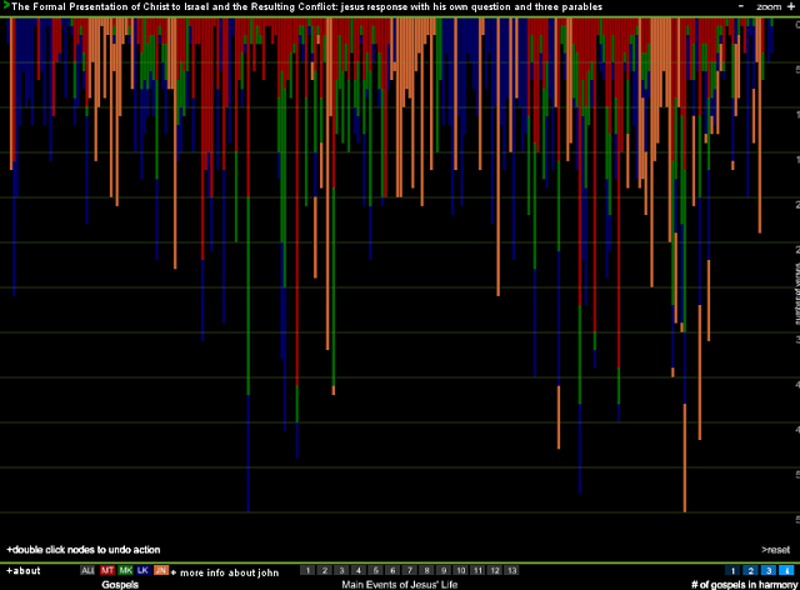
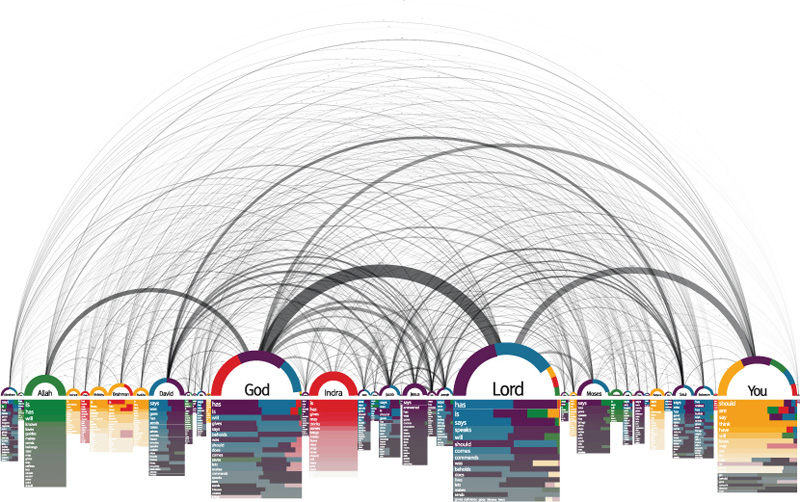
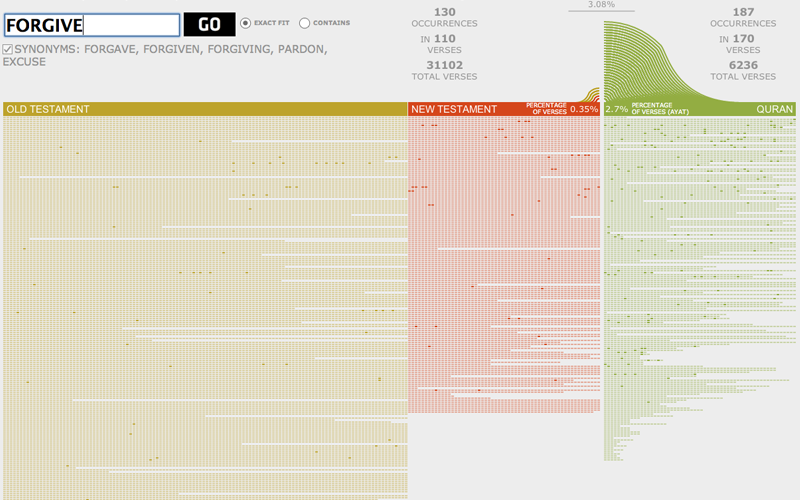
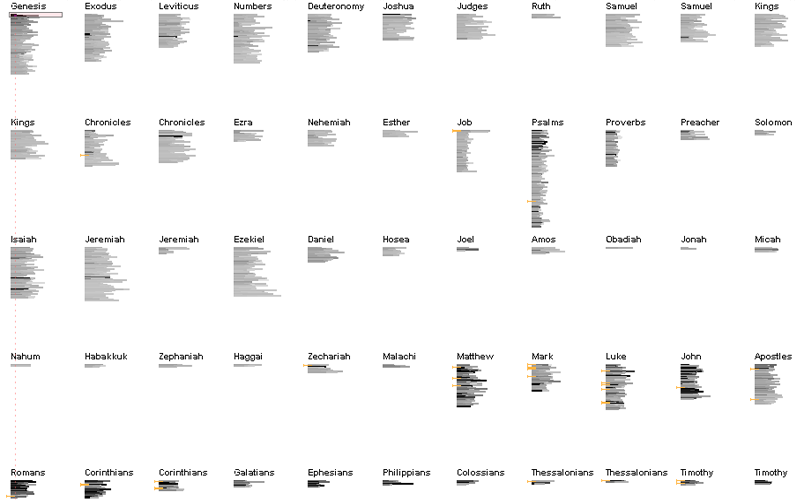
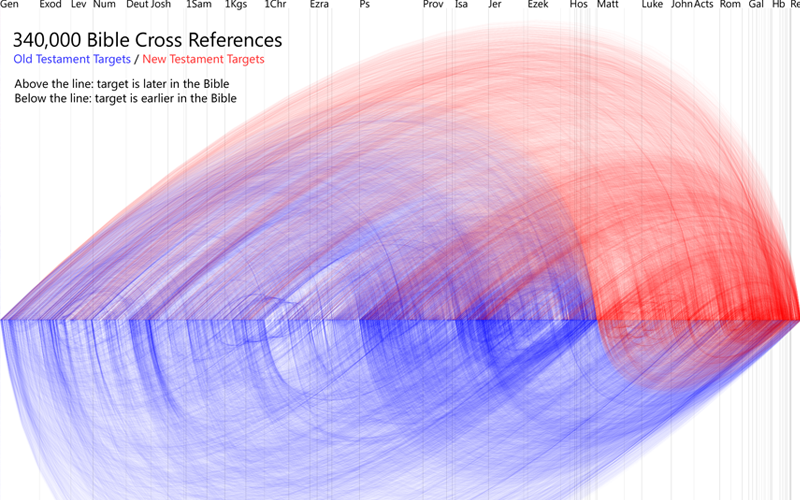
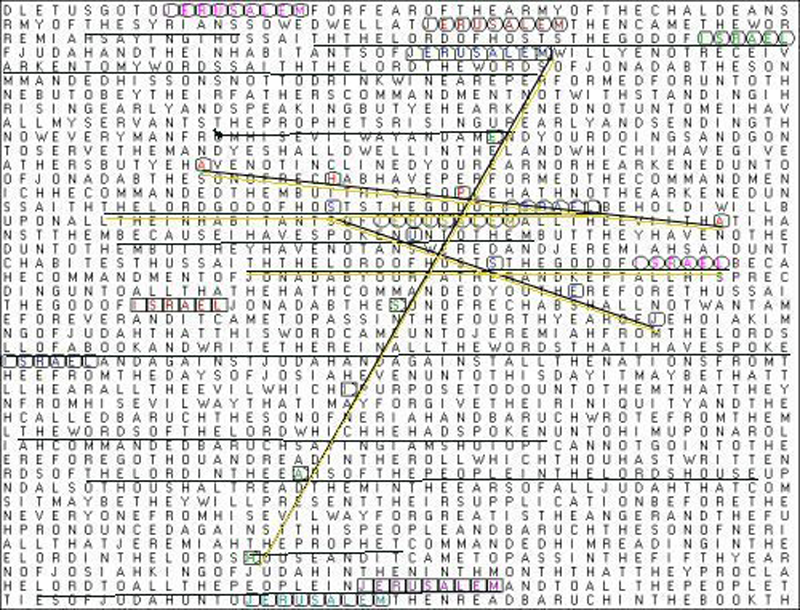
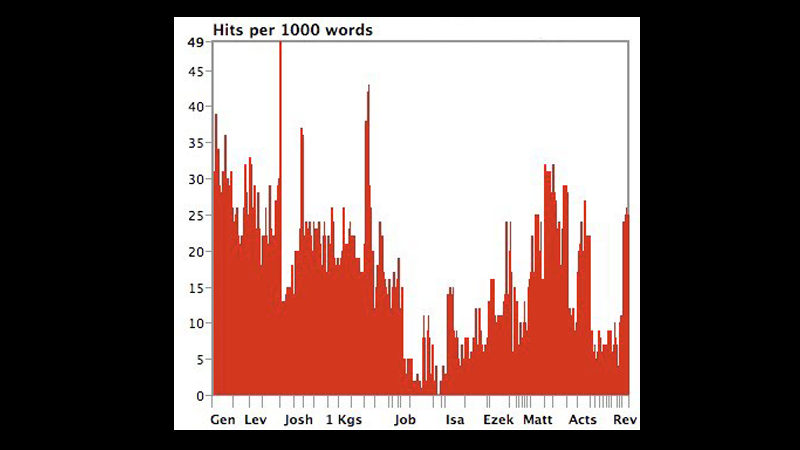
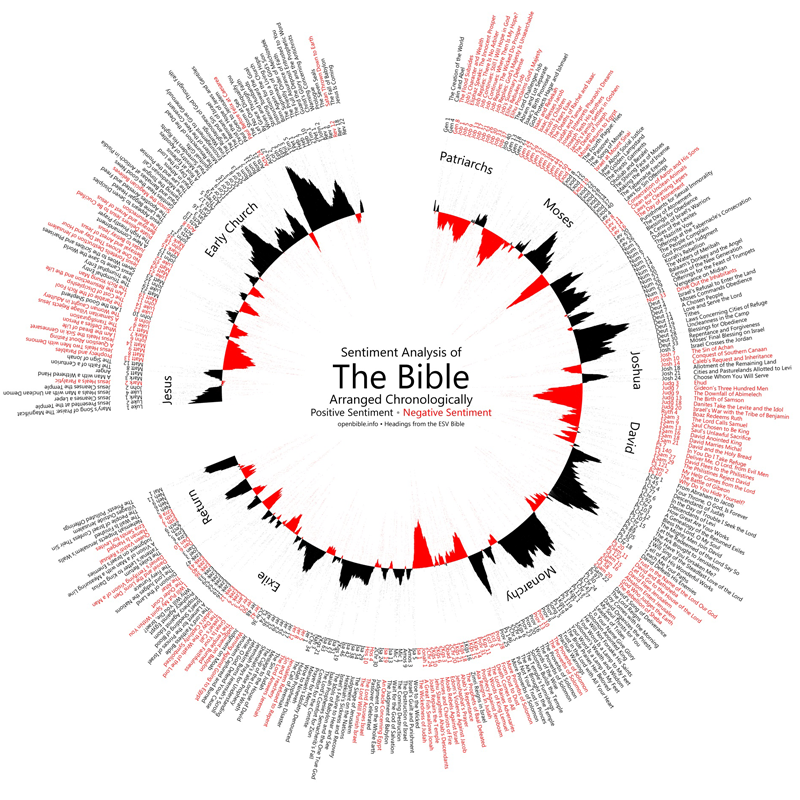
These bars plot the narrative of Jesus' life. Each bar represents a significant event, the length denotes the number of verses and the colours show which gospel the verses came from. This is actually a detailed interactive you can use here which allows you to click through and read every single passage.Photograph: Ahn DangThis visualisation covers includes holy texts from Buddhism, Hinduism, Islam and Judaism as well as the Bible. The 41 most frequently cited characters are arranged alphabetically and scaled according to how many times they are mentioned. The colours above the names show where they appear e.g. 'Allah' appears only in the Qur'an and 'You' appears in all the holy books. Under each of these names is a bar chart that visualizes each character's "activities" (determined from adjacent verbs in the text).Photograph: Philipp Steinweber and Andreas KollerPitch Interactive have created this tool that allows you to search for any particular word and compare its frequency in the Old Testament, New Testament and Quran. It's incredibly detailed as you can select whether or not you want to view synonyms and read the specific verses that are mentioned by clicking on any of the darker squares. Photograph: Pitch InteractiveKushal Dave used Google to count how often Bible verses appears online and made these darker to show which parts of the Bible are being used the most. You can try the interactive version of his research here.Photograph: Kushal DaveThere are 340,000 cross-references between the Old and New Testament that are visualised here. It reveals a surprising asymmetry - if verse A cites verse B, verse B doesn’t necessarily cite verse A.Photograph: OpenBible.infoFrom the eloquent to the confusing. Enthusiasts of "the Bible code" search for hidden prophecies and passages in the Old Testament Hebrew text. As Revelation13 explains "The spaces between words are eliminated, so that the Old Testament is a continuous block of Hebrew letters. Then, by skipping letters at a programmed interval, the program searches for words. There appear to be patterns to the passages where the words are found". In this visualisation, the words 'Messiah' and 'Jesus' apparently reveal a cross shape.Photograph: revelation13.netAs the Biblical Prospector explains: the following graph shows the number of occurrences, per 1000 words, of verses in the King James Version of the Bible that begin with the word and. The first occurrence of this pattern Genesis 1:2: "And the earth was without form...." The next verse also begins with and: "And God said, Let there be light..." In fact, 29 out of 31 verses in the KJV Genesis 1 begin with the word and.Photograph: Biblical ProspectorEven the Bible has become the target of sentiment analysis enthusiasts. This visualisation claims to explore the "ups" and "downs" of the Bible narrative, using sentiment analysis to quantify when positive and negative events are happening. The results? "Things start off well with creation, turn negative with Job and the patriarchs, improve again with Moses, dip with the period of the judges, recover with David, and have a mixed record (especially negative when Samaria is around) during the monarchy." You can explore the book-by-book results here.Photograph: OpenBible.info
Sign up to read this article
Read news from 100’s of titles, curated specifically for you.