Every year Hindus mark the arrival of spring by staging the spectacular Festival of Colour, a celebration recognised in today's Google Doodle.
Holi always makes headlines across the world thanks to the beautiful pictures it produces, as revellers take the streets of cities across India, Bangladesh and Nepal to dance and pelt each other with multi-coloured powders.
Here are five things you need to know about this annual extravaganza.
1. Holi celebrates the triumph of good over evil
The festival, which dates back to the 4th century, is best known for the spectacle of worshippers gathering to toss rainbows of powder into the air, completely coating one another.
There is a serious purpose behind this uproarious festivity, however. Holi carries an array of symbolic meanings, celebrating the triumph of good over evil as well as fertility, love and the end of winter.
2. The festivities take place across two days
Holi is divided into two parts: Holika Dahan and Rangwali Holi.
The former is staged the night before the big day and sees celebrants gather to observe a purification ritual in which a pyre of logs and dung-cakes is burned, intended to represent the triumph of faith. Families gather to roast grain, popcorn, coconuts and chick peas together.
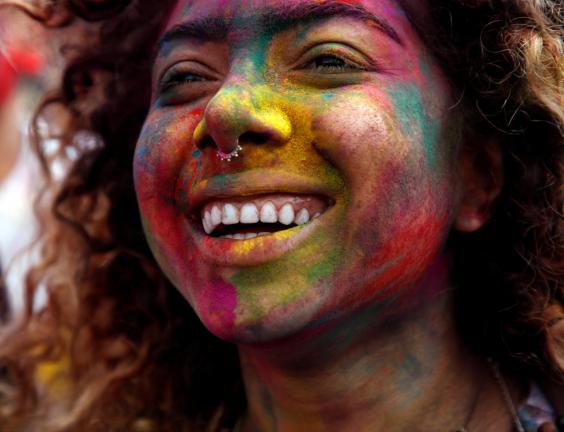
Rangwali Holi is the main event: when everyone races around throwing handfuls of gulal (finely-coloured powder) and spraying water, a joyous occasion in which differences of caste and ethnicity are temporarily forgotten.
This is the most common form the celebrations take but they can run on for much longer: Holi lasts for 16 days in the Braj region of India.
3. Holi originates in Indian mythology
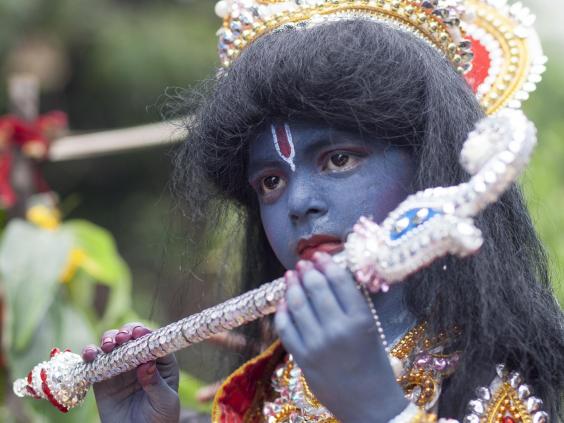
The holiday draws its origins from the ancient legend of Krishna and Radha.
The supreme deity fell in love with the goddess Radha but was concerned about differences in their skin colour, his being blue. His mother advised him to playfully paint her face to overcome their differences. Lovers today continue the tradition by making sure their own faces match when the gulal starts flying.
Holi also takes inspiration from Hindu Vedi scriptures in which Holika, a malevolent devil, was burned to death after her brother, the demon king Hiranyakashyap, ordered her to pass through the flames carrying his son (her nephew) Prahlada, the boy having angered him by forsaking evil to become a devotee of Vishnu. Prahlada survived thanks to his faith while Holika perished in agony.
This is the significance of the ceremonial fires - which worshippers even run through in homage to the legend, an extreme expression of devotion - that are staged to this day.
4. The timing of Holi is synchronised with the moon
The date of the celebration varies every year in accordance with lunar cycles.
This year, Rangwali Holi takes place on 2 March, while the pyres of Holika Dahan were burnt last night.
5. How do people clean up once the party’s over?
Hindus are advised to moisturise their skin carefully before taking part and some oil their hair to ensure the gulal can be easily rinsed out - a bid to pre-empt disaster.
Those taking part are also careful to ensure that the powders thrown are non-harmful and so they are most commonly made from a mix of food dye, flour and water.
Afterwards, everyone spruces up and gathers in their Sunday best to distribute gifts of traditional sweets.