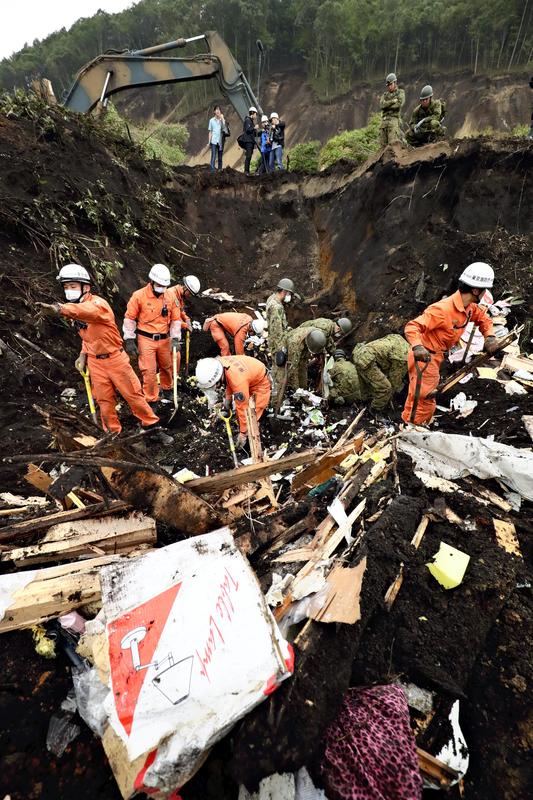
ATSUMA, Hokkaido -- People were watching rescue operations on Saturday morning -- and praying for the safety of their family members and friends -- in Atsuma, the town in southeastern Hokkaido that was hit by a powerful earthquake that triggered large-scale landslides.
Once the 72-hour mark passes after the outbreak of a disaster, the survival rate of those needing rescue is said to fall sharply. The districts buried by large amounts of earth and sand were to reach that point in time early Sunday.
"I can't believe the slopes of such high mountains have been hollowed so badly," said Tomoko Kinoshita, 69, as she was observing a rescue operation by Self-Defense Force personnel in the Yoshino district in Atsuma.
Kinoshita, who lives in Mukawa, a neighboring town, had rushed to the district to look for a relative, Tomoko Mikami. Since the quake, Kinoshita had been unable to contact Mikami, who lived at the foot of a hill in the district.
Kinoshita, who works in the fisheries industry, had delivered tuna sashimi and other dishes to Mikami on Wednesday evening. She recalled Mikami expressing gratitude by delightedly saying, "I was in a bit of a fix because I had just run out of okazu [dishes to serve with rice]."
Kinoshita described Mikami as a travel lover who had a cheerful personality and many friends. "I really hope she will be discovered as soon as possible," Kinoshita said, with her hands placed together in prayer.
In addition to the Yoshino district, SDF personnel searched overnight the interiors of mud-filled houses in Tomi- sato, another district of the town.
"We're working intensively since today and tomorrow are important for their lives," one officer said.
Parents' bodies found
"This is a bad dream," said Shingo Nakamura, 42, an official of the Atsuma town government, when he identified the bodies of his parents on Friday.
After the powerful earthquake hit the town early Thursday, Nakamura, who works in the local industry and economy promotion section, went on patrol to the Yoshino and Tomisato districts.
At that time, Nakamura had not been able to contact his father, Hatsuo, 67, and mother, Yuriko, 65, who were living in the Tomisato district. When a restless Nakamura arrived at the site of his parents' house during the patrol, he discovered the familiar building had been completely destroyed by a mudslide.
The bodies of the couple were discovered that night, with a number of family photo albums also dug out of the mud around them.
The albums contained photos of, for example, a young Nakamura running at a sports meet or his family smiling during a trip. The photos were taken by Yuriko to preserve memories of childhood for her son.
"You have such a caring family," Nakamura was told by an SDF official. As he turned the pages, he was hit by a mixture of nostalgia and heart-wrenching loss, he said.
Nakamura was also unable to contact his grandmother Kimiko, who lived with his parents, and search operations for her were continuing.
"My father was stubborn but straightforward, and my mother was so affectionate, caring about others," Nakamura said. "I didn't expect I would lose them so early like this. I really hope that at least my grandma can survive."
Read more from The Japan News at https://japannews.yomiuri.co.jp/