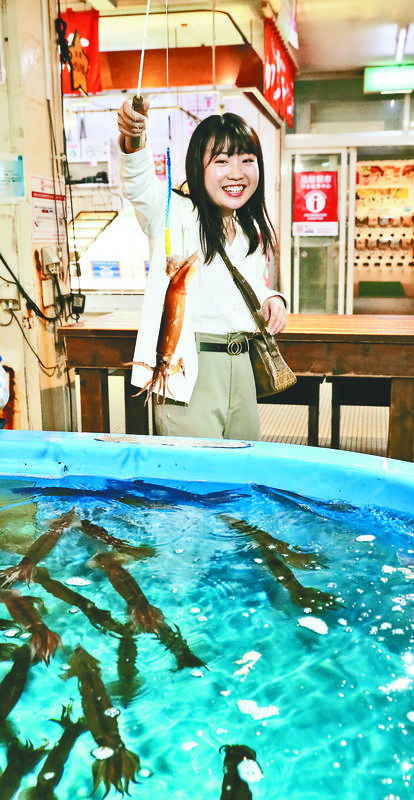
HAKODATE, Hokkaido -- I lowered a fishing rod to put a hook into a school of amber-colored surumeika Japanese flying squid swimming in an enclosure. Although I was given advice that hooking a squid by its fins is the key, my hook caught the squid's body. When I raised the rod, the squid squirted water at me.
I was trying my luck at an indoor fishing pond at the Hakodate Morning Market in Hakodate, Hokkaido. Visitors can fish for squid that landed in the morning at a nearby port, after which the fished squid are prepared at an adjacent stall.
I was astonished at the vitality of my squid as its arms looked as if they were trying to stand even after being cut from the body. The squid sashimi I was served looked transparent and I could tell how fresh it was from the firm texture as I chewed.
Hakodate is known as a major base for catching squid.
"Squid that travel north in the Sea of Japan and the Pacific Ocean can be caught here over a relatively long period," said Hideki Tonami, the 68-year-old director of the National Cooperative Association of Squid Processors who also runs a food company in the suburbs of the city. "Producing processed squid items has also become a major local industry."
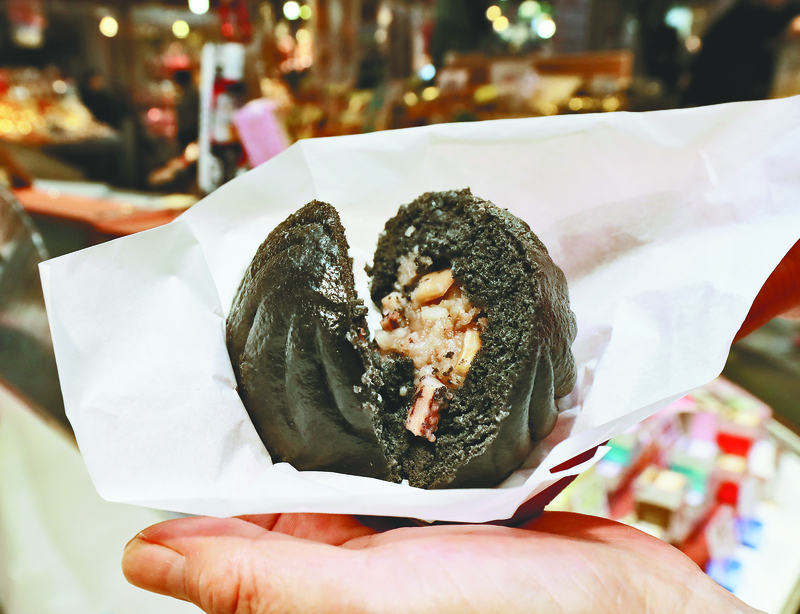
On shelves at the morning market are an array of such products, such as shredded and dried squid and ikameshi, a savory food that consists of a whole squid body cooked with rice inside. Some shops even sell steamed buns dyed with squid ink as well as cuttlefish ink pudding.
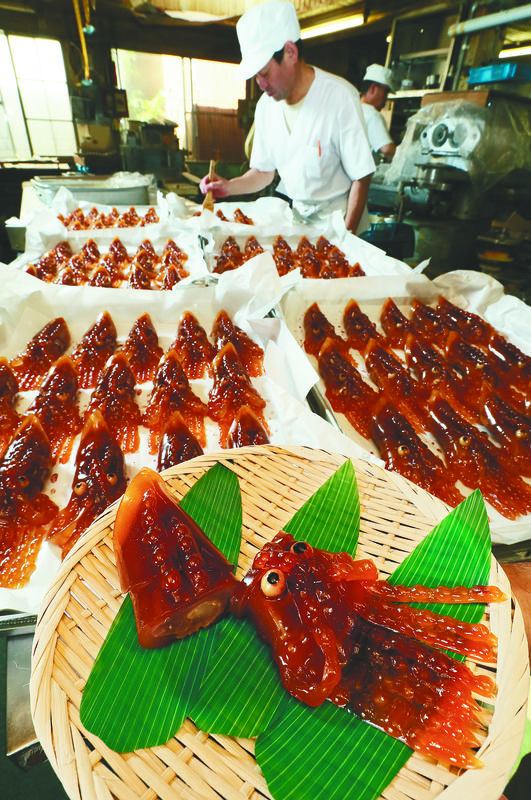
About 2 kilometers north of the market there is also a confectionery that sells numerous amber-colored, glossy, squid-shaped objects.
"Try some -- they don't taste like squid," said a laughing Mitsuhiro Wakasugi, the 59-year-old president of the shop, Hakodate Yanagiya.
These ika-yokan are yokan jellied bean paste, which usually comes in a rectangular shape, in the form of squid. The product drew attention when it was released to mark the shop's renovation 22 years ago and has since played a role in promoting Hakodate as a city of squid.
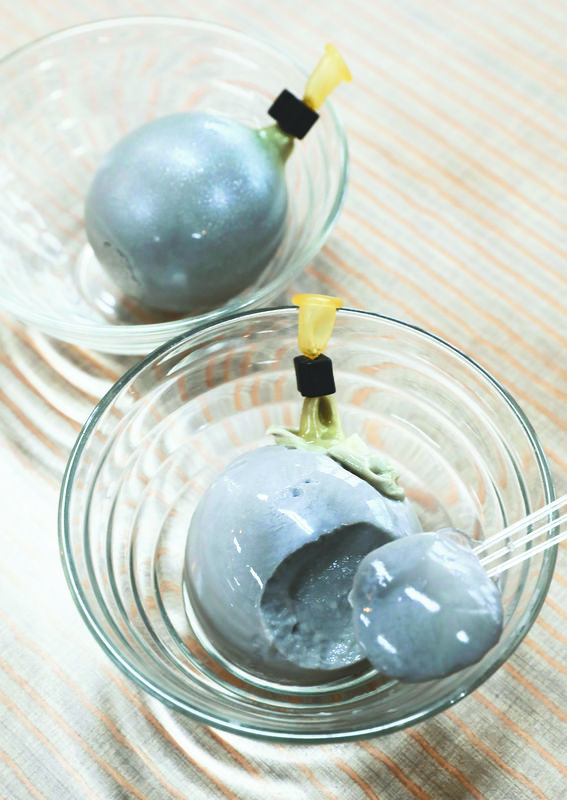
It takes two days to complete each squid, from the hardening of the liquefied yokan to making the shapes of the head, body, 10 arms and tentacles, and putting coffee-flavored red bean paste within. Each squid costs 1,188 yen.
There is a warning written on the box wrapper saying, "Please don't prepare this as sashimi," because it looks like real squid. When it is cut, the bean paste inside resembles the rice in ikameshi.
The yokan squid's body and arms have a chewy texture, which reminded me of the fresh squid I ate at the morning market, but I got somewhat disoriented by the sweetness.
"When I was a child, the sea was covered with lights for luring squid at night," Wakasugi recalled. "In the morning, an elderly woman would come to my neighborhood to sell a cartload of squid, so we had squid for breakfast."
His accounts indicate how closely squid is linked to the lives of people in Hakodate.
In recent years, however, the local squid industry has been plagued by poor catches that some people blame on global warming.
"As a producer of ika-yokan, I feel responsible to protect the city of squid," Wakasugi said.
Read more from The Japan News at https://japannews.yomiuri.co.jp/