
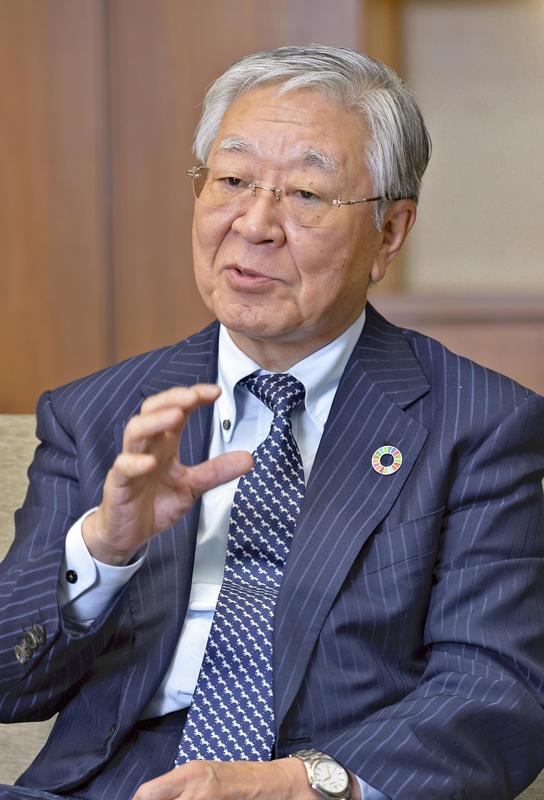
Hitachi Ltd. is likely to put on hold a project to build a nuclear power plant in Britain, mainly because it has become difficult to recruit investors over concerns about ballooning construction costs, it has been learned.
The company could make a final decision early next year at the earliest after considering the stances of the Japanese and British governments, according to sources.
Hitachi has already informed the Japanese government side of the possibility that it could freeze the project, sources said. The suspended period appears to be undetermined, but the company will leave some possibility it could resume the project after scrutinizing its profitability.
The project would be led by Horizon Nuclear Power, a Hitachi subsidiary in Britain, and is expected to cost more than 3 trillion yen (26.4 billion dollars). It involves building two nuclear reactors on the island of Anglesey in Wales, with their operations aimed to start in the early 2020s.
On June 4, Hitachi reached an agreement to begin full-fledged negotiations with the British government.
Of the total cost, arrangements have been under way to have the British government finance more than 2 trillion yen, with the remaining 900 billion yen to be shouldered equally by three parties -- Hitachi; the British government and British companies; and Japanese government-affiliated financial institutions and Japanese companies -- by attracting additional investors in Horizon.
Hitachi had intended to make a final decision on the project in 2019. However, it has become difficult for the company to rally support for the project from prospective investors. Within Hitachi as well, cautious opinions have grown about the profitability of a project involving a huge investment that would be recouped through electricity charges over a long period.
As Prime Minister Shinzo Abe and British Prime Minister Theresa May could meet in January, Hitachi plans to make a decision after taking into account the outcome of the meeting, sources said.
The Japanese government has set nuclear power plant construction as a pillar of its infrastructure export policy, which has been promoted together with the private sector. However, costs to beef up safety measures at nuclear power plants have ballooned since the 2011 Great East Japan Earthquake.
A project in Vietnam that Japanese entities had hoped to win was withdrawn in 2016, while Lithuania has put on hold Hitachi's plan to build a nuclear plant.
Toshiba Corp. has decided to withdraw from building nuclear power plants overseas, while Mitsubishi Heavy Industries Ltd. is facing difficult situations in a similar project in Turkey.
All these developments mean Japan currently has no prospect to export a nuclear power plant.
Risks too big for 1 firm
Hitachi is considering freezing its project to build the nuclear power plant in Britain, because it could be too big of a risk for the firm to handle on its own.
Hitachi has set lowering its share in Horizon from 100 percent to 50 percent through additional investments as a condition to undergo the project, because this would mean the risk involved is dispersed. The firm had hoped that the additional funding would come from major utilities such as Tokyo Electric Power Company Holdings Inc. The condition was set because a nuclear power project carries the unavoidable risk of having to pay huge damages in the event of an accident.
Hitachi also has had several outstanding issues -- including the price at which Britain would purchase electricity from the plants -- to deal with since starting full-fledged negotiations with the British government.
Leadership in May's administration has been faltering amid its negotiations over the country's exit from the European Union, and this situation could have encouraged Hitachi to review its project. Hitachi is thus facing a difficult decision, because if it eventually decides to give up on the British project, it could mean a loss of at least 270 billion yen.
Read more from The Japan News at https://japannews.yomiuri.co.jp/


.jpg?w=600)









