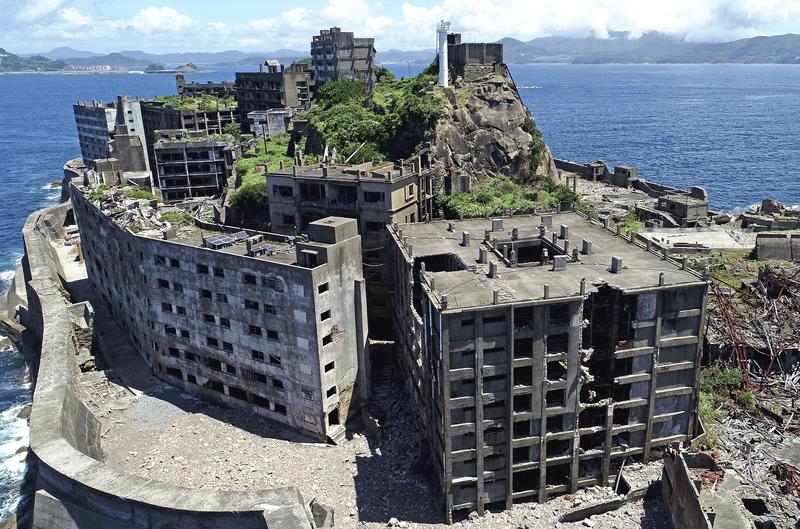
NAGASAKI -- One of the country's earliest reinforced concrete buildings and a registered World Heritage Site since 2015, partially collapsed as a result of this year's heavy rains.
The partial collapse of the building on Hashima island in Nagasaki has revealed the critical state of all of the buildings that give the island a battleship-like appearance and from which the island takes its well-known nickname, Gunkanjima (Battleship island).
The Yomiuri Shimbun took aerial photos of the partially collapsed building No. 30 on Aug. 13.
The seven-story structure, 17.4 meters high, was once an apartment building for miners. A portion of the exterior walls and beams of the south side's fourth to seventh floors and the west side's sixth to seventh floors are gone. Walls in other areas are covered with cracks and have areas with exposed rusted steel.
The building, constructed in 1916 and bearing historical value as the island's oldest reinforced concrete structure, is in danger of being completely destroyed.
According to the Nagasaki municipal government, heavy rains caused the collapse on the building's south side on March 27 and its west side on June 11-12. Officials believe that the concrete absorbed water and collapsed under its weight.
"The building collapsed from the inside, making it impossible to build scaffolding for repairs. It's impossible to repair it as it is now," a municipal government official said.
The island was once an undersea coal mine base of operations. High-rise buildings made from reinforced concrete were adopted here earlier than any other part of the country, among which were apartment buildings, such as company housing to cope with an increasing population. The island itself was closed in 1974 and became uninhabited. Thirty buildings remain to this day, including elementary and junior high schools.
Most of the buildings have passed their typical lifespan of about 50 to 60 years, and the deterioration of the concrete has become serious.
"The value of the World Heritage site has not been affected because the oldest of the buildings are from the Taisho era (1912-1926)," said an official of the Cabinet Secretariat, which presides over the Sites of Japan's Meiji Industrial Revolution: Iron and Steel, Shipbuilding and Coal Mining, a set of relevant World Heritage sites in Japan, of which the island is a part.
However, modern Japanese history specialist Manabu Arima, the director general of the Fukuoka City Museum, is not so sure.
"The reason why Hashima is introduced as a symbol of [Japan's] industrial revolution era is because of its warship-like appearance.
"Measures to prevent deterioration should be considered and implemented as soon as possible," he said.
Read more from The Japan News at https://japannews.yomiuri.co.jp/