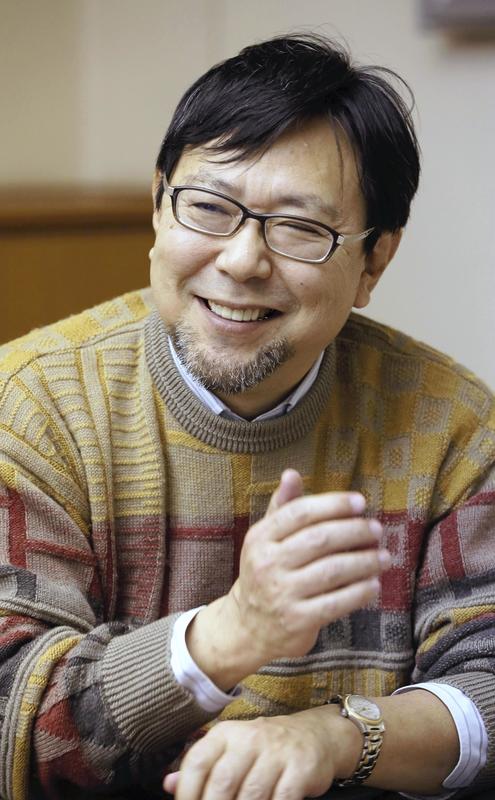
With the novel coronavirus spreading again, leading to debate over whether a "second wave" is coming, the impact of the pandemic is not likely to subside soon. But according to Prof. Kazuto Hongo of the University of Tokyo's Historiographical Institute, this kind of battle with an epidemic is not new for the Japanese people.
Hongo's specialty is Japanese medieval period, when era names frequently changed with the occurrence of epidemics or natural disasters. He is also known for his TV appearances.
Over Japan's long history, its people have fought and overcome numerous epidemics, such as smallpox, dysentery, malaria, cholera and influenza. Ahead of Hongo's Aug. 27 lecture, "Japanese History and Epidemics," at The Yomiuri Shimbun's Tokyo headquarters in Chiyoda Ward, Tokyo, Yomiuri Research Institute Senior Research Fellow Satoshi Tabata interviewed Hongo, who spoke from a historical viewpoint about how to live with an epidemic.
The following are excerpts from the interview.
The Yomiuri Shimbun: The spread of the novel coronavirus has brought renewed attention to the Spanish flu pandemic about 100 years ago.
Kazuto Hongo: At that time, people didn't even know that the flu virus existed. People took measures such as not going near patients, regularly washing their hands and gargling. Japanese people still do these things today. These are wise, long-standing practices that we should keep doing. Today we may laugh at people in the Taisho era (1912-1926) because they didn't even have the concept of viruses, but we may be laughed at by people 50 or 60 years from now because we weren't able to quickly produce a vaccine [for the novel coronavirus].
Q: Looking back on Japanese history, people have suffered through many epidemics. During Japan's medieval period, which is your academic specialty, era names frequently changed due to epidemics.
A: In the past, the era name changed whenever there was an uncontrollable natural disaster, social unrest or political instability. Under the past system in Japan, in which politics was closely connected to religious rites [conducted to pray for the peace and prosperity of the nation], when a serious natural disaster or epidemic occurred, people would become discontented and distrustful of the ruler, causing his administration to collapse. Changing the era name was meant to appease public sentiment by temporarily separating politics from religious rites.
Q: Some global epidemics in the past did not affect Japan, such as the plague, which was dubbed the Black Death and much feared in Europe.
A: Japan has been fighting various diseases since ancient times, but the plague didn't spread extensively in Japan. To put it simply, this was because Japan is separated by the sea. The Mongol Empire, which sent military forces twice to attack Japan, eventually perished due to the plague because the empire was connected with Europe by land. It is said that one-quarter to one-third of the population in Europe died from the plague. The disease reached China and ruined the empire. But it didn't land in Japan. Japan owes much to the sea in this respect.
Q: How should we understand the relationship between history and disease?
A: From the standpoint of demography, the three factors inhibiting population growth are famines, epidemics and wars. Historical demography specialist Akira Hayami said that the population of Japan was 6 million in A.D. 600. It was 12 million in 1600, an increase of only 6 million over a period of 1,000 years. In contrast, the population in 1700 during the Edo period (1603-1867) was 25 million. So the population grew more than twofold in only 100 years.
People today may feel that life during the Edo period was hard. But for people at that time, in fact, it was comfortable. This is partly because there were no wars and people were to some extent spared from starvation. Another reason is that people had learned how to cope with diseases. Medicine advanced during the Warring States period [from the late 15th to late 16th centuries], allowing medical specialists to earn a living.
Q: In the Edo period, people finally became able to cope with diseases. Does that mean their lives came to more closely resemble ours today?
A: It doesn't mean there were no disease-related problems during the Edo period. Take syphilis, for example. That disease is said to have been brought back to Europe from the Americas by Christopher Columbus. It was also brought to Japan. In fact, many people suffered from syphilis during the Edo period.
A researcher of historical ruins says that old cemeteries found in Tokyo show two remarkable characteristics. One is the high mortality of young children. A large number of children's bones have been found here. Many children died young, of course from smallpox and also due to poorer hygiene than today. The other feature is the remains of syphilis patients. Their bones are blackened and easy to recognize.
Q: In light of history, how should we face the novel coronavirus today?
A: Many people know that it's not true that the more science evolves, the rosier our lives become. When finding measures to fight the coronavirus, we should have more down-to-earth discussions by involving not only scholars in scientific fields but also specialists in other fields, such as academic economists and philosophers.
Read more from The Japan News at https://japannews.yomiuri.co.jp/