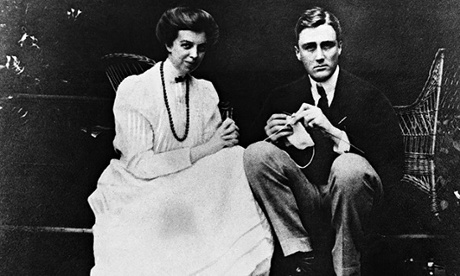
The intertwined lives of Eleanor and Alice Roosevelt, the subject of a new book by Marc Peyser and Timothy Dwyer temptingly called Hissing Cousins, began in tragedy. In 1884 the two girls were born into separate houses of a great family. Eleanor’s father, Elliot Roosevelt, elder brother to future president Theodore, was alcoholic and mentally unstable. Eleanor’s mother would die of diphtheria when the girl was only eight, and the serious and shy young Roosevelt would be raised by her grandparents. She got to spend the summers with her boisterous uncle Theodore and his family, dutifully swimming, hiking and camping, never complaining, even when her uncle pushed too hard.
Eleanor’s cousin and playmate Alice refused her father’s rough outdoor activities, which included diving into the cold Long Island Sound. She cried, she pouted, she got angry – the very opposite of her stoic cousin.
Alice Roosevelt had the misfortune of sharing the beauty of her mother Alice Lee, who died days after her daughter’s birth and hours after her mother-in-law. Theodore Roosevelt was devastated by his wife’s loss. He marked the date, which happened to be Valentine’s Day, with an X in his diary: “The light has gone out of my life.” He handed the child to his sister and escaped to North Dakota to hunt buffalo, hardly seeing Alice for the first three years of her life before remarrying. He never spoke of her mother again.
The two women who emerged from these traumatic childhoods became devoted to each other as kin but found friendship impossible. They would spend much of their lives pinpointing in each other the weaknesses they could not bear in themselves. To Alice, Eleanor was prim and law-abiding, more concerned with others than she was with herself, not just considerate but sanctimonious. To Eleanor, Alice was sharp and shallow, more empty than cruel.
To their credit, considering the catfight promise of the title, Peyser and Dwyer resist the urge to declare one woman victorious over the other. Neither Eleanor nor Alice come out of this history unscathed, each thrown more sharply into relief by the other. Hissing Cousins unravels the Machiavellian question that would haunt both women in their path to power: is it better to be clever, or is it better to be good?
Though they were opposed by temperament and politics seemed to do everything in tandem. They both turned 16 in 1900, and both would marry, at 20 and 21, men who would be politically ascendant and emotionally frustrating. They both would, at the age of 36, earn the right to vote after a lifetime of political service. And they both would outmanoeuvre, outplay and outlast a series of presidents in roles that would redefine what it meant to have political power in Washington.
Even their attitudes towards each other had an eerie parallelism. Alice pitied Eleanor: “She took everything – most of all herself – so tremendously seriously,” Alice said. “If only she had allowed a little levity into her life ... Whereas she responded to her insecurity by being do-goody and virtuous, I did by being boisterous and showing off.”
Likewise Eleanor pitied Alice. In 1916, long after Alice’s teenage reign in the White House was over, Eleanor would find her unchanged. “Now that I am older & have my own values I can only say what little I saw of her life gave me a feeling of dreariness & waste ... She hasn’t a conception of any depth in any feeling or so it seems. Life seems to be one long pursuit of pleasure & excitement & rather little real happiness either given or taken on the way.”
It was Alice, however, who introduced Eleanor and Franklin, and the family lore maintained that she was forever jealous of losing him. Then again, Alice may have simply hated not winning. The husband she did eventually choose, Nicholas Longworth, was an Ohio senator just as lively and wandering as herself.
In Hissing Cousins, family and motherhood become footnotes, as do the presidents that come and go from the White House. Instead the progress of their twinned lives propels the drama. Because the list of similarities, incredibly, goes on. The two women had competing newspaper columns. The same week in 1933 that Eleanor published a book of essays about the role of women in the wider world, Alice published her memoirs, which the New York Times listed as one of the best books of the year. Alice often did impressions of Eleanor at her parties; once hearing of it, Eleanor would calmly ask Alice to see it.
Both Alice and Eleanor also had philandering husbands, to whom they both offered divorce. As was terribly rare for women of their era, they both had more money, power and influence than their husbands. Both men declined. The marriages were, afterwards, unconventional, but each in a way that suited the woman in question’s temperament. Eleanor would never again sleep in the same bed as FDR, but their companionship remained strong. (The passions of Eleanor’s adult life would be ruled by Lorena Hickok, who became close to the first lady as a White House reporter. They would exchange over 3,000 letters and Hickok would give her a sapphire ring. “Your ring is a great comfort to me,” Eleanor wrote, “I look at it and think she does love me ...”) For her part Alice took the break as license to do whatever she liked with whomever she liked. She had a long-standing affair, and later a child, with a senator from Idaho who was two decades older and as bullish as her father.
Eleanor would be remembered for her politics, Alice for her tongue, and each were to the other “examples of how not to live”. But Hissing Cousins proves that being a Roosevelt, and a woman, is not a zero-sum game. Because the one thing Alice and Eleanor certainly got out of their enmity was an unwavering belief in their own selves. Both of them would outlive the men they married and die distinguished in their own right. It turns out that even among women, a little healthy competition is a good thing.
- Hissing Cousins is published in the US by Random House.