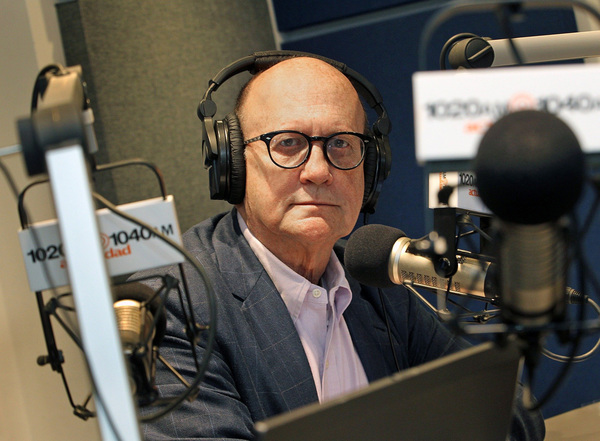
MIAMI _ It's 10:30 a.m. on the morning after the second presidential debate, and Ricardo Brown is live on the air on WURN-AM Actualidad Radio hosting his daily political talk show "Panorama Nacional." But instead of a heated analysis of how Hillary Clinton and Donald Trump fared during their showdown, Brown is speaking softly, Vivaldi playing in the background, telling his listeners he's in the mood for peace and quiet.
Brown even tells his co-host Maria Fernanda Silva that he's considering taking a long vacation until Nov. 9, when the election will have been settled. A little while later, at the radio station's offices outside Miami, Brown says he wasn't kidding about taking a break. Only his smile implies he's not serious.
"I try to stick to the middle of the road when I'm covering elections, but this one has been difficult because you keep getting hit by trucks going in both directions," he says. "I'm getting bored. I want this election to be over soon. In fact, I want the next four years to be over soon. No matter who wins or loses, the next four years are going to be gridlock in Washington. We'll survive as a nation. Heck, we survived the Civil War. But I'm bored. I wish I was a bear. I want to hibernate until this is all over."
Brown's candidness about his election fatigue is refreshing. It's hard to imagine an English-language news personality of his stature _ an Emmy award-winning correspondent and reporter who has covered stories for Univision, Telemundo and CBS Telenoticias in more than 50 countries over four decades _ being this frank and off-the-cuff.
But in the present-day of South Florida's Spanish-language TV and radio, a personal connection edges out political agendas. This more moderate, restrained tone is a radical departure from what Hispanic media in Miami used to be in the 1980s and '90s: an often bitter landscape dominated by hardliners who raged at Castro's regime and stoked public sentiment against anyone they deemed sympathetic to communist governments. In 1976, a car bomb severed the legs of WQBA host Emilio Milian, who had denounced extremist Cubans on the air.
Today, though, Hispanic media have evolved and caught up with their English-language counterparts _ not just in terms of professionalism, but also in importance and advertising. That sophistication is critical in earning the attention of U.S. Latinos, who account for 17.6 percent of the country's inhabitants and wield 11.3 percent of its purchasing power. In 2015, overall spending on U.S. Hispanic media (including TV, radio, newspapers and magazines) totaled $7.83 billion.
President Barack Obama and Republican nominee Mitt Romney spent eight times more money in 2012 on Spanish-language ads than in 2008. 2016's totals won't come anywhere near that, since Trump has spent no money on Hispanic media advertising. But the increase proves the growing importance of courting Spanish speakers, whose numbers continue to grow.
In direct impact, the dollars spent on Spanish-language media buys in the presidential campaigns are relatively insignificant.
But an election year brings a windfall to news outlets in both languages. Kantar Media's Campaign Media Analysis Group projects that an estimated $4.4 billion will be spent on TV ads for the 2016 election, an increase from $3.8 billion in 2012.
And although nightly news programming can't compete with filmed entertainment in the ratings game, prominent Spanish-language news and radio personalities can use their reportage to build their audiences and establish loyalty over the course of the election cycle, particularly among populations whose own histories have been marked by dictatorships. In media businesses, the larger the audience, the more the outlets can charge advertisers of all types.
And then, of course, there is the influence of the voters on the election outcome. According to a poll released by Univision earlier this month, 60 percent of Hispanic registered voters in Florida would vote for Clinton if the election were held today. The percentage was even greater in other states such as Nevada (65 percent) and Colorado and Arizona (66 percent).
In an election year when immigration has become an intensely debated issue, the 27.3 million U.S. Hispanics eligible to vote _ an increase from the 23.3 million in 2012 _ could determine the results in critical swing states such as Florida. Yet according to a recent study by the Pew Research Center, only 69 percent of registered Latino voters say they are "absolutely certain" they will vote in this year's election, down from 2012's 77 percent. The study also showed that 33 percent of eligible Latino voters who say they will not cast a vote on Nov. 8 cite a dislike of both candidates, while 22 percent don't feel their vote would make a difference.