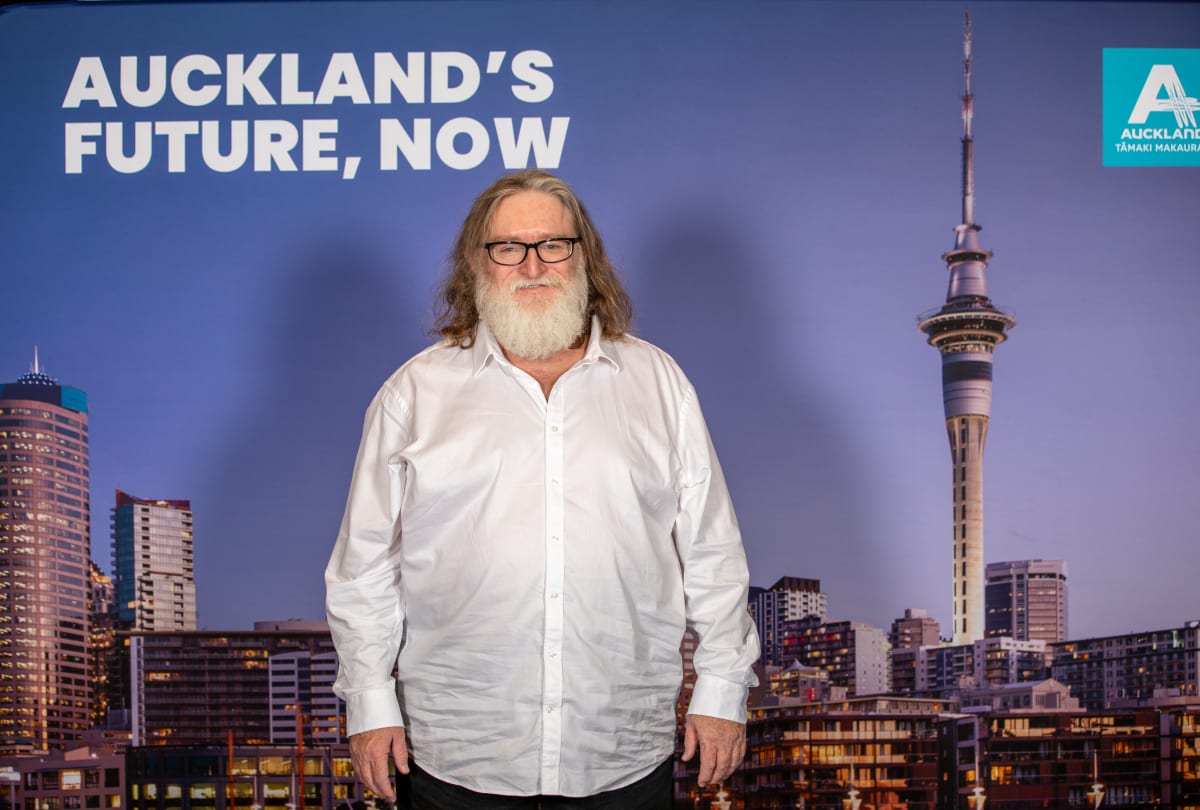
US video game billionaire Gabe Newell, marooned in New Zealand during lockdown and now with NZ residency, was a special guest at the Auckland's Future Now conference. The chief of Valve Corporation spoke with our former Los Angeles trade diplomat Leon Grice about his time here, his motorsport team, our gaming industry, this country's appeal for high tech businesses and the chances of bringing his major online e-sports event, The International, to New Zealand. This is a lightly edited transcript of their exchange:
Leon Grice: Tell us how you happened to arrive here in March last year.
Gabe Newell: So my parents in their late 80s had always wanted to come to New Zealand, so a group of us from around the world decided to meet them here. We were supposed to be here for 10 days, but then the situation was a pandemic in the United States and really started to get out of control. And the last thing we wanted was for them to go back to Colorado. So we've been here ever since.

LG: You haven't just been passively sitting around, obviously, doing a lot of Zoom calls back to the United States. You've immersed yourself in this country. So there's three things: motorsport, America's Cup and e-sports. Tell us about motorsports and what your experience is and what you've been doing that field.
GN: So I've been pretty interested in understanding New Zealand and we've tried a number of different things to see if I can just try stuff, see what it's like [say] to get legal agreements done and promotions. One of the things we do in the States is we raise money for Seattle Children's Hospital, through motor sport. Motor sport is kind-of an inherently selfish thing. So we try to do something that is more about giving back. We've replicated that here. The team's called Heart of Racing. We're working with Starship to do the same kinds of things. And we've tried other things like working with Rocket Lab, to launch now into space. It's a reference to something that happens in one of our video games. We raised a couple of hundred thousand for Starship. And it's those sorts of things to just sort of understand what the business environment is like and how to actually get things done.
LG: And you've also been involved with the America's Cup, with Team New Zealand, and Grant Dalton described you as a really good bloke. He said, 'he really is less a sponsor and more part of the team'.
GN: It's just about what the America's Cup, what Team New Zealand, tells a businessman about New Zealand's capabilities right there at the cutting edge of some really critical technologies. Like, my view of the America's Cup was that it's a sleepy old people sport, for people who are in established thinking about the 1870s. And instead, when I look at it, right, they're doing absolutely world class work in modelling and simulations, artificial Intelligence. That's exactly the same kind of things you'd be seeing Intel or Facebook or Google doing, and that kind of work is being done all the time here in New Zealand. It's a remarkable example of what's possible, what New Zealand is capable of, at the world-class level in the most technical fields.

LG: Do you think the sort of talents and skills and capabilities you saw on Team New Zealand are leverage-able?
GN: Absolutely. I just want to walk through a couple of test cases. So one of the things that has emerged is we started working with people who came out of Weta. And then the other big developments have been around e-sports, which behave much more like traditional sports. You don't want the rules to change every time. Like in football, there's not football 2.0 and football 3.0. And it's super useful to put on events like We ❤ Aotearoa, to get a sense of the feasibility of that. So when we just do these tests, there really is nothing in these interesting high-tech areas, in both the gaming industry and related fields, that isn't isn't feasible to do here.
LG: What did you learn about those sorts of audiences, about the culture of this place by doing that?
GN: There are a bunch of things that are now unique to New Zealand, right, in terms of why you would be interested in hosting either workforces or events here in New Zealand, that are less attractive to run anywhere else in the world.
LG: . And you've also been connecting with the gaming association here as well. What's your perspective on its future, and what its potential is?
GN: It's been great to get to know developers here and see the success, like Ninja Kiwi just went through an acquisition which is a great result for them. There's a lot of passionate entrepreneurial spirit here in New Zealand around gaming. It would be really helpful to make it easier for them, to be able to bring in sort of more senior talent to help jumpstart stuff. It helps when you're trying to build a triple-A title to have access to some of the people, either in Europe or in the US or Japan, who've been through that a couple of times. And also making it easier for capital around the country to fund these projects. It seems like there are some difficulties. When I'm looking at businesses that are here, it seems like they would be super attractive to capital around the world, but there are some impediments to making that happen.
LG: Perhaps you could describe where your business is operating and what Covid has done to it and and how you're shifting your strategy?
GN: So we're a really large business. So if you look at kind of the amount of internet traffic that's generated by by our video games and our platforms, it's larger than a lot of countries. The last time I checked, we were larger than the UK – so people don't necessarily understand the scale of what you're doing with these kinds of businesses. There are two aspects to it. One is service provision, and the other is your workforce. And the service provision side, you're used to planning around natural disasters, because the last thing you can afford is that a hurricane someplace means that you're not able to serve your customers for a couple of weeks, or an earthquake or volcano or some other natural disaster. So you're trying to distribute your footprint as much across the world as possible. That's just a standard part of the planning, strategic planning that you do.
And I think Covid has really opened my eyes and a bunch of other people's eyes to the risks to your workforce of not hedging those risks appropriately. So when you look at our productivity over the last year, we're not a capital intensive business, the most important things are the productivity of the workforce, and it's knocked down by about 30 percent. Imagine if you're in a business, it's a huge supply shock. And you look at other companies like the Googles and Microsofts of the world, they're going to be experiencing similar kinds of reductions in productivity. And New Zealand has created through all of everybody's efforts, this enormously valuable place where you can go and have meetings like this where you can get a lot of work done, you can have face to face conversations where you're not getting that 30 percent hit.
And I think that that's going to be incredibly attractive to people. Saying, we need to be able to have offices set up in New Zealand, because they have this proven track record, anybody that thinks that Covid is not going to be impairing productivity for knowledge workers, for the next several years is really myopic about the real costs associated for pandemic responses. It's hard for people in Auckland to really grasp how damaged things are outside of your life, but I'm talking to friends and co-workers in Seattle all the time. And there are a lot of people that I talk to who literally don't go out of their house for months at a time. Obviously, vaccines are going to help, but then you've got the variants coming, you've got the Brazilian variant that is spreading up and down the West Coast. So this is not a problem that's going to go away.
And realistically, we should anticipate because of climate change that this will be an ongoing challenge. Right now, it's Covid-19. At some point, it's going to be MERS-2, or something along those lines. And if you're trying to plan where is a safe place to have a workforce, New Zealand has proven that it is, if not the best, certainly in the top three places in the world for hosting high-tech workers, where you're going to be able to distribute risk. This is something that has enormous appeal to us at Valve. And I'm sure it's going to be appealing to a wide variety of people: that this is a great place to have part of your labour force to offset any potentials down the road.
LG: And so how do we capture that opportunity? You've been lucky to be able to get out and and immerse yourself and and I think when we're talking on the phone the other day, we were talking about pilots to actually assess how these things are operating. And so you're talking about all the big tech companies?
GN: Yeah, I think they should be doing it. And it's just really a question of how welcoming New Zealand and Auckland are going to be to those sort of pilot programmes. I think that it should be embraced, I think it's a great opportunity for New Zealand to capitalise on all the hard work they've done. I'm happy to help participate in spreading that message. I've certainly been a beneficiary of that. And I expect, you know, that my my colleagues, at these other companies are going to be equally appreciative of the opportunity.
LG: Is this about employing labour? Or is it about cultivating labour locally?
GN: If you're going to develop New Zealand skills here, you're going to want to move them to headquarters to continue to do their professional goals – because they'll be coming back. There are lots of skills and talents that are that are going to be useful that are not currently in New Zealand that will help jumpstart it, so it's becoming part of that global community of high tech workers and being recognised as a great place to develop these kinds of products and services.
LG: Valve's employee handbook is iconic and ahead of its time. Thoughts, please, on how to create a truly engaging culture that attracts world class talent?
GN: The more talented people there are, it's a different kind of world. When you look at our productivity per employee, it's tens of millions – not hundreds of thousands – of dollars in revenue per employee. And so what you do with with people like that? A lot of times it's offering them flexibility, autonomy and great colleagues to work with. The number one request I get get nowadays is not for higher salary or more vacation time, it's getting into New Zealand realistically.
LG: What are your next steps in terms of your relationship with this country?
GN: Oh, I'm here for the foreseeable future. I became a resident without expectation and certainly, you know, our offices aren't open. Everybody's working remotely. I'm just working slightly more remotely than everybody else. So I certainly find this to be a great place to live. And, you know, I'm just waiting for situations to evolve, I'm like all New Zealanders going to be looking for what sort of opportunities for travel there are right now. I'm super happy to be here and its a great environment.
LG: The depth of the talent that you see here. How does it compare in terms of the talent pools that you have around the world?
GN: New Zealand has all of the pieces to be a leader in just about any industry, that its entrepreneurs decide to invest in, the technical skills, the educational system, the sort of attitude and make-it-happen kind-of principles that are kind-of critical to that are all here. So it's just unleashing that spirit and and seeing what it builds.
LG: It's just been announced The International is heading to Sweden this year. What is the feasibility of bringing The International to Auckland?
GN: I was trying. That was an interesting debate. I was a fan of having it in New Zealand, but there were a bunch of sunk costs associated with going to Sweden. But I've done all the legwork to know that we can have those events here.
LG: Fantastic. It's wonderful to have had you here and it's exciting to have you as a new New Zealander.