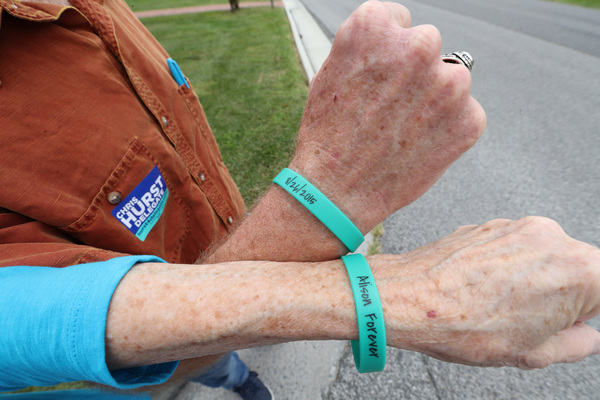
BLACKSBURG, Va. _ In the life he had dreamed of, the one he got to live for awhile, Chris Hurst would spend this time preparing to deliver the evening newscast.
Instead, on a damp Tuesday after Labor Day he's standing in a Virginia Tech classroom, delivering a campaign speech tinged by loss to a couple dozen student activists and campaign volunteers. With boyish features and reddish blond hair, Hurst wears jeans, gray Adidas sneakers and a turquoise rubber wristband with the words "Alison Forever" and a date, 8/26/2015.
That's the day Alison Parker, the woman he planned to marry, was shot and killed on live television in a murder that shocked the country with a graphic glimpse of gun violence. Parker was a morning reporter and Hurst an evening anchor at the Roanoke, Va., station, WDBJ.
Now, Hurst, who grew up on the Main Line in the Philadelphia suburbs, is on the other side of the news, a Democrat running an underdog campaign for state delegate in a southwest Virginia district that reflects some of the divides so sharply exposed in 2016.
Hurst insists that new gun laws are not his driving priority _ but they cast a long shadow here. A decade ago Virginia Tech reeled from one of the worst mass shootings in American history, when a student killed 32 people on campus before taking his own life. The campus is in the heart of the district, Virginia's 12th.
Yet Hurst begins his speech tonight by pointing to President Donald Trump, and his decision hours earlier to end a program that gave protections to young people who were illegally brought to the U.S. as children.
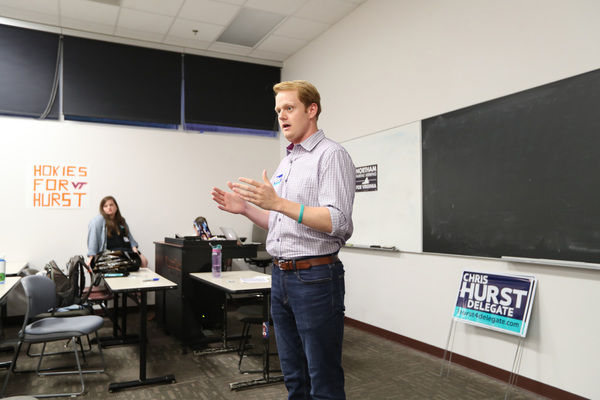
Those young adults, he says, now face a deeply uncertain future.
"In my own way," he says, "I've been on a difficult road, too."
At just 30, Hurst's road already includes a seemingly charmed career and deep love _ and then sudden, wrenching, loss. It now overlaps with the country's charged political moment and its raw cultural chasms.
He's running in a district nestled amid the Blue Ridge Mountains, home to both Blacksburg, a bustling, liberal college town, and rural Giles County, Trump country that rubs up against West Virginia. Three out of 4 voters in Giles supported Trump last year, while Blacksburg's Montgomery County backed Hillary Clinton, giving her a narrow edge in the district and fueling Democratic hopes for an upset this fall.
Given Hurst's story, the local contest in a district of about 80,000 has drawn unusual attention. Hurst is followed today by a Los Angeles-based filmmaker, Tim Johnson, who grew up nearby and is mulling a documentary.
"It feels like there's a lot of things converging here that might be a microcosm," Johnson says.
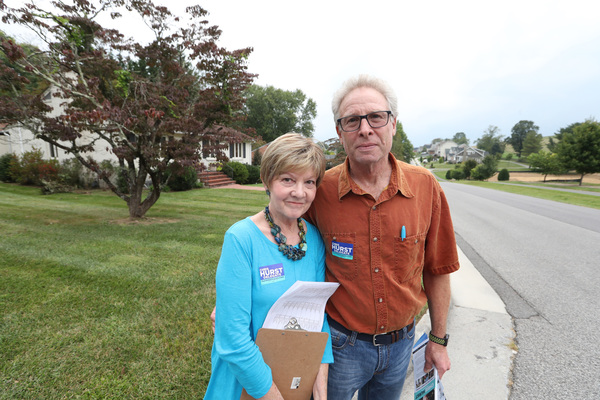
He films as Hurst speaks to his young supporters, delivering his speech with the casual authority of a former anchor.
He talks about keeping guns away from domestic abusers and the mentally ill, but adds, "This campaign has never been solely about gun violence." So he also stresses climate change, equal pay for women, abortion rights and racial injustice _ and insists that a new wave of millennial energy will change Virginia.
Andy Parker, Alison's father, watches in the audience. He says quietly, "He was born to do this."
After the speech, Hurst mingles with the students, chatting about issues, pizza and Facebook, though eventually the talk again turns to guns.
"We are going to see action on this issue," Hurst says _ but only once a critical mass of people have seen or felt the effects of shootings first-hand. Getting to that point, he laments, means more will be hurt first. "It's frustrating," he says.
Parker's parents _ like former Congresswoman Gabby Giffords and the families of the children and teachers slain in Newtown, Conn. _ have become vocal advocates for tougher gun laws after the shooting that scarred their lives, though they say they understand why Hurst focuses on other issues, like education or health care, which are more tangible day-to-day concerns, for most people.
"Other things are bigger priorities _ until it happens to you," Barbara Parker says. "When you lose somebody to gun violence, all of a sudden it becomes in the forefront, it becomes the issue, and that's what happened to us."