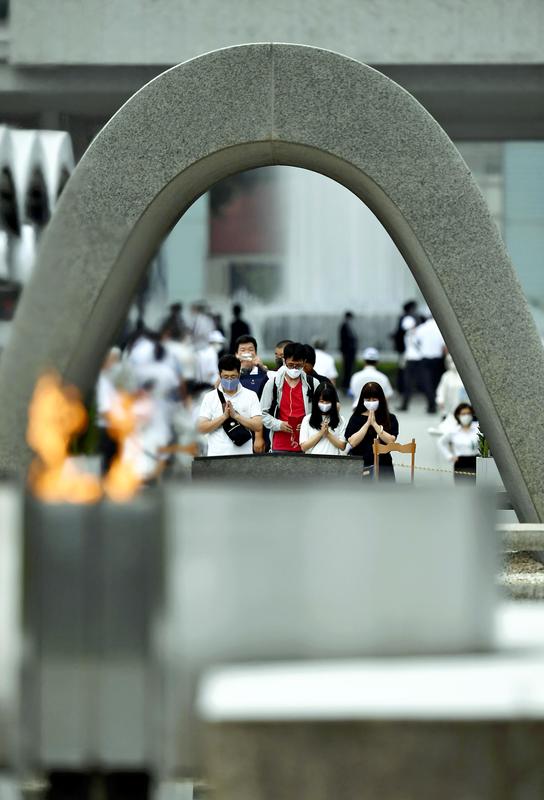
HIROSHIMA -- Hiroshima Mayor Kazumi Matsui on Thursday called for unity in the battle against nuclear weapons and the novel coronavirus at a memorial ceremony to commemorate the 75th anniversary of the atomic bombing of Hiroshima.
About 800 people attended the ceremony, which started at 8 a.m. in the Hiroshima Peace Memorial Park in the city. Participants mourned the victims and renewed a pledge that the horror of nuclear weapons should never be repeated.
In his peace declaration, Matsui described nuclear weapons and the novel coronavirus as a "threat to human beings." He said, "Civil society must reject self-centered nationalism, and unite against all threats."
As part of efforts to prevent the spread of the virus, entry to the venue was limited only to invited people from 5 a.m. to 9 a.m.
The city reduced the number of invitees, which usually reaches about 11,000 every year through atomic bomb survivor groups and other organizations. Seats for general attendants were not prepared, and the seats that were put out were positioned 2 meters apart on each side.
In addition to atomic bomb survivors and representatives of bereaved families, Prime Minister Shinzo Abe and representatives from the Delegation of the European Union to Japan and 83 countries, including such nuclear states as the United States and Russia, also attended the ceremony
The number of representatives of bereaved families was a record low of 23 from 23 prefectures.
At 8:15 a.m., the time the atomic bomb was dropped, representatives of victims' families sounded the peace bell, followed by a one-minute silent tribute by all participants.
"Rumor at the time had it that 'nothing will grow here for 75 years.' And yet, Hiroshima recovered, becoming a symbol of peace," Matsui said in his declaration.
Matsui stressed unity against threats to humanity and avoiding the reoccurrence of such a tragedy. "No country can live in peace alone. The world is connected," he said, quoting Sadako Ogata, who served as U.N. high commissioner for refugees and died at the age of 92 last year.
He also referred to the July ruling by the Hiroshima District Court regarding exposure to so-called black rain, which recognized people outside the designated area at the time of the bombing as sufferers of the bombing.
Matsui called on the central government to provide generous assistance for the survivors, saying, "I demand the political decision to expand the 'black rain' areas."
He urged the government to change course on its negative position toward signing and ratifying the Treaty on the Prohibition of Nuclear Weapons. "I ask the Japanese government to heed the appeal of the atomic bomb survivors ... As the only nation to suffer a nuclear attack, Japan must persuade the global public to unite with the spirit of Hiroshima," he said.
Prime Minister Abe said in a speech, "We would like to lead the international community's efforts to achieve a world free of nuclear weapons by working to bridge the gap between countries that are in different positions, and by persistently encouraging dialogue and action among them."
The names of 4,943 victims whose deaths were confirmed in the past year were added to the list of deceased victims at the cenotaph for the atomic bomb victims. This brought the total number registered at the cenotaph to 324,129.
The number of atomic bomb survivors across the nation stood at 136,682 as of the end of March, with an average age of 83.31 years, up by 0.66 from the previous year, illustrating the aging of the atomic bomb survivors.
Read more from The Japan News at https://japannews.yomiuri.co.jp/