Hiring demand across Asia Pacific and the Middle East is easing in the third quarter of 2026, but employers continue to prioritise skills, particularly in artificial intelligence and communication, according to a new ManpowerGroup survey.
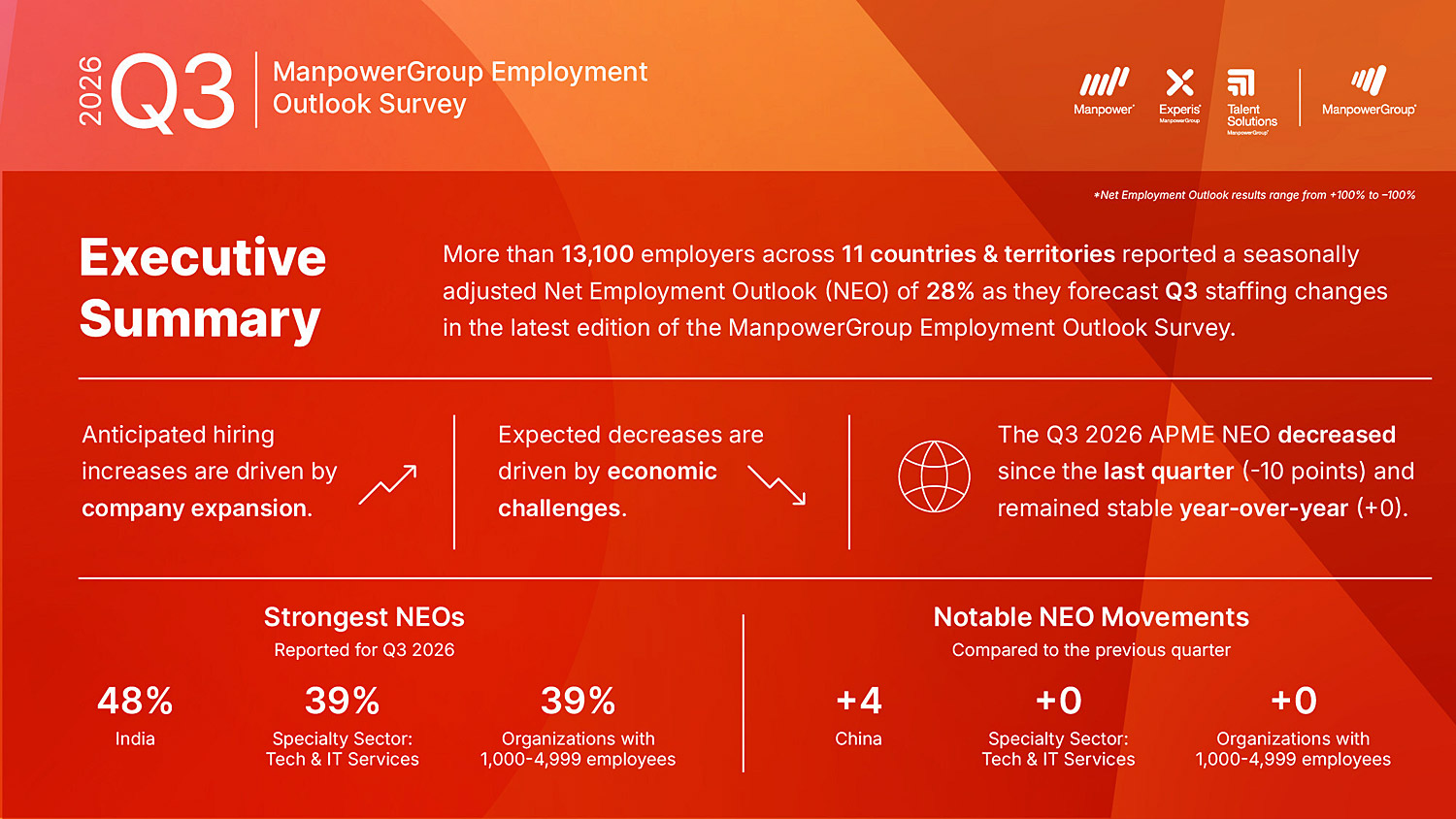
The report has shown a net employment outlook of +28% for the two regions, reflecting slower hiring momentum compared with the previous quarter, although overall sentiment remains stable compared with a year earlier.
Employers are becoming more selective, focusing on talent that can deliver immediate value while supporting long term competitiveness.
Across the regions, 43% of employers plan to increase headcount, while 15% expect to reduce staffing and 41% foresee no change. This shift points to a more cautious approach as businesses respond to economic uncertainty and rising operating costs.
India continues to lead global hiring intentions with a strong outlook of +48%, despite a notable decline from the previous quarter. China and Vietnam follow with outlooks of +33% and +28% respectively, showing continued resilience in key growth markets. In contrast, hiring sentiment remains weaker in more mature or externally exposed economies such as Hong Kong, Japan and Singapore.
Regional analysts say moderation reflects a more complex business environment, shaped by geopolitical pressures, supply chain disruptions and higher energy costs. While these factors are affecting countries at different levels, they are prompting employers to reassess expansion plans and manage risks more carefully.
Despite the slowdown, demand for technical skills remains high. Employers across the regions are placing a premium on artificial intelligence capabilities, with AI literacy and AI model development ranking among the most sought-after skills. Sales, marketing and traditional information technology expertise also continue to attract strong interest.
Soft skills are proving equally important in the evolving workplace. Communication, teamwork and collaboration top the list of qualities employers are willing to reward, followed closely by critical thinking and problem solving. Adaptability, willingness to learn and professionalism are also seen as essential as businesses adjust to rapid change.
ManpowerGroup experts say the findings highlight a clear shift towards a more balanced workforce strategy in Asia Pacific and the Middle East, where technical expertise must be matched by strong human skills. Employers are increasingly looking for talent that can combine digital knowledge with the ability to work effectively in diverse and fast-moving environments.
While hiring activity may become less intense, the survey suggests that competition for high quality talent is intensifying. Companies are expected to continue investing in skills that not only meet current operational needs but also strengthen their position in an increasingly technology driven global economy.