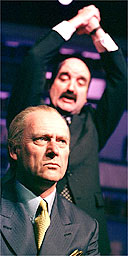
"Where's the beef?" cries the politician-hero of Hinterland as he surveys a savourless sandwich. And I'd ask much the same question of Sebastian Barry's play itself.
However much of a hoo-ha it may have caused in Dublin, because of its hero's apparent resemblances to Charles Haughey, in the Cottesloe it seems a dramatically tame affair.
Barry's hero, Johnny Silvester, is a disgraced Irish elder statesman facing a tribunal's charges of corruption. But, as he sits in his Georgian mansion in the Dublin hinterland, he confronts more immediate accusers.
His wife never lets him forget his 15 years of sexual infidelity. His once brilliant son has turned into a suicidal depressive. An undergraduate interviewer taunts him with betrayal of his country. A ghostly politician thrice emerges Banquo-like from the bookcase to promise that the fires of hell are being stoked against his arrival.
With so many judges pointing the finger, it is impossible not to feel a smidgin of sympathy for Silvester. And part of Barry's point is that people get the politicians they deserve and that Ireland itself may have profited from Silvester's corrupt reign. But this strikes me as a feeble defence of personal political enrichment.
Like Barry's infinitely superior The Steward of Christendom and Our Lady of Sligo, the play is essentially an interrupted monologue written in heightened prose. But whereas in the earlier plays Barry was drawing on his own intimate family history, here he is speculating on the private life of a public man.
And, although he effectively suggests Silvester's ailing mind is an addled mix of borrowed quotations, Barry's language is often self-consciously literary: I've heard more natural responses to a piece of classical music than the hero's "too late in the day for the poise and clarity of the eighteenth century."
What Barry is good at is providing lead parts for actors; and, in Max Stafford-Clark's characteristically precise production for Out of Joint, the Dublin Abbey and the National, Patrick Malahide conveys the hero's peculiar mixture of vanity, vulnerability and punctured gravitas.
It is a fine performance faithfully supported by James Hayes as a loyal factotum, Dearbhla Molloy as the accusatory wife and Phelim Drew as the damaged son.
But one part does not make a play and in the end one feels Barry is too close to recent Irish history to see it in cool perspective.
· In rep. Box office: 020-7452 3000.