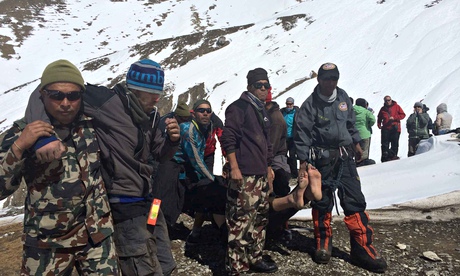
The death toll in the Himalayan trekking disaster has risen sharply with the discovery of at least seven more bodies in the snow on a pass in Nepal.
Thirty-nine people are known to have died when an unseasonal storm swept high ridges and passes on Tuesday, on a popular 320km trekking route around Annapurna, the world’s 10th tallest peak, catching scores of western walkers.
Niranjan Shrestha, spokesman for the Nepalese army, said the remains found today were of four Canadian and three Indian trekkers. “Due to heavy snow helicopters were unable to land… We are hoping to recover the bodies early morning tomorrow [Sunday],” he said.
Other officials gave the total dead as nine. The overall toll is expected to rise as snow melts and rescuers push into new areas. More than 40 people are still unaccounted for, mainly independent trekkers. Ramesh Prasad Dhamala, president of the Trekking Agencies Association of Nepal (TAAN), said that they had information that around 22 trekkers were stuck in between Yak Kharka and Fedi. He said a rescue was planned for Sunday.
Concerns are now growing that several British trekkers could have been caught in the storm. The Foreign Office confirmed they had been contacted by concerned families who had not heard from their relatives in days but said they had received no information about any British victims. Officials in Nepal told the Guardian they, too, had no reports of British casualties.
The storm, caused by a cyclone that crossed northern India last weekend, caught hikers as they crossed the exposed 5,400m Thorong pass, one of the final stages of the famous Annapurna circuit route and its highest point.
At least 17 tourists died from exposure or in avalanches on the pass after the weather deteriorated fast, bringing biting cold, heavy snowfall and low visibility. Foreign victims included hikers from Canada, India, Israel and Poland, but an equal number of local guides and porters perished.
October is peak trekking season in Nepal and usually sees perfect conditions for the sport. Nepal’s biggest mountains largely remain the preserve of experienced mountaineers with technical equipment and experience. However, trekking attracts many more people. More than 110,000 foreign trekkers visited Annapurna in 2013 – a significant rise on the 106,000 in 2012.
Authorities have faced widespread criticism over their handling of the disaster, particularly the failure to pass on warnings from the meteorological office to trekkers.
Kumar Tamang, a 24-year-old guide who was rescued on Friday, remembered how he had tried to wait out the storm in a tent but was forced to abandon the meagre shelter it provided.
“The wind started blowing heavily. We held the tent down, thinking that ... it might stop in a while. But it got worse and … our tent was covered. [We] decided to walk to the nearest village.” Tamang and his 16 clients had been walking for 12 days when the storm struck.
“We didn’t have any clue of such weather coming,” he said.
Nepal’s prime minister, Sushil Koirala, announced plans to set up a new weather warning system to reach trekkers and prevent disasters in the future. The poverty-stricken south Asian state relies heavily on tourism revenues from climbing and trekking.
Paul Sheridan, a 49-year-old policeman from South Yorkshire who survived the storm, said many trekkers and local staff were not adequately equipped.
“There were biting winds and cold so severe it froze your eyelids. But there were people trying to protect their heads with plastic bags and without gloves … It was an accident waiting to happen,” Sheridan told the Guardian.
Trekkers on the Annapurna circuit rely on a system of guesthouses less than a day’s walk apart for accommodation and rarely carry their own tents or cooking equipment.
Few have been trained in poor weather navigation, avalanche avoidance or search techniques.
Mohan Krishna Sapkota of the tourist ministry said the “incident has taught us a lesson” and that emergency shelters would be constructed to prevent similar incidents in the future. The government will also move to restrict individuals trekking “on their own”.
“We will strictly record their names and ask them to take all the information about the weather, area and adopt safety measures,” he said.
Dhamala said that in future, all trekkers would be required to have at least a guide and porter with them. It is unclear, however, what system might be put in place to ensure guides are trained and tested.
The snowstorm is one of Nepal’s worst trekking disasters since 1995, when a huge avalanche struck the camp of a Japanese trekking group in the Mount Everest region, killing 42 people including 13 Japanese.
The Himalayan nation has suffered multiple avalanches this year, with 16 guides killed in April in the deadliest accident to hit Mount Everest, forcing an unprecedented shutdown of the world’s highest peak.
Nepal is home to eight of the world’s 14 highest mountains. Income from tourism, including permit fees from trekkers, who made up more than 12% of its 800,000 tourists in 2013, accounts for 4% of its economy.