Get all your news in one place.
100’s of premium titles.
One app.
Start reading
The Guardian - UK
The Guardian - UK
Environment
Felicity Carus

Himalayan glaciers disappear as world warms up

Nepal Glaciers: Climate Change in the Nepalese mountains
Top: An very deep layer of ice covered the Imja glacier in the 1950s. Over the next fifty years, small meltwater ponds continued to grow and merge, and by the mid 1970s had formed the Imja lake. The thin cover of debris on this glacier may have accelerated surface melting, as heat is transferred to the ice below
Bottom: By 2007, the Imja lake had grown to around one kilometre long with an average depth of 42 metres, and contained more than 35m cubic metres of water. The Imja glacier is retreating at an average rate of 74 metres a year, and is thought to be the fastest retreating glacier in the Himalayas.
Photograph: The Mountain Institute/Erwin Schneider/Alton Byers
Nepal Glaciers: Climate Change in the Nepalese mountains
Top: Taboche peak (6,367m) as seen by Erwin Schneider from the east, above the Nangkartshung monastery. Taboche, and its neighbour Jobo Laptsan (6,440m) to the right preside over the lower Khumbu valley. At their base is the path to Everest base camp. Tsholo Tso is a moraine dammed lake at the foot of Jobo Laptsan. Bottom: Taboche seen from the same point in 2007. The clean, debris-free glaciers and ice nestled below the Taboche summit have been reduced considerably by recent warming trends. The ice in the small glaciers below the ridgelines to the right (north) has suffered the most, perhaps because of its lower altitude, below 6,000 metres. Photograph: The Mountain Institute/Erwin Schneider and Alton Byers
Nepal Glaciers: Climate Change in the Nepalese mountains
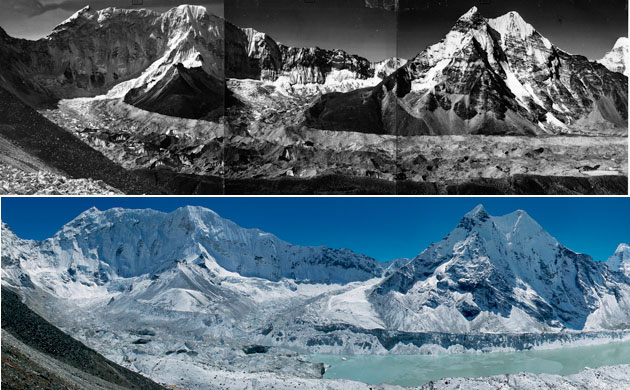
Top: The original photographs, taped together to form a panorama of Ama Dablam (6856m) and Imja valley. They were taken from a point high above Nangkartshung monastery near the village of Dingboche on the Everest trekking trail.
Bottom: Ama Dablam and Imja valley photographed from the same point in 2007. Warmer temperatures have contributed to the recession of more than 100m of ice, seen to the left of Ama Dablam. The dramatic melting of glaciers and ice witnessed at lower altitudes is not yet seen at higher altitudes where the temperatures are much lower.
Photograph: The Mountain Institute/Erwin Schneider and Alton Byers
Nepal Glaciers: Climate Change in the Nepalese mountains
Top: Khumbu and Imja valleys as seen from the upper slopes of Taboche (6,367m) by Erwin Schneider. To the left is the pyramid shaped Pumori (7,146m) with the Khumbu glacier just below, at the head of the Khumbu valley – the gateway to the Everest base camp. The Everest massif in the next frame is dominated by the long wall of Lhotse (8,410m). Imja valley is in the middle of the panorama, the approach to Island Peak clearly visible. Ama Dablam (6,856m) appears in the fourth photo
Bottom: Alton Byers's 2007 panorama shows how although glaciers all over the world are shrinking this is not the case everywhere. The contrast between the two images shows that global warming has not yet led to dramatic ice loss at extreme high altitudes (ie above 5,000m).
Photograph: The Mountain Institute/Erwin Schneider and Alton Byers
Nepal Glaciers: Climate Change in the Nepalese mountains
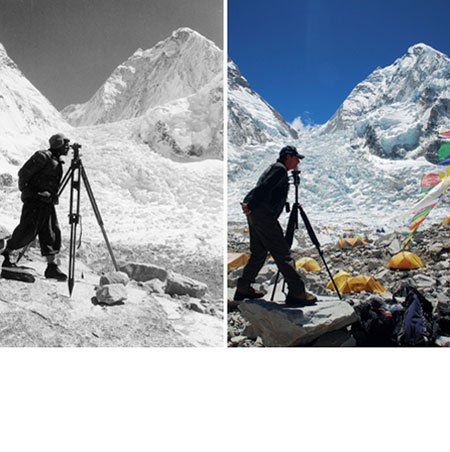
Top: In 1956, the Swiss scientist Fritz Müller spent nine months at altitudes of over 5,000 metres studying the mountains and glaciers of the Everest region. Müller had been the scientific leader of the successful 1956 Swiss Everest expedition, and stayed on after the expedition to study glaciers
Bottom: Alton Byers had his photograph taken in the same spot almost 50 years later during his expedition. Byers is a mountain geographer and climber specialising in high altitude ecosystems. Over three decades he has worked in the remote mountainous regions of Africa, South America, Asia, and North America.
Photograph: Courtesy of Jack D. Ives/The Mountain Institute/Fritz Müller and Alton Byers
Changing Landscapes: Khumbu, Nepal, 1956: A Sherpa helps out with the glacier research work
Khumbu, Nepal, 1956: A Sherpa from Fritz Müller’s team helps out with the research work. His only safety measure is a rope with a simple knot. The photographs seen here of the research teams working in the glaciers are unique. They show the methods and techniques used by these teams, as well as their climbing and scientific equipment, which was state of the art for the 1950s Photograph: Fritz Müller/Jack D. Ives
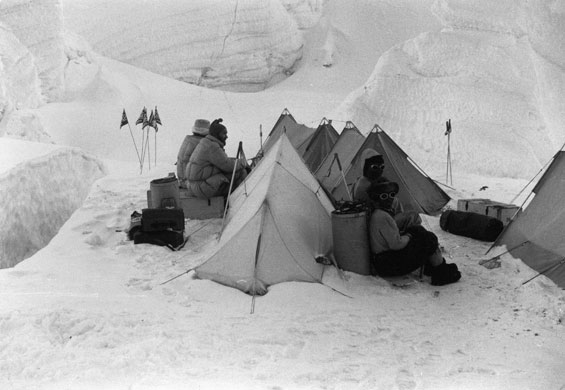
Changing Landscapes: Khumbu, Nepal, 1956: Members of Swiss Everest Expedition rest at high camp
Swiss and Sherpa members of the 1956 Swiss Everest Expedition rest at a high camp somewhere in the upper Khumbu ice fall. Nepal opened its doors to foreign visitors in 1950. It was now possible for climbing expeditions to come and climbed many of the great Himalayan mountains. The first ones to be scaled were Annapurna (8,091 m) in 1950, and Mount Everest (8,850 m) in 1953 Photograph: Fritz Müller/Jack D. Ives
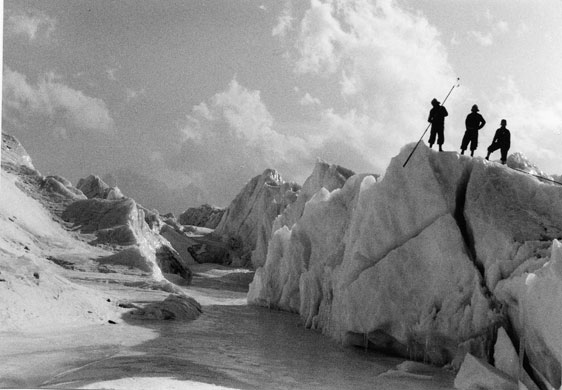
Changing Landscapes: Khumbu, Nepal, 1956: A research team stand on a serac to inspect the ice
Khumbu, Nepal, 1956: Three members of Müller’s research team stand on a serac to inspect the ice. A serac (originally from the Swiss French word ‘sérac’, a type of crumbly white cheese) is a block or column of ice formed by intersecting crevasses on a glacier. Often house-sized or larger, seracs are dangerous since they may topple with little warning Photograph: Fritz Müller/Jack D. Ives
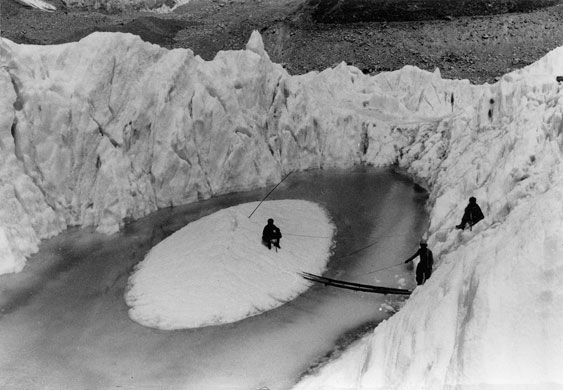
Changing Landscapes: Khumbu, Nepal, 1956: Müller’s team work on a small ice island
Khumbu, Nepal, 1956: Müller’s team working on a small ice island, formed in the middle of a glacier pond. The men have built a rudimentary ladder to stretch across the icy water to make it easier to cross without getting wet Photograph: Fritz Müller/Jack D. Ives
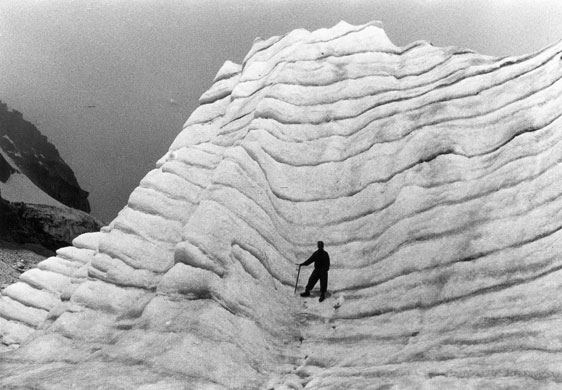
Nepal Glaciers: Climate Change in the Nepalese mountains
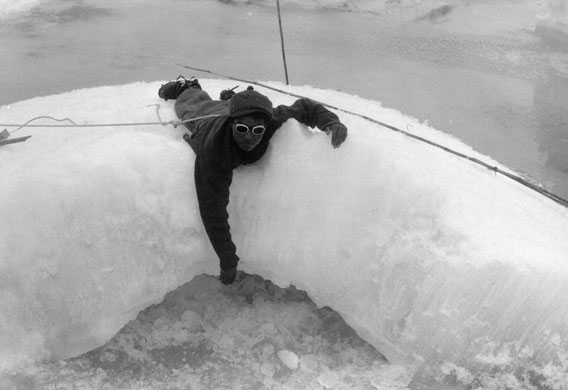
Ice wall on the Khumbu glacier. One of Müller's men leans on his ice axe while standing high on an ice wall. The man does not have a fixed rope to keep him safe and is relying purely on his crampons and ice axe to stop him falling Photograph: Courtesy of Jack D. Ives/Fritz Müller
Nepal Glaciers: Climate Change in the Nepalese mountains
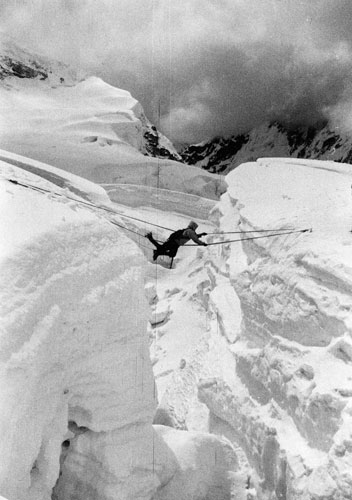
Crossing a cevasse: A member of Müller's scientific research team crosses a crevasse in the Khumbu ice fall using two climbing ropes. Today climbers use aluminium ladders and fixed ropes to cross these crevasses Photograph: Courtesy of Jack D. Ives/Fritz Müller
Sign up to read this article
Read news from 100’s of titles, curated specifically for you.
Already a member? Sign in here
Related Stories
Top stories on inkl right now
One subscription that gives you access to news from hundreds of sites
Already a member? Sign in here
Our Picks
Fourteen days free
Download the app
One app. One membership.
100+ trusted global sources.