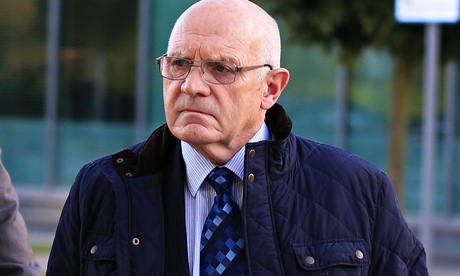
One of the senior South Yorkshire police officers in command at Hillsborough when 96 people died in a crush has apologised at the new inquest into the disaster for misleading the court in his evidence.
Former superintendent Roger Marshall, who was in charge outside the Leppings Lane turnstiles on 15 April 1989 at the FA Cup semi-final between Liverpool and Nottingham Forest, said in a statement read to the jury: “I offer my unreserved apology for misleading the court.”
Marshall misled the inquest in his evidence on 2 and 8 October, when he drew an unfavourable comparison between football in the 1980s – which he said, agreeing with his own QC, John Beggs, was “suffering from severe hooliganism” – and rugby league, which he described as a “family game”. Peter Wilcock QC, representing 75 families whose relatives died at Hillsborough, questioned Marshall about his description of the crush outside the Leppings Lane turnstiles, when Marshall accepted the police “lost control”, as “a battle we couldn’t win”.
Wilcock said battles happened in wars, and the FA Cup semi-final at Hillsborough was “not a war or violent confrontation at all”. Marshall replied that it was supposed to be a “benign presence” of people at a sporting occasion, then compared the football semi-final with a rugby league match at Hillsborough between Wigan and St Helens on Boxing Day 1989, which he said he policed. At that game, Marshall said, the crowd had been 27,500, and he had policed it with just 12 officers. This compared with 801 policemen on duty for the 54,000-strong football crowd at the FA Cup semi-final.
On Marshall’s next day of evidence, Beggs returned to the evidence he had given about that rugby league match. Marshall agreed with Beggs that rugby league was not an “upper class, dilettante” sport, and as at football, supporters liked a drink. Asked to what he attributed the difference in policing for the two sports, Marshall replied: “There is really no potential for public order problems with rugby league. They just don’t happen. It is a family game, family people, no problem.”
In fact, the jury has now been told, Marshall’s evidence was wrong about that rugby league match.
In an agreed statement read to the court, Marshall said: “It has been brought to my attention that in this aspect of my testimony, I gave erroneous evidence, in that: 1) I did not police the Wigan versus St Helens game on Boxing Day 1989, and 2) the game was not played at Hillsborough.
“I offer my unreserved apology for misleading the court. I am embarrassed and distressed that I made this mistake.”
The coroner, Lord Justice Goldring, explained to the jury: “It is clear that Mr Marshall was wrong in what he said about the rugby league match, in two ways. First: he did not police [the match]. Second, the match was not played at Hillsborough.”
The inquest heard earlier from Anthony Hollinrake, who was 25 and a Liverpool supporter when he went to the 1989 semi-final and was caught in the crush in the central pen 3 of the Leppings Lane terrace. Hollinrake, who went to the match with his brother, Peter, said that after the crush happened and he was pulled out in great distress, he told a police officer on the pitch that a crush barrier inside pen 3 had collapsed, and the situation was “really bad”. The officer, he said, replied: “Fuck off and sit down.”
Describing his experience, Hollinrake told the court that unlike the 1988 semi-final between the same two clubs, police did not check supporters for tickets some distance before the area in front of the Leppings Lane turnstiles, and there “didn’t seem to be any organisation”.
He joined hundreds of people outside waiting to enter through the turnstiles, he said, and found himself caught in a crush, which became “unpleasant”, with people screaming. Eventually he was directed to enter the ground through a large exit gate, C, which the jury has heard was opened on police orders. Hollinrake said nobody checked their tickets as they walked through, and inside, he was told by a steward that they should go down a tunnel, which led to the terrace’s central pens.
The pen was so full of people, Hollinrake said, that once inside it, he lost control of his movements. A young boy, whom he thought was around 10, opened a gate at the back to escape the crush, but Hollinrake said a police officer pushed the boy back in, and shut the gate. Hollinrake ended up down the terrace, with his midriff pressed against the metal crush barrier, 124A, “where I didn’t want to be”.
He said a man about his own age was bent over the barrier backwards, in great pain, and he believed he had broken his back. He was trying to help the man by holding up his torso, but then the barrier collapsed, slowly folding to the ground. Hollinrake said he was thrown forward, on to other people, then people fell on top of him. In that pile of people, struggling to breathe, a sensation he compared to drowning, Hollinrake said: “I was thinking about my loved ones, to tell you the truth.”
His brother, who had made it on to the pitch, finally pulled Hollinrake out with the assistance of a police officer. While some policemen were doing their best to help with dead and injured people, Hollinrake agreed with Pete Weatherby QC, representing 22 bereaved families, that there was “absolutely no evidence of organisation” by senior officers. He said some policemen were standing in a line not doing anything, apparently stopping people from getting on to the pitch, so he approached one, telling him of the collapsed barrier and “really bad situation”.
The officer, Hollinrake told the court, replied: “Fuck off and sit down.”
Sam Green, representing the Police Federation, while saying he did not condone the bad language, or deny the words were said, asked Hollinrake whether he thought the officer might have been in shock, like many people that day. Hollinrake replied that he could not make that judgment, but thought it was wrong.
“I have always respected the police and still do,” he said, “so I was shocked by what he said to me.”
Approximately 50 people whose relatives died at Hillsborough, mostly parents who lost their children, were in court to hear the evidence.
The inquest will resume after a break, on Monday 3 November.