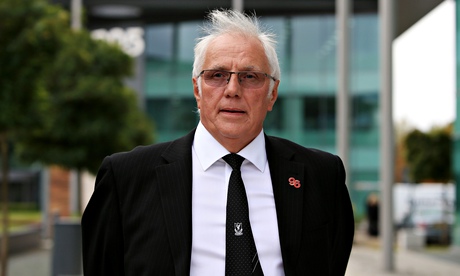
Trevor Hicks, whose two teenage daughters were among 96 people killed by the crush at Sheffield Wednesday’s ground during the FA Cup semi-final in 1989, has given harrowing evidence at the new inquest into the Hillsborough disaster, and of treatment by South Yorkshire police on the day, which he said was “appalling”.
Hicks said when it became obvious there was serious crushing in the central “pens” of the Leppings Lane terrace before Liverpool and Nottingham Forest kicked off at 3pm, he and other Liverpool supporters called up to a police officer, asking to help the people trapped. The policeman, Hicks told the inquest, ignored them for a while, then finally replied: “Shut your fucking prattle.”
Hicks said that at 10pm on the day of the disaster, 15 April 1989, he identified his daughters, Sarah, 19, and Victoria, 15, in body bags at the ground’s gymnasium. He was then immediately taken to make a statement by South Yorkshire police. CID officers, he said, repeatedly asked whether he and his daughters had been drinking alcohol.
Several relatives of other victims whose relatives died wept quietly in the converted courtroom in Warrington, as Hicks described his experiences.
The managing director of an engineering company, Hicks said he and his then wife, Jenni, and the girls, who lived in north London, had Liverpool season tickets and watching the team was something they did together as a family. They travelled up to Sheffield on the morning of the match and had a picnic in the car park before going into the ground. His wife had a seat in the north stand, while he and his daughters were standing and went through the Leppings Lane turnstiles. Hicks said the girls liked to stand behind the goal, and they met up with other young fans who had nicknamed them “the London girls”. He left them to it, and went to the side of the terrace, in “pen” 2, where there was lots of room.
From that position, Hicks said, just below the police’s control box, he could see crushing develop in the central “pens” where his daughters were standing, with people clearly in distress, including an elderly man in a grey suit who appeared, Hicks said, to be “dying standing up”.
He said one policeman, who was wearing an officer’s flat police cap, and whom he believes to have been Supt Roger Greenwood, the officer in charge inside the ground that day, ignored supporters’ calls for him to help. Then they called on the second officer to help, to “do his job”, Hicks put it, and met with the response: “Shut your fucking prattle.”
As people began to climb over fences at the side and front to escape the central “pens”, some then collapsing on the pitch, the police “totally misread the situation”, Hicks told the inquest. He said police clearly believed fans were engaged in a hostile pitch invasion, which they intended to prevent.
He saw Sarah, wearing a T-shirt and Dr Marten shoes, being passed over the fence, and he went on to the pitch. There he found his daughters laid out together, being given mouth-to-mouth resuscitation. He began to give Victoria, whom they called Vicki, first-aid using training he recalled from years previously as an ICI apprentice, which involved sucking vomit from her mouth.
He described the scenes on the pitch as “chaos”, with no organisation by police, or medical equipment. He said many police officers were standing around “doing nothing”.
When one ambulance arrived, he went in it with Victoria, after being promised Sarah would be put in the next vehicle. Leaving his daughter on the pitch was, he said, “one of the worst moments”. After 15 minutes at Sheffield’s Northern General hospital, he was told Victoria was dead. Hicks said he then began a long and fruitless search for Sarah before he and Jenni were driven, on police instructions, back to the Hillsborough gymnasium.
He and Jenni were told that the coroner for the first inquest in 1990-91 had ordered that all bodies be taken to the gymnasium, so Victoria’s body had been driven from the hospital back to the football ground.
“To stick her in a van and take her back to the ground was not really the way to treat the deceased,” Hicks told the inquest.
In the gymnasium, the couple were taken into a room where a police officer was posting up on a board Polaroid pictures of the dead. His wife, he told the inquest, was astonished at the sight of the photographs, and said: “So many?”
The police officer replied: “Oh, they’re not all there, love.” At that point, Hicks said: “It hit me like a brick.”
When they asked to see Victoria’s body, Hicks said they were told: “Well, she’s nothing to do with you. She is the property of the coroner.” Finally, they identified Sarah’s picture on the board of photographs, and both girls were brought out to their parents, in body bags. He said Jenni wanted to hug them, which she did.
Hicks said he was then taken immediately by CID officers to an “anteroom” to make a statement. He reflected afterwards that he should not have made a statement in that emotional condition, after seven traumatic hours, Hicks told the inquest. CID officers repeatedly asked him, half a dozen times, if he and the girls had been drinking alcohol, which he found “infuriating”, he said.
He told the inquest: “The way we were treated – and this is well documented – at the gymnasium, was appalling.”
Hicks referred to his years campaigning for his own and other families, as a founder member and chair of the Hillsborough Family Support Group, of which he is now honorary president. He said he believed the official interim report by Lord Justice Taylor, in August 1989, “dealt with most things”, but the first inquest, in Sheffield, “tried to rewrite” Taylor’s conclusions.
Michael Mansfield QC, representing 75 bereaved families, including those in the HFSG, asked Hicks about the evidence that some South Yorkshire policemen had given at this inquest, which was ordered after the first inquest was quashed in 2012. Some officers have claimed Liverpool supporters were “blind drunk” outside and would not listen to instructions.
Hicks said: “I must have been at a different game” to them. “I have sat in court many days and have been absolutely – in fact I will probably get told off [for saying so] – but it really does brass me off to have to listen to it,” he said.
The coroner, Lord Justice Goldring, said he was not going to tell Hicks off, but encouraged him not to continue criticising the police testimony in his own evidence.
The barristers representing South Yorkshire police, the senior officers in command on the day (Ch Supt David Duckenfield, Supt Roger Marshall and Greenwood), the Police Federation and other then senior officers, did not have questions for Hicks.
Another Liverpool supporter, Colin Moneypenny, who worked for Liverpool city council at the time, gave evidence about being caught in the crush in “pen” 3 of the Leppings Lane terrace. He criticised police for mismanaging the game, failing to help when fans were in distress, then creating a “complete fiction” that fans were to blame.
With friends, Moneypenny had entered the Hillsborough ground through the large exit gate – gate C – which had been opened on police orders to alleviate a crush outside the Leppings Lane terrace, which he described as “chaos”. Once inside, he said there seemed no option than to walk through the tunnel opposite, which led to the central “pens”.
Moneypenny told the court he was lifted off his feet by the “sheer number” of supporters, and carried to the front of the “horror-show” of “pen 3”. He landed on his tip-toes, and could clearly feel he was standing on a body, which he has since always assumed had to be “one of the 96” who died.
Moneypenny said he has suffered trauma since, wondering if he should have tried to help, but said it was impossible to move in the “vice-like” crush, and if he had tried to go downwards, he would have been sucked down and been killed himself. He said he spent 20 minutes trapped in the crush, screaming at police officers on the other side of the perimeter fence to help, but they did “absolutely nothing”.
Eventually, the pressure eased, and Moneypenny made his way slowly back to the tunnel. On the other side of it, he said he saw four or five officers laughing and joking, and he challenged them and told them to help, because people were dying.
“They hadn’t a clue which was going on,” Moneypenny said, which he presumed was owing to poor communication, and that was “disgraceful”.
Asked by Rajiv Menon QC, representing 75 of the bereaved families, his view of the case made by some police officers that the supporters contributed to the disaster by entering through gate C and “pushing” those at the front, Moneypenny said: “I am absolutely disgusted. It is a complete fiction. It has been going on for many years and I am sickened by it. The fans didn’t contribute to it. The fans were the victims.
“The police and the other authorities were there to ensure our safety. If people were drunk, or disorderly, it was [the police’s] job to find them. In 1988 [at the FA Cup semi-final at Hillsborough between the same two clubs], it seemed to work. Why didn’t it work in 1989? Because the police didn’t do their job properly.”
The inquest continues.