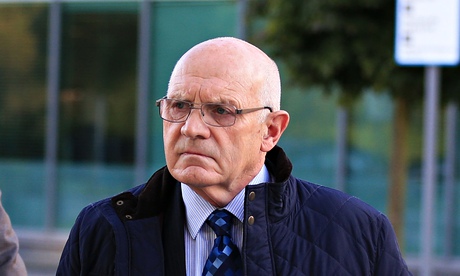
The South Yorkshire police superintendent who was in charge outside the Leppings Lane turnstiles at the 1989 FA Cup match at Hillsborough when 96 people died, has told the new inquest into the deaths that he did not make any decisions of his own to manage the crowd that day.
Roger Marshall, questioned by Paul Greaney QC, representing the Police Federation, agreed that he had supported the decisions of two more junior officers – which was first to close Leppings Lane to traffic, then, once the police had lost control of the crowd, to request the opening of a large exit gate.
“I do have to ask you, in these circumstances,” Greaney asked Marshall, “whether you made any decisions of your own that day in relation to the management of the crowd?”
Marshall, who is now retired, replied: “In terms of saying, ‘do this, do that, do the other’, the answer is probably no.”
The inquest is taking place at Birchwood park, Warrington, before the appeal court judge Lord Justice Goldring, who is also in the role of coroner.
In court Marshall explained that he was “a visible presence” in the crowd of Liverpool supporters attending the semi-final against Nottingham Forest, and that he trusted he had “a good team” of police officers around him.
He said he had been overwhelmed by the noise of the crowd at Leppings Lane, when congestion developed outside seven turnstiles through which 10,100 Liverpool supporters had to enter the Hillsborough ground. The police radios were not working, Marshall said, and he could not give orders “other than by waving your hands about”.
When the time came for the “crucial decision,” to open the exit gate and allow large numbers of Liverpool supporters to enter and alleviate the crush outside, he “did not hesitate”, Marshall said of his actions.
Greaney suggested that the request to open the gate was an endorsement of the advice of another officer, Bob Purdy, an inspector.
“Do you think you should have been making your own decisions about what to do, and giving instructions?” Greaney asked.
“Well,” Marshall responded, “the opportunity was very, very, limited. I just feel that I was doing my best, as were all the other officers.”
Goldring intervened when Marshall said under questioning, as he had throughout his previous three days of evidence, that he was not going to criticise David Duckenfield, the chief superintendent and officer in command at Hillsborough, or other senior police.
“It isn’t a question of whether you want to,” Goldring told Marshall, “it is about answering the question.”
After that, Marshall did accept that “with the benefit of hindsight, it was probably not the best practice” of Duckenfield to have stayed in the police control room at Hillsborough throughout the crowd’s build up.
Brian Mole, a chief superintendent and experienced commander at football matches, who was moved from the division responsible for the Hillsborough stadium, in Sheffield, to Barnsley 19 days before the semi-final, used to leave the control room and walk round the ground, Marshall confirmed. He said that Mole had been “extremely capable,” and “a good deal more experienced than Mr Duckenfield”.
In relation to the opening of the exit gate, and the police failure to meet incoming fans and direct them away from the tunnel leading to the overcrowded central pens of the terrace, Greaney said to Marshall: “If Mr Mole had made the decision to open gate C, he wouldn’t have done so without deciding he was going to manage the consequences?”
“I think so, yes,” Marshall replied.
Marshall had previously told the inquest that he regretted having not asked for police to meet fans let through the exit gate. Most did go through the tunnel leading to the terrace pens, and that is where the terrible crush happened, which led to deaths of 96 Liverpool supporters.
“That was the critical failure wasn’t it, Mr Marshall?” Greaney asked, referring to the failure to direct fans away from the tunnel.
“Yes, I will accept that, absolutely,” Marshall said.
“But at the end of the day they [Duckenfield and Bernard Murray, a superintendent, in the control room] are the ones who should have been making those decisions?”
“Yes,” Marshall said.
He told Greaney that he had not been given a single day’s training in crowd safety during his police career and before that 1989 football match which attracted a crowd of 54,000. Asked if this was a disgrace, Marshall said they had training relevant to their needs, which was mainly to do with policing disorder and industrial disputes, including the miners’ strike.
“The South Yorkshire police was a jolly good force,” Marshall said.
Asked by Greaney if he was prepared to agree it was unacceptable for senior officers to have had no such training, when he was responsible for the safety of thousands of people arriving at the Leppings Lane end of Hillsborough, Marshall replied: “Yes.”
Later, he said that health and safety practices did not have the emphasis in the 1980s that they did now, that the focus of the force was on the investigation and suppression of crime, and that the training at South Yorkshire police was in step with that of other forces.
Finally questioned by his own QC, John Beggs, Marshall accepted that he had responsibility, which he profoundly regretted, for not asking that the match kick-off be delayed when the crowd congestion built up at the turnstiles, and for not asking for fans to be met inside the ground when the gate was opened.
He also acknowledged “deficiencies” in the police planning for the match, including a failure to make clear in the written operational order that the central pens had to be carefully monitored by police, and that the central tunnel was to “be closed if appropriate”.
Marshall also agreed that there was “a natural bottleneck” at the Leppings Lane, an insufficiency of turnstiles, and that the signage was poor.
He agreed with Beggs, however, that a significant and influential minority of Liverpool fans had drunk a lot of alcohol, from early that morning, that approximately 200 people had no tickets which made the congestion worse, and that many arrived late.
Marshall said that when the crowd became congested, supporters still arriving at the back continued to push when they could have withdrawn, that they did not exercise self-discipline and did not co-operate with instructions given by him and other police to stop pushing.
Beggs suggested to Marshall that while he had accepted his responsibility relating to the disaster, his position was that there were many causes to the disaster, including the role of the supporters.
“Some of the Liverpool fans have a responsibility for what occurred, the situation which arose?” Beggs asked.
Marshall agreed. “Because it is the truth, isn’t it?” Beggs said. “It is,” Marshall said.
“But have you ever seen any such responsibility accepted?” Marshall replied: “No sir, no.”
Approximately 100 family members whose relatives were killed in the Hillsborough crush were in the courtroom, listening in silence as Marshall gave evidence.
Geoffrey Moody, a Chelsea supporter who went to the semi-final at Hillsborough with two friends who were Liverpool fans and survived the terrible crush in “pen” 3, giving evidence after Marshall, told the inquest that he arrived at between 2:20pm to 2:25pm.
This was not late, he said, it was ample time to move 50 yards inside the ground. However, he and his friends arrived to find the severe congestion outside. There was no “aggressive pushing” by fans outside, he said, but bunching and shuffling.
Pete Weatherby QC, representing 22 families whose relatives were killed, asked Moody if the crowd outside was moving “in just the sort of way that you would expect, in any congestion outside any football match where congestion occurs?”
Moody agreed: “Or any kind of stadium, really.”
In his original statement to Lord Justice Taylor’s official inquiry, Moody had described the organisation at the match as a disgrace. He told the inquest he was referring to the fact he saw no police or stewards outside the ground, then nobody inside directing supporters to side pens where there was plenty of room.
“All we could see was the runnel in front of us, which we all assumed would be the only entry point to the stadium,” Moody said.
He entered “pen” 3, which he said was “very, very full”. He said he suffered pain of a severity “nine out of ten”, and he and other supporters were screaming at police officers, five or six feet away, to open the gate in the perimeter fence. The officers told them to “push back”, Moody said, which was impossible. Eventually he fell unconscious, and when he came to, he found himself on the pitch.
On the pitch, Moody said, the people giving first aid were “mostly other fans, doing their best”, including trying to resuscitate severely injured people. He said he did not see “any organised first aid response taking place”.
The inquest continues.