A teenager who died at Hillsborough in 1989 was still alive at about 3.30pm without having had expert medical attention, the new inquests into the disaster have heard.
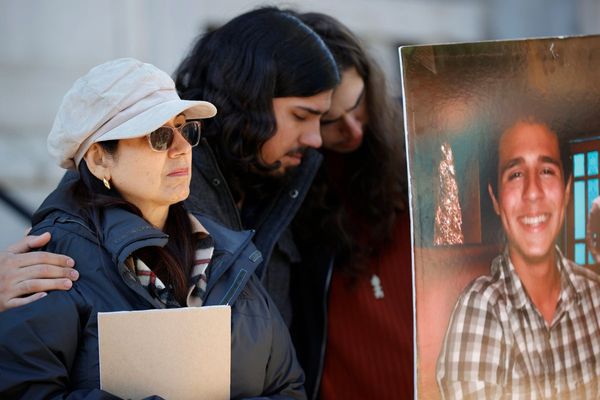
Kevin Williams, 15, whose mother Anne Williams campaigned against the 3.15pm “cutoff” imposed at the first inquests in 1990-91 beyond which no evidence was heard, was described as having a weak pulse at about 3.32pm. Anne Williams died in 2013 before she could see the new inquests start in Warrington.
Expert medical witnesses told the new inquests they did not consider “plausible” the evidence of former special constable Debra Martin, who has said Kevin Williams had a pulse at about 4pm, opened his eyes and said “Mum” before he died in the Hillsborough gymnasium.

Martin told the inquests, which began last year, in October that she stood by her evidence. She said she later felt that she had to sign a statement giving a different version of events, which was substantially drafted by West Midlands police officer Julie Appleton. Also appearing at the inquests, Appleton denied that, and insisted she had not put pressure on Martin to change her account.
Dr Jasmeet Soar, an intensive care specialist, told the inquests the evidence of an off-duty Merseyside police officer, Derek Bruder – who said he saw Kevin’s head move, then felt a pulse in his neck at 3.32pm – was plausible. Bruder, who was at Hillsborough supporting Liverpool in the FA Cup semi-final against Nottingham Forest, said that from his seat in the north stand he saw Williams lying on the pitch and clearly saw his head “twitch”.
Bruder clambered down through the seats to help the teenager and said that when he arrived on the pitch he saw his head twitch again. He reached Kevin at approximately 3.32pm and said he was certain that he felt a faint pulse, after which Bruder began to give him mouth-to-mouth resuscitation, with an experienced St John’s Ambulance volunteer, John Towler, giving chest compressions.
However, after 10-15 minutes of “exemplary” efforts to revive Kevin, they found they could not succeed, and another doctor examined the boy and told them he was dead.
Soar said he believed Kevin was dead at 3.45pm and he was then taken to the gymnasium. He added that it was not plausible for him to have regained consciousness sufficiently to speak and declined again after that.
After discussing Martin’s evidence with Prof Jerry Nolan, the inquests’ other medical expert on intensive care, Soar said: “We don’t think it is plausible [for Kevin] to be deeply unconscious for that duration, and then to retrieve an adequate level of breathing and oxygen level and blood pressure for the brain to then regain adequate consciousness, to then say a single word, and for that process to reverse again. So we don’t have a medical explanation for that.”
Kevin’s head movements seen by Bruder, Soar said, suggested either that the teenager had just gone into or was about to go into cardiac arrest at that time. While it is difficult to feel a pulse and Bruder could have been mistaken about that, Soar said, it was “plausible” that Kevin did have a weak heartbeat then.
Dr Nat Cary, a pathologist, said severe neck injuries, including bone and thyroid cartilage fractures, were evidence the teenager’s face had been “pressed up against an immovable object”.
Another of the 96 victims, Stephen Copoc, 20, died despite “vigorous” CPR attempted by two South Yorkshire police officers, the inquests heard. Soar said it was most likely that Copoc – a council gardener in Liverpool – was dead after he was brought out of the crush on the Leppings Lane terrace sometime before 3.29pm, when the officers tried to resuscitate him. Copoc had bruises on his arms that were consistent with being gripped by somebody else, the medical experts said.

Nick Brown, representing Copoc’s family, asked Soar: “If Stephen hadn’t been in respiratory arrest or in cardiac arrest [while still in the crush on the terrace], and he’d received immediate, appropriate, sustained life support, it is possible he could have survived, if he’d received that treatment?” Soar replied: “Yes, that is a possibility.”
Earlier, a retired former South Yorkshire police constable, Raymond Boocock, told the inquests that at the semi-final the previous year, 1988, he had closed the tunnel leading to the central “pens” of the Leppings Lane terrace. Boocock told the jury that he saw the pens were “practically full”, so he closed the doors at the entrance to the tunnel and stood in front of it, directing supporters to the side pens, where there was room. Boocock said he did this of his own accord, and it was “common sense”.
The jury has already heard that in 1989, a large exit gate, was ordered by the match commander, Ch Supt David Duckenfield, to be opened to allow large numbers of Liverpool supporters in and relieve a crush outside the ground. The tunnel was not closed off and the incoming supporters went into the central pens, where the lethal crush happened.
Two other officers have given evidence that there was an order in 1988 to close the tunnel when the pens were full, and two Liverpool supporters have given evidence that there was a line of five or six officers blocking access to it. Boocock, himself a Liverpool supporter, insisted that he had done so alone, on his own initiative: “I was an officer of 20 years’ experience by then,” he said. “You know, I’d been to a few matches and looked after the fans. That’s what we were there for.”
The inquests continue.