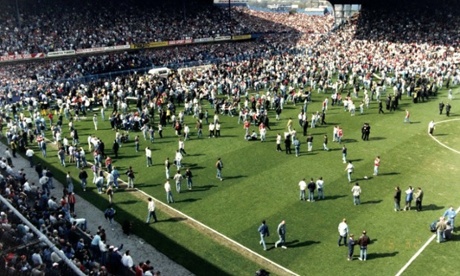
A 26-year-old man who died in the 1989 Hillsborough disaster was checked for signs of life and underwent resuscitation efforts for just one minute and 10 seconds before being carried away up the pitch, an inquest has heard.
One of those who carried Andrew Brookes – on an advertising hoarding being used as a makeshift stretcher – said he did not appear to be dead at that time, and he was shocked years later to discover Brookes was one of the 96 people who died.
The court in Warrington was told that Brookes, who lived in Bromsgrove, Worcestershire, and worked for Land Rover at the company’s Longbridge plant, had gone to support Liverpool at the FA Cup semi-final against Nottingham Forest with four friends.
One friend, Mark Richards, said they entered the Hillsborough ground through the turnstiles at the Leppings Lane end, then went down the tunnel facing them and into pen three of the terrace, behind the goal where they liked to stand, at around 2.55pm.
Richards said the pair were split up by a surge in the crowd, and the last time he saw Brookes he was “in a good mood and in good spirits”.
Photographs shown on the screens in the courtroom picked out Andrew Brookes in the crowd, standing near the front of pen three where the lethal crush took place, at 3:08pm.
He was then shown on BBC footage being pulled out of the pen by a line of police officers and laid on the grass, in scenes described as “chaotic,” with several other supporters also lying prone on the pitch.
An ambulance officer, Leslie Worrall, told the inquests he could not recall that he attended to Andrew, but BBC film showed him doing so, with an airbag used to inflate the lungs, while a police officer performed chest compressions.
Worrall told the inquests that his paramedic training made it second nature to check a patient for a pulse or signs of breathing, so said he must have done so.
Questioned by Michael Mansfied QC, representing Brookes’s sister Louise Brookes, Worrall accepted that the footage showed he attended Andrew for just one minute, 10 seconds.
“That’s not very long, is it?” Mansfield asked.
“It’s not very long, no,” Worrall replied.
“The situation was fairly chaotic and lots of people walking about; [the disaster has] just happened,” Mansfield said. “In those circumstances, it is quite difficult to perhaps determine signs of life that are very faint, would you agree?”
“It is difficult,” Worral agreed, “but obviously you feel for the pulse. If there is not a pulse, there isn’t a pulse.” On Brookes, Worrall said, there was not a pulse.
Brookes was then picked up and carried on a hoarding up the pitch by two police officers and four Liverpool supporters, one of whom, Graeme Fairchild, had his left arm in a sling.
In a statement read to the jury by Christina Lambert QC, for the coroner, Sir John Goldring, Fairchild said he had been worried he would drop the hoarding, but was trying to do all he could to help. He said that Brookes was not wearing any shoes, his trousers were down around his ankles, and he appeared to have wet himself, because his underpants were wet.
Fairchild said Brookes did not look dead “whatsoever” at that stage, because his eyes were not open and his face not blue as other people’s were. Fairchild said he was shocked to discover, in 2012, that he was one of those who had died.
Brian Johnston, another Liverpool supporter who helped to carry the hoarding, said they put Brookes down near the far, Kop end of the pitch, because somebody had shouted that Brookes had stopped breathing.
Johnston, who had had some basic first aid training at his work, then began trying to resuscitate him, with Peter Walton, a sergeant in the South Yorkshire police, and two supporters – Stephen Gavin and Richard Anderson.
Johnston told the court he believed Brookes was not dead then, because his face had not turned pale, and he still had some colour in his cheeks. As they worked on him, Johnston said he saw Brookes’s chest rise in between compressions, and he believed they had achieved some response, that he was breathing.
Both Johnston and Anderson recalled a doctor, identified as Ian Loch, who had gone to the match as a spectator, then approaching them, kneeling down alongside Brookes “for a matter of seconds,” Johnston said, and telling them words to the effect of: “You’ve done all you can, he’s gone.”
Johnston said he did not see the doctor doing anything when he had knelt down, and said he swore at the doctor, telling him not to be “stupid”.
Anderson, who in April 1989 had just left the army where he had had some first aid training, said he punched the turf in frustration, because he had helped Brookes in the belief he could be saved.
Explaining his reaction, he said it was “helplessness. Not being able to do anything for Andrew”.
Walton, giving evidence, said he disagreed with Johnston’s belief that Andrew was alive when they were working on him, telling the inquests he believed Brookes’s face was discoloured, purplish, by then. He recalled Dr Loch examining Brooks twice before telling them he was dead; Stephen Gavin recalled Dr Loch checking for a pulse in Brookes’s groin. Walton said he remembered Anderson striking the ground in frustration:
“There were one or two angry fans, because they’d put the effort in,” Walton told the court, “and they were sad to lose him”.
Johnston said he put his sweatshirt over Andrew’s face, “for dignity,” before taking him into the gymnasium, which South Yorkshire police were using to keep all the dead bodies.
His sweatshirt was then returned to him and then, in police footage of the scene in the gymnasium, the court was told Brookes is seen with a black bin bag over his face. Lambert said it is not known “when or by whom the bin liner was placed over Brookes’s face”.
One of the friends with whom Brookes had gone to the match, John Harris, was directed to the gymnasium after spending hours looking for him, and there he identified his dead body at 10.55pm.
Brookes’s father, George Brookes, drove up to Sheffield, arriving at Hillsborough just after 1am, and was shown polaroid photographs of the dead people in the gymnasium, but could not pick Andrew out. He was later told that Harris had identified him.
Louise Brookes, who lived at home at the time with Andrew and their parents, George and Gillian, described her brother as “the apple of my mum’s eye”. During the first session in the courtroom, Louise left two seats empty next to her, in memory of her parents who have both since died.
The inquests continue.