Our news wrap of the day/evening/night’s events is here. Thanks for reading.
Clinton hearing over after marathon 11 hours
- After the hearing was adjourned, Clinton hugged reps. Cummings and Schiff, who had both at times vigorously defended her.
- The hearing will not move the needle much for hardline Republicans, who will feel that Clinton’s insistence that no classified emails were sent to her server especially was a lie - potentially their ‘gotcha’ moment
- But overall Clinton held firm agains questioning that looked increasingly partisan as the hours ticked by and tempers frayed.
And we're done.
Gowdy thanks Clinton for her patience and adjourns the meeting - after more than 11 hours of questioning.
Gowdy pushing for a source for Clinton’s “90-95 percent” figure.
“That is a fair question,” says Clinton. “I’m not at the state department any more, but I do want to defend them. ... They don’t have the resources, they don’t have the personnel.”
“I think they’re doing the best they can.”
The end is near!
Two more observations, Gowdy says.
First, he says she’s diferrent when talking to the people than when talking to the court about emails.
“The clock is ticking,” says Clinton. Laughter in the room
Another interjection from rep. Sanchez about how much longer this is going to take. “The fewer the interruptions, the longer [it will take],” Gowdy says.
Rep. Earl Blumenauer (D-OR) has no seat, standing behind HRC for an hour so far pic.twitter.com/9rMtKHConO
— Luke Russert (@LukeRussert) October 23, 2015
Gowdy now questioning Clinton’s assertion that 90-95 percent of her emails were on the state department server. “The inspector general’s report said that less than one percent of emails were captured.”
“I can only talk about my emails,” Clinton says.
Clinton has had enough
“I really dont care what you say about me, I don’t care a bit,” Clinton snaps, after an angry line of questioning by an increasingly sweat-shined Gowdy. “I care what you’re saying about Admiral Mullen.”
Closing in on 11 hours #benghazihearings pic.twitter.com/BdodiwCGJ9
— Luke Russert (@LukeRussert) October 23, 2015
Just for fun, imagine George W. Bush testifying for 10 hours about *anything.*
— Jamison Foser (@jamisonfoser) October 23, 2015
Asked if she’d like a short break, Clinton says “no.”
Clinton starts coughing. She’s been talking for getting on for 12 hours. “I need a lozenge.”
“Parliamentary enquiry - how late are we going tonight?” asks rep. Sanchez.
No answer.
The scene in the room right now.
#11thHour pic.twitter.com/wgJYuCD6Fc
— Tim Mak (@timkmak) October 23, 2015
If you had told the Clinton campaign earlier this week how good Wednesday/Thursday would be for her, they wouldn't have believed you
— John Bresnahan (@BresPolitico) October 23, 2015
Politically speaking, over the last week Clinton has broken the back of Sanders, Webb, Biden, and the Benghazi committee.
— Ryan Lizza (@RyanLizza) October 23, 2015
“When the attack began, did you know how the night would play out,” asks Pompeo, a little obtusely.
10+ hours in. Shit is getting weird y'all. pic.twitter.com/xnoxB7Tzkk
— Jennifer Bendery (@jbendery) October 23, 2015
Clinton now answering rep. Pompeo’s questions almost monosyllabically.
This hearing is starting to look like it might be a disaster for the Republicans, rather than for Clinton.
#Benghazi chair Gowdy: It's worth any amount of political badgering to learn more about these four dead Americans
— Chad Pergram (@ChadPergram) October 23, 2015
If you play hour 8 of the Benghazi hearing alongside “Dark Side of the Moon” it syncs up perfectly
— daveweigel (@daveweigel) October 23, 2015
Hour 10. Trey Gowdy is insisting, yes, I wanted this job. pic.twitter.com/OhdilYJAfM
— Jennifer Bendery (@jbendery) October 23, 2015
Clinton looks deeply moved as she answers.
It is deeply unfortunate that anything as serious as what happened in Benghazi could ever be used for partisan political purposes, and I’m hoping that we can move forward together, start listening to each other, and I appreciate greatly what you said, ranking member Cummings.
Schiff and Cummings berates the Republicans on the committee
“Everyone on the podium is hoping they’re the one that has the ‘gotcha’,” says Schiff. “I think they’ll rue the day that they did this.”
Cummings next. And wow, he’s angry:
When I listened to [the other witnesses] talk about that night, all of them were brought to tears. And I remember saying to myself, if you can create a culture in an organisation where people in talking about their boss, and how she reacted, and what they felt, it brought them to tears, it says a lot.
It bothers me when I hear people even imply that you didnt care about your people. That’s not right. Then I sit here and watch you. ... And I just for one want to thank you, and I appreciate what you’ve done.
You’re right, it’s easy to sit here under these lights and monday morning quarterback about what should have been done. You’ve laid it out.
I don’t know what we want. Do we want to badger you over and over until you’re tired and we get that gotcha moment? We’re better than that.
You can comment if you like, I just had to get that off my chest.
There is Applause in the room.
“Back to the Future” somehow failed to predict the hours-long Benghazi hearing.
— Matthew Keys (@MatthewKeysLive) October 23, 2015
“As for your emails, I feel like channelling Bernie Sanders - but I’m no Larry David,” says Schiff.
"We stay here much longer you're going to have to take that 3am phone call from the committee room." - Adam Schiff has got jokes.
— Sabrina Siddiqui (@SabrinaSiddiqui) October 23, 2015
Rep. Sanchez is going for Gowdy for letting Westmoreland go over time. Schiff then takes up the refrain. “I’m exhausted. Your testimony now has gone on longer than all the other hearings that we have held, combined. But in the interests of full disclosure, we haven’t done much.”
Updated
Clinton points out that John Kerry is actually the first secretary of state to rely primarily on a government server.
Westmoreland’s response: “it just doesn’t smell right.
If your drinking game word was "Blumenthal," you've been unconscious for five hours.
— Karen Tumulty (@ktumulty) October 22, 2015
The longer this goes on for - and we are entering the tenth hour of questioning - the more of a political win this is likely to be for Clinton. She has kept her cool, and refused to be drawn; the Republicans on the committee, by contrast, have looked shrill, hectoring, and like they are trying to score political points.
If #Hillary can endure this it's hard to argue she doesn't have what it takes to deal with, say, Vlad the Impaler or the Freedom Caucus.
— Howard Fineman (@howardfineman) October 22, 2015
Jordan pushed Clinton hard on emails and couldn't yield any new details – let alone a strong emotional reaction – frmo her.
— Jennifer Epstein (@jeneps) October 22, 2015
Some outstanding multitasking going on from rep. Westmoreland:
HAPPENING NOW: I'm questioning Secretary Clinton at the @HouseBenghazi hearing.
— Lynn Westmoreland (@RepWestmoreland) October 22, 2015
Rep. Westmoreland says he cares more about the server than the server than the emails.
Updated
WHERE IS THIS GOING? WHERE ARE WE? WHY ARE WE DOING THIS?
— Christopher Hayes (@chrislhayes) October 22, 2015
Jim Jordan making a lot of hay over the fact that Clinton said she was “the most transparent person ever.”
2:50am in Riyadh. CNNi still broadcasting the Clinton hearing on Benghazi.
— Ahmed Al Omran (@ahmed) October 22, 2015
Remind me what Bernie Sanders said about Clinton’s emails. pic.twitter.com/ilUUD1JF1m
— Jim Roberts (@nycjim) October 22, 2015
.@jim_jordan always starts slowly during questioning, then works up to kinda emotional. He's a master at that that.
— John Bresnahan (@BresPolitico) October 22, 2015
.@Jim_Jordan scores points on Clinton emails, her "transparency," and her "revised" statements on classified emails. Clinton's answer weak
— John Bresnahan (@BresPolitico) October 22, 2015
Jim Jordan wants to know how they decided which emails were personal. Did they use search terms or personal?
All of the above, Clinton responds.
“What were the search terms?” Asks Jordan. Clinton says she didn’t get involved in the search. “You don’t know?” says Jordan in disbelief.
Jim Jordan and Adam Smith almost get into a fight when Jordan asks about emails. Gowdy shuts it down because we can't have nice things.
— Sabrina Siddiqui (@SabrinaSiddiqui) October 22, 2015
And Blumenthal.
Jim Jordan’s back at the plate. He’s trying to get the conversation back to emails.
Outside GOP cloakroom tonight, many Rs subdued as they discussed #BenghaziCommittee. No celebrating. Priv say Clinton formidable.
— Robert Costa (@costareports) October 22, 2015
Strong moment for Clinton, talking about when she met one of the agents injured in the attack. Her voice is emotional - she speaks stop-start.
The agent who was in hospital all those months, he came over to me and said ‘can you do everything you can do to get me back out in the field ... he was determined to go back. To protect our diplomats, to protect you when you travel. I was struck then as I was before by [their] quality, integrity, and courage.
I care deeply about each and every one of them.
Btw, how about Rep. Sheila Jackson Lee? Always on the aisle for SOTU & she makes sure she's in the HRC background for ALL of hearing. #TV
— Luke Russert (@LukeRussert) October 22, 2015
“We’ve been here for nine and a half hours and the questions are increasingly badgering - I could say increasingly vicious,” says rep. Smith. He has some critical things to say about the Republicans on the committee.
“We’re looking to learn things that might help us prevent further attacks, but it looks like they’re just looking to wear you down. I’m curious if they’re interested in just continuing to badger the witness,” he continues. “I dont think its fair.”
Clinton says Roby’s characterisation of the narrative is part of “a theory you and your colleagues are trying to weave.”
Roby now pressing Clinton as to whether she spoke to the survivors. Clinton says yes - “it was a roving series of conversations.”
“Everybody was doing everything they could do,” Clinton says, sounding more and more exasperated.
Roby: "You were alone?" Clinton: "The whole night?" Rob: "Yes, the whole night." Clinton: Laughs her head off.
— John Bresnahan (@BresPolitico) October 22, 2015
In simultaneous Capitol Hill news, Paul Ryan has announced his run for speaker. You can read my colleague Ben Jacobs’ story about it here.
“I want to begin by apologising for my Republican colleagues who want to testify for you because it fits in better with their outlandish narratives,” rep. Sanchez says.
Updated
“I find it deeply saddening, because obviously everyone who knew him, everyone who worked with him - including Libyans - would have given anything to prevent this from happening.”
“I am very well aware of the dangers faced by our diplomats and our development officials,” Clinton says, firmly. “There was never a recommendation from Ambassador Stevens to close the facility.”
“It’s easy to sit here in this lovely warm hearing room and say, we should have,” she continues.
“Did you ever personally speak to Ambassador Stevens after you swore him in in May?”
“Yes, I believe I did,” Clinton said. Says she “cannot recall” exactly when.
“I appreciate the passion and depth of your feeling,” Clinton says. “But we have embassies in warzones. We have places being attacked all the time.”
“And you’re their boss,” Brooks says, almost overcome with emotion.
“Yes,” says Clinton.
“It is obvious that a waiver was not signed,” Brooks ploughs on. “So therefore, you did not sign a waiver. Which when most of our people who are stationed in such dangerous places...”
Susan Brooks asks if Clinton is aware that congress passed an act after the Nairobi embassy bombing specifying that only the secretary of state could sign waivers on security. “Was a waiver signed in Benghazi after the temporary mission compound was authorized?”
“I think that the CIA annexe I had no responsibility for,” Clinton says. Says she cannot speak for that. “The compound in Benghazi was neither an embassy nor a consulate. Those are the only two facilities for which we would obtain a formal diplomatic notification; and those are the only facilities that we would have sought a waiver for.”
“From this time forward, do ambassadors have to call you to get help from other agencies?” asks Duckworth.
“No,” says Clinton, “and there was an understanding between the embassy and the CIA annexe. They immediately notified the CIA annexe and they immediately tried to come to the assistance of the people in the compound.”
“I think that DoD is trying hard to think about, especially in North Africa and the Middle East, they can respond,” Clinton says. “One of the claims that was made - that was proved to be untrue - was that they withheld air support. Indeed, air support was later shown to be too far away.”
Tammy Duckworth asks whether Clinton had any difficulties in coordinating with DoD and other departments in preparing for September 11, which could have been expected to be a dangerous day.
Clinton says that’s at the heart of what she hopes will “come out of this” - that it will be a learning experience.
US senator Brian Schatz of Hawaii has had enough.
This hearing is a hatchet job. Hillary Clinton is clearly the most qualified candidate to be President. Just a command performance.
— Brian Schatz (@brianschatz) October 22, 2015
Peter Roskam is now testifying on Clinton’s behalf, speaking in her voice: “He kept faith with the State Department even when we did not keep faith with him. ... would you say that’s accurate?”
“Of course I would not say that” says Clinton testily.
“You had two ambassadors who requested [extra security],” Pete Roskam says. “Here’s what happened to those requests.” He takes his papers, and rips them in half.
Peter Roskam up next. He says he has a theory he’s developed. “That you initiated a policy to put the US into Libya, and overcame a numb of obstacles and were successful in doing that. Ultimately the decison was the president’s, but you were the prime mover.”
But then I think something happened. My theory is that after Gaddafi’s death, then I think your interest waned, and I think your attention waned.
He says then storm clouds were gathering. “If Libya unravelled, then you had a lot to lose ... if it went the wrong direction, it would be on you. So the question is, how is it possible that these urgent requests when they came in, how did they not break through to your inner circle?”
“I absolutely did not forget about Libya after Gaddafi fell,” Clinton answers.
Updated
And we’re back.
“Democrats say this is a witch hunt. Now I’m not calling her a witch, but the person they’re supposedly hunting for is right there, so it’s a bit weird to call it a witch hunt,” says another caller to C-SPAN.
A caller just asked on C-Span why there “isn’t a White caucus in congress.”
Twice the Gowdy; twice the Clinton.
For all you superfans out there, CSPAN-2 is re-airing the Benghazi testimony in its entirely at 8 pm
— Katherine Krueger (@kath_krueger) October 22, 2015
Seven hours and counting.
Everyone’s whining about it, but I think Peter Jackson is doing a great job directing the Benghazi hearings.
— daveweigel (@daveweigel) October 22, 2015
In most polls of likely voters, he doesn't crack their top five most important TNR writers from the 1980s https://t.co/brWJE1kt39
— Ben Jacobs (@Bencjacobs) October 22, 2015
Donald Trump reacts to Benghazi hearing on @hughhewitt show: “Maybe Biden did the wrong thing getting out yesterday.”
— Jenna Johnson (@wpjenna) October 22, 2015
Thinkprogress has made a video collecting “mansplaining” moments from the hearing so far.
The hearing included some rather patronizing moments from male committee members who scolded Clinton for not answering their questions in a “yes” or “no” fashion and obsessively asked her if she needed to pause and read notes from staff members.
The meme potential here. #BenghaziCommittee pic.twitter.com/bgBghzQULg
— Andrew Katz (@katz) October 22, 2015
— Dorsey Shaw (@dorseyshaw) October 22, 2015
The hearing will go on for two and a half more hours, Cummings just told CNN.
“There is no contradiction,” Clinton says.
“How about this. ‘No planned attack’ – ‘pre-planned attack’,” Jordan says, holding up the talking points for when Rice went on the Sunday shows.
Ten-minute break now.
Updated
Clinton wouldn't tell reporters how she thinks the hearing's going, but her expressions suggest probably pretty good pic.twitter.com/gsg4SoDMGG
— Liz Kreutz (@ABCLiz) October 22, 2015
“The next morning, at 9:59, I gave another statement,” Clinton says. “I’m sorry congressman. If I haven’t been clear, I will try to be clear. I was talking about people in the region ... using the fact of the video not only to arouse crowds, but also that would deter governments from coming to our rescue.”
Jim Jordan is up now. He accuses Clinton of having “raised the video,” talking about the video that was
“In our first round you said that the statement was not meant to explain the type or cause of the attack. Lets look at that statement,” Jordan says. He reads part of it:
Some have sought to justify this ... as a response to vicious material presented on the internet
Clinton responds by reading the statement in full. Jordan pressing that the above constitutes a “motive presented.” Clinton says it doesn’t.
General consensus from the Twitterati is that this movement is what best sums up today’s hearing so far:
This is an excellent GIF. pic.twitter.com/muyDeVmkJU
— Blake Hounshell (@blakehounshell) October 22, 2015
Well this is just a tremendous GIF. #BenghaziCommittee pic.twitter.com/Bnpi6rcQ43
— Dan Zak (@MrDanZak) October 22, 2015
I'm saving this to use the next time someone tries to get all up in my grill: pic.twitter.com/6ArBZZ2btN
— Julia Macfarlane (@juliamacfarlane) October 22, 2015
Mother Jones’ David Corn has a theory as to why:
Rs should have stayed away from Blumenthal/Clinton Fdn & focused on HRC's mgmt of State Dept & its security failure. #ThatsAllThereIs
— David Corn (@DavidCornDC) October 22, 2015
“No-one here has shown anything you’ve said or ambassador Rice has said that was in any way inconsistent,” says Adam Schiff, who has been speaking for about eight minutes now without asking a question.
Previous #Benghazi Cmte Hearings: 1: 2 hrs 48 mins 2: 2 hrs 36 mins 3: 2 hrs 20 mins TOTAL: 7 hrs 44 mins TODAY (-breaks): 5 hrs & counting
— Frank Thorp V (@frankthorpNBC) October 22, 2015
Worth reading this conversation between Trevor Timm and Megan Carpentier about what they call the real scandal behind the boondoggle: the fact that we were there at all.
Clinton begins to lose patience.
“I think what all of us want to know: what did you do? what decisions did you make?” Representative Westmoreland asks, exasperatedly.
“I was responsible for sending Chris Stephens to Benghazi,” Clinton says. “I was responsible for working on the policy both before and after the end of the Gaddafi regime.”
“I was responsible for quite a bit, congressman,” she adds testily. “I was not responsible for specific security requests.”
Updated
The five agents protecting the compound didn’t fire their weapons because they thought it would make the situation worse, Clinton says.
Fun: Sidney Blumenthal is watching today's committee hearing & Clinton's testimony, according to a source who spoke with Blumenthal today.
— Dan Merica (@danmericaCNN) October 22, 2015
“I’ve tried to be nice,” says rep. Westmoreland. “Let’s give each other some space.”
He brings up a briefing from Vicky Nuland at State which said that the Libyan militia did not turn up on the night of the attack. Says Nuland describes the US security force as “robust.”
“Would you call five DS officers robust?” he asks.
“What would you have done different,” Westmoreland asks.
“Well, I’m trying to tell you,” Clinton snaps. “There are many issues we need to address. That’s why I’m here, to continue to honor those we lost. ... there are many elements that go into that.”
She points at contractors; the unarmed militia that they had from Libya. “I think we should ask host countries [for more].”
It might also have made a difference if they’d had more help from the CIA, she adds.
Clinton is now talking about the attacks in Paris. “It’s important that you look at the totality,” she says.
“Let me return to my time,” says rep. Westmoreland.
This has certainly not been the bloodbath Republicans hoping for campaign ammunition had hoped. From our bureau chief Dan Roberts:
this is now just creating clips for the next Clinton campaign ad. I imagine some Republicans are wishing Trey Gowdy would wrap it up.
— Dan Roberts (@RobertsDan) October 22, 2015
Worth noting that the 2014 Armed Services Committee also found that there had been no stand down order.
There was no “stand down” order issued to U.S. military personnel in Tripoli who sought to join the fight in Benghazi.
But it continued:
However, because official reviews after the attack were not sufficiently comprehensive, there was confusion about the roles and responsibilities of these individuals.
Clinton says she did not send a stand down order
“Of course not.”
Updated
Rep. Cummings is speaking out about the politicisation of this committee.
“The idea that you would intentionally take steps to not send [military help] to personnel in Benghazi is simply beyond the pale,” he says, after playing a video from Darrell Issa.
“I think I’ve been pretty well satiated that given where the troops were, how quickly the thing all happened and how quickly it dissipated, we probably couldn’t have done more,” he says.
“I sincerely hope this puts this offensive claim once and for all,” Cummings continues. “I’m asking you madam secretary: did you order defense secretary Leon Panetta to stand down?”
“Of course not,” Clinton replies.
Updated
Former White House adviser David Axelrod is amused by the time spent today on Sidney Blumenthal:
Ironic that career kibitzer and conspiratorialist Sidney Blumenthal should be elevated to epic heights in GOP Benghazi conspiracy theory.
— David Axelrod (@davidaxelrod) October 22, 2015
Updated
“Violence goes up and goes down,” Clinton says. Says the ultimate responsibility to close diplomatic missions is something she took very seriously - “but there was no recommendation to do so.”
Rep Martha Roby asks about a memo in which Clinton described the situation in Libya as “a mess”.
Asks whether the references she makes to the security situation would “amount to one as highly vulnerable.”
Clinton says that the description of the situation is “something that we were aware of,” says they took monitoring very seriously. But that the kinds of assessments from which Roby is reading aren’t unusual.
Updated
Gowdy tells me: "We got more to go so I don’t like to prejudge investigations before they’re over or hearings before they are over"
— Ben Jacobs (@Bencjacobs) October 22, 2015
When asked how late things will go and whether reporters should order in dinner tonight, Gowdy jokes "maybe breakfast"
— Ben Jacobs (@Bencjacobs) October 22, 2015
Updated
Nicky Woolf here, taking over from my colleague Alan Yuhas as we head into roughly the seventh hour of Hillary Clinton’s testimony before the house select committee on Benghazi.
So far, Secretary Clinton has managed to fend off most of the attacks, and there has been a lot of partisan bickering from the committee table.
Still on break for the House to vote, a few committee members are loitering around and talking to reporters.
Jim Jordan just told me he couldn't talk because he's "working out his questions."
— Ben Jacobs (@Bencjacobs) October 22, 2015
On Clinton: "You don't have to defend her," Elijah Cummings tells @sahilkapur off House floor. "She can defend herself." #Benghazi
— Matt Laslo (@MattLaslo) October 22, 2015
Why there?
.@HillaryClinton coming clean to #BenghaziCommittee seeming abt as likely as me getting a Che Guevara tattoo on small of my back! #Benghazi
— Gov. Mike Huckabee (@GovMikeHuckabee) October 22, 2015
Updated
Taking a quick recess so the committee members can go vote pic.twitter.com/Xsiw2hgh5K
— Lauren Gambino (@LGamGam) October 22, 2015
The hearing is now almost entirely gibbering about politics. Roskam talks about “a victory lap” on Sunday morning talk shows, and reporters don’t appreciate it.
The Guardian’s DC bureau chief, Dan Roberts.
it feels like the Benghazi committee has moved on from trying to wound Clinton and is now just trying to embarrass her with email extracts.
— Dan Roberts (@RobertsDan) October 22, 2015
The New Yorker’s Ryan Lizza.
Roskam now criticizing State/HRC for successfully spinning a reporter.
— Ryan Lizza (@RyanLizza) October 22, 2015
Politico’s Glenn Thrush.
Roskam is doing a hell of a job proving this committee isn't trying to drive Clinton's poll numbers down
— Glenn Thrush (@GlennThrush) October 22, 2015
And MSNBC’s Chris Hayes.
We are currently mired in an inquisition into whether a politician had her staff try to make sure she got good press.
— Christopher Hayes (@chrislhayes) October 22, 2015
Roskam goes on about the political machinations of Clinton’s staff. “You were thinking about credit for you, isn’t that right?”
“No, it’s not,” Clinton says. “It was a very gutsy decision for the president to make, it was by means an easy call.”
She downplays her own role in the US decision to join military intervention in Libya; Roskam still hasn’t asked anything about the Benghazi attacks. He’s onto an email from Sidney Blumenthal.
“‘We came, we saw, he died.’” Republican Peter Roskam quotes Clinton to Clinton. “Is that the Clinton doctrine?”
Nope, Clinton says. That was “an expression of relief” that Muammar Gaddafi would not threaten civilians anymore.
Roskam starts talking about how “the Libya policy is your policy”, a repeat of his earlier argument that Clinton is fully responsible for US action (and inaction) in Libya. He still hasn’t asked a question, nor said the word “Benghazi”.
Democrat Tammy Duckworth has gone deep into the weeds about the types of security contractors and private guards the US employs, as it did in Libya, and the pair talk about “static” vs “more kinetic contractors”.
The security provided by contractors during the attacks “was not adequate for what we needed then or really at any time”, Clinton says.
She adds: “several of them were injured on the night of the attack, so I don’t want to cast aspersions on them.”
Similarly, Clinton says: “the Libyans there was a desire to be helpful but not a capacity.”
Duckworth then turns the questions to Congress, and Clinton says: “The Congress never fully funded the security requests that the administration sent. Following Benghazi that has improved but I think greater response would be more helpful.”
Kansan Republican Mike Pompeo is questioning Clinton about security.
She says that she accepted the recommendations and reports of the security professionals – which, based on the hearing, means State Department security officials and CIA officers.
Pompeo quotes a Senate intelligence review that found the attacks “were likely preventable”, and asks whether Clinton agrees.
“I would like to think that anything of that magnitude and the loss of life were preventable,” she says.
“There were many, many situations, many security issues that we had to deal with during the four years when I was security of state, and I did leave what I hope will be a very important position, namely the deputy for high threat posts.”
Pompeo doesn’t think an undersecretary would get as much done as the actual secretary, but Clinton says she feels good about having someone “100%” committed to security questions.
Just catching up on the Benghazi hearing? Here are three-and-a-half hours of testimony in three-and-a-half minutes:
And here’s our report on the first round of the marathon hearing – the emails, the suitcase and the secret smile – from my colleagues Dan Roberts, Lauren Gambino and Ben Jacobs in Washington:
TLDR version, according to some people in the room:
"What we've learned here," begins Rep Smith then pauses."is nothing." #BenghaziCommittee
— Lauren Gambino (@LGamGam) October 22, 2015
Updated
“We have learned substantively nothing about what happened in Benghazi” from this committee, Smith concludes, giving Clinton an opportunity to narrate what happened to the ambassador and security officers with him.
The safe room was anything but safe. I’m sure the committee members know that neither Chris Stevens nor Sean Smith died from injuries directly received by the attackers. They both died of smoke inhalation. When we have safe havens we need to have equipment that will enable people to withstand what happened in Benghazi.
The diplomatic security officer who was with the ambassador and Sean Smith endeavored to lead them to safety through a wall of black smoke. He wanted to get them through the interior of teh compound to the roof, where they would get clear of the fire and the attackers … he himself nearly died of smoke inhalation.
Rather than proceeding and saving himself which would be a human instinct, he turned back into that wall of black diesel smoke trying to find Chris and Sean. He did find Sean, and Sean had succumbed of smoke inhalation. He managed to get Sean out of the building, but could not find ambassador Chris Stevens.
One of our failures after the attack was our failure to find the ambassador. We hoped against hope that he had somehow managed to get out of the compound … Additional efforts to find his body or to find him were unsuccessful, and htey had to withdraw because of teh continuing attack on the CIA annex before we knew what happened to the ambassador.
We were desperate … we learned later that the Libyans had found the ambassador. And they had carried him back to the hospital, and Libyan doctors labored nearly two hours to rescuscitate him.
I mention all of this [to the committee and public] because this was the fog of war … and [because diplomatic security officers] did everything they could to save their lives.
Democrat Adam Smith has the mic again and is (again) railing against Republicans: “the purpose of this committee is to prosecute you.”
Despite what Republicans have said, Smith adds: “this is unquestionably that, a prosecution … it shouldn’t be a prosecution, we have the former secretary of state here. We should be genuinely trying to inquire about how we gather more information.”
“We don’t need to spend $4.6mn and 17 months to prosecute you, there will be plenty of time for that” in the coming presidential campaign, he says.
Updated
Brooks asks Clinton about security at the temporary compound in Benghazi, which the former secretary of state says was never at any point considered a consulate.
She also asks why Clinton would have conferred with the former ambassador to Libya, which the latter says because “he is also an expert” whose advice was valuable.
“We were trying very hard to get the people in positions of authority in Libya to get to work with them on everything from border security to trying to collect the weapons” of militias, she says.
Brooks follows up by asking about how could ambassador Stevens himself not know what security the Benghazi compound would get. Clinton tries to parry by talking about Stevens “great sense of humor” – she starts reading an email about “fire sale” purchases from the British – and Brooks cuts down the awkward attempt at comedy.
Those “fire sale” purchases were barricades being left behind by other embassies, Brooks says, “because we weren’t providing physical security”.
Clinton grows serious again, saying that the US did provide physical security to the compound.
“Most of us don’t know much about Libya,” Republican Susan Brooks croons to the tune of Don’t Know Much About History … or she just says it, not doing anything to keep the hearing entertained at all.
Instead she’s put up a big map of Libya and maybe lost some of the class.
These people are both fast asleep at the Benghazi hearings. pic.twitter.com/8Fk7HjOidn
— Byron Tau (@ByronTau) October 22, 2015
Clinton continues to hit her talking points on two of Republicans’ main criticisms: emails and the controversial opinions of Sidney Blumenthal.
HRC: “You didn’t need my email address to get my attention. Most of my work, as I said this morning, had nothing to do with my emails.”
— Lauren Gambino (@LGamGam) October 22, 2015
Clinton said some of Sid's emails were helpful, most of them weren't.
— Jake Tapper (@jaketapper) October 22, 2015
Meanwhile, a former ambassador has his say and a New Yorker reporter raises a reasonable question.
As ambassador in Russia, I enjoyed multiple ways to communicate with Secretary Clinton. Email was never one of them.
— Michael McFaul (@McFaul) October 22, 2015
Why would anyone want an ambassador to use Hillary's unsecured email account rather than State's secure system to contact her?
— Ryan Lizza (@RyanLizza) October 22, 2015
Gowdy persists in his argument that Blumenthal’s emails directly to the secretary of state: “How did you decide when to invoke a people and process, and who just got to come straight to you? Cause it looks like certain things got straight to your inbox and the request for security did not.”
“The secretary of state should personally review the security situation of our facilities and embassies,” Gowdy says.
Yes, personal email came to my personal account. Work related email did as well. I also relied on a number of my aides and staff members as well as a number of experienced foreign staff members and officers who were similarly engaged in receiving information and communicating.
So far as I know he did not raise any issue of security with any of those people. He raised it with those he knew it would be properly addressed. If he had raised it with me I would be telling you that.”
She says she’ll say it as often as she has to about Blumenthal, comparing him to a friend who comes up at a dinner party and offers their opinions about the world.
“Sid Blumenthal was not my adviser, official or unofficial, on Libya. He was not involved in any of the conversations [to decide policy]. On occasion I did forward what he sent me to make sure it was in the mix, so that if it was useful it could be used.”
Updated
Clinton continues giving her impression of ambassador Stevens.
“I think any ambassador … would say they handled a lot of information, some of it was about what’s happening in country, some of it was happening. And Chris felt very strongly that the United States needed to remain in and committed to Libya.”
Gowdy isn’t satisfied, saying he doesn’t understand why Stevens would have “to read and respond to an email sent by Sidney Blumenthal, it didn’t matter what city he was in, he didn’t need help messaging the violence he needed help with the violence.”
Clinton sticks to her story: “Chris Stevens had regular contact with members of my staff and he did not raise security issues.”
Chris Stevens communicated regularly with the members of my staff, he did not raise security with the members of my staff. I communicated with him on certain issues, he did not raise security with me, he raised security with security professionals. Now I know those are not the answers you want to hear but those are the facts.”
We’re back. Republican chairman Trey Gowdy has the floor, and he is already reading from Clinton’s emails.
He asks why Clinton would be reading emails from Sidney Blumenthal, her friend and declared not-adviser who sent her many memos on foreign affairs, and not from ambassador Chris Stevens, who died in the Benghazi attacks. “Help us understand how Sidney Blumenthal had that kind of access to you and the ambassador did not?”
Clinton says that Stevens “regularly” emailed with her top aide Jake Sullivan, and did not raise concerns about security with him.
“He knows where to pull the levers, where to go for information, where to register concerns, and I think he did exactly as one might have expected. He dealt with security issues by dealing with the security professionals who make the assessments.”
Amid all the drama, a few new details have emerged with actual relevance to the Benghazi attacks. Among them an email from Clinton to her daughter Chelsea, who used an email with the pseudonym “Diane Reynolds”.
This is the full, newly released email exchange from Hillary Clinton on the night of the Benghazi attack pic.twitter.com/BKiwuSi1tM
— Steven Dennis (@StevenTDennis) October 22, 2015
Summary
The hearing takes a break – here’s a quick summary of what’s happened during Hillary Clinton’s testimony to the House committee investigating the 2012 Benghazi attacks.
- Republicans interrogated Clinton on a range of subjects, not all clearly relevant to the 2012 terrorist attacks that killed four Americans, including ambassador Chris Stevens. Clinton defended herself in part by saying she only recommended policy on Libya, and that final decisions were in fact made by president Barack Obama.
- Clinton similarly parried questions about the security situation for Stevens by saying she relied on advice from diplomats and intelligence officials. “There was no credible or actionable threat known to our intelligence community at that time,” she said, adding that Stevens’ requests for increased security went through official channels and never to her directly.
- The former secretary of state also fired back at Republicans eager to cite newly released emails from her private server. Most of her meetings were on the phone or in person, she said, with some briefings “so top secret that they were brought into my room in a closed briefcase that I had immediately to read and return to the courier.” She repeated said: “I did not do the vast majority of my work from email.”
- Clinton and Republicans wrangled over the State Department’s muddled public statements after the attack and her communications with Sidney Blumenthal, a Clinton friend who sent her many apparently unsolicited emails of advice. Clinton recounted how she and the administration tried to interpret intelligence after the attack; she admitted she did not think the White House would trust Blumenthal but said he “was not my adviser”.
- Democrats defended Clinton and accused Republicans of waging a partisan campaign to undermine her poll numbers in the 2016 presidential race. “There won’t be anything definitive about the findings of this committee,” Adam Schiff said. “Those who want to believe the worst will believe the worst.”
- Republican chairman Trey Gowdy defended the purpose of the committee, saying it was “not a prosecution” and telling Clinton the investigation was not about her, she was “an important witness among half a hundred witnesses”. He said Blumenthal was relevant because he had “unfettered access” to her.
- “I’ve lost more sleep than all of you put together,” Clinton told the committee, pleading for the members to treat the Benghazi attack as Congress treated the 1980s attacks in Lebanon that killed more than 250 Americans – to fund security efforts and reform security protocols and assessments.
- The committee adjourned with rambunctious squabbling over releasing all the relevant transcripts of the investigation, after Gowdy’s questions about one of Clinton’s friends rambled past the threshold of Democrats’ patience.
Updated
Rep. Cummings shouting down Gowdy, demanding full committee transcripts be made public. HRC is all, mmmhmm gurl. pic.twitter.com/ekNhAeLZws
— Jennifer Bendery (@jbendery) October 22, 2015
Trey Gowdy and ranking Democrat Elijah Cummings are now bickering wildly, sitting right next to each other.
“Why don’t we just put the entire transcript out there and let the world see it? What do we have to hide!”
Gowdy gets defensive, asks what about all the other transcripts, rambles about parliamentary procedures, etc. His pate shines with sweat. “The only transcript you want released is this emails and Sidney Blumenthal.”
Cummings is fed up: “I’d like to have all of them released!”
Clinton watches, the hint of a smile on her face as she watches committee disintegrates out of Gowdy’s control. Gowdy threatens “if you think you’ve heard about Sidney Blumenthal, wait until the next round, and with that we’re adjourned.”
Clinton now smiling broadly as the Republicans and Democrats on the committee start squabbling about whether other hearings should be public
— Dan Roberts (@RobertsDan) October 22, 2015
Updated
Trey Gowdy, the Republican chairman, is now chasing Clinton about emails from Sidney Blumenthal, a Clinton family friend who was banned from working at the State Department from the White House, and who often sent Clinton memos about Libya and many other topics.
Gowdy asks many questions about Blumenthal, and whether Clinton listened him, about “credibility and whether to assess how credible that source is”.
“He was not advising me and I have no reason to ever mention that or to know that the president knew that,” she says.
Gowdy: "He was your most prolific emailer on Libya/Benghazi." Clinton: "He was not my adviser." #Blumenthal
— David Catanese (@davecatanese) October 22, 2015
Clinton says she told Abedin to delete attribution from Blumenthal email because she thought "more important to just look at the substance"
— Alana Goodman (@alanagoodman) October 22, 2015
“I don’t know what this line of questioning does to help us get to the bottom the deaths of four Americans,” Clinton says, getting frustrated with Gowdy.
“It’s relevant because our ambassador was asked to read and respond to Sidney Blumenthal’s drivel,” Gowdy replies.
“I think it’s fair to ask why Sidney Blumenthal had unfettered access to you … and why there was no access between you and the ambassador.”
Updated
‘I’ve lost more sleep than all of you put together’
— Howard Mortman (@HowardMortman) October 22, 2015
Republican chairman Trey Gowdy asks her whether she has anything she wants to say about losing a friend, Chris Stevens, in the attack.
“I’ve lost more sleep than all of you put together,” she says. “I have been wracking my brain for what more could have been done, or should have been one. When I took responsibility I took it as a challenge and as an obligation to make sure that when I left the State Department [we reformed measures].”
“I would like to get back to that time” of bipartisan concord, Clinton continues.
People rose above politics, a Democratic Congress worked with a Republican administration to say what have we learned. Similarly when we lost more Americans, the bombings in east Africa, again, the Republicans and Democrats worked together.
So again, I’m an optimist, congressman, I’m hoping that that will be the outcome of this and the effort so that we really do honor the effort, not only of those we lost but those who are serving as we speak.”
Gowdy gets upset. He insists nobody has made any conclusions about anything, that “this is not a prosecution, this is an investigation,” and there’s nothing – never mind this Republican shouting at a Democrat – partisan about it.
Gowdy, shouting at Schiff: “There are 20 more witnesses.”
— Eric Bradner (@ericbradner) October 22, 2015
Updated
Democrat Adam Schiff is running down a list of facts that dismantle some Republican talking points, but he is doing so in a monotone that must surely have knocked out any reporters who were clinging to consciousness in the room.
“One thing I think we can tell already is there will be nothing final” about this committee, Schiff says, especially “when we don’t know what we’re looking for.
“There won’t be anything definitive about the findings of this committee,” he says. “Those who want to believe the worst will believe the worst.”
“We were not making up the intelligence, we were trying to get it, make sense of it, and then share it,” Clinton replies, explaining that they had received the intelligence about a militant group claiming
“I’m sorry that it doesn’t fit your narrative, congressman, I can only tell you what the facts were … I think the intelligence community did the best job they could and we all did the best we could to then share that with the American people.”
After a bout of finger wagging and yelling from Rep Jordan, HRC trolls back: “I wrote a whole chapter about this in my book Hard Choices”
— Dan Roberts (@RobertsDan) October 22, 2015
She defends any comment she had about that inflammatory video at the time, saying “we needed to let other governments know” that the US would not allow its embassies to be attacked or violently breached by protesters, as they were in Egypt and Tunisia.
No one appears to have convinced anyone of anything. A much more interesting question is raised by the president of a progressive thinktank.
What possible explanation could there be for the fact that this committee hasn't called Patraeus given CIA's involvement on the ground?
— Neera Tanden (@neeratanden) October 22, 2015
Republican Jim Jordan brings up an inflammatory video that was briefly raised in the immediate aftermath of the Benghazi attack. He asks about the confused characterization of the attack as a protest, or because of the video, or because of a militant group.
“Why didn’t you tell the American people exactly what you told the Egyptian prime minister,” Jordan asks.
"Where did the false narrative start?" @Jim_Jordan "with you Madame Secretary" saying her statement "blamed video"
— Kelly O'Donnell (@KellyO) October 22, 2015
Clinton tries to reply that there was “a lot of incoming information”, for instance that a militant group claimed responsibility and then disavowed it, but Jordan is having none of it. He says she could have told the truth, said “you know what, we’re not quite sure,” or tell a “false narrative”.
you know this isn't working when the committee members start yelling
— Dan Roberts (@RobertsDan) October 22, 2015
His point seems to be that Clinton covered something up for political reasons. Maybe. It’s confusing.
“You can’t tell your own people the truth,” he says, sounding winded and sad.
Democrat Linda Sanchez asks Clinton to “debunk” some misconceptions about the response to the Benghazi.
Clinton says that she learned of the attack when a State Department official rushed into her office, and that she and other top officials immediately gathered. They tried to make contact with CIA and diplomatic personnel on the ground, but only managed to reach the second-in-command intelligence official, she says.
Then, Clinton says, she spoke with then CIA director David Petraeus, Libyan officials, intelligence personnel and anyone they thought “possibly could help”.
“It was all hands on deck, everyone jumped in to figure out what we could do.”
It was just a swirl and whirl of constant effort to try to figure out what we could do. And it was deeply distressing, when we heard that the efforts by our CIA colleagues were not successful, that they had had to evacuate the security officers; the diplomatic security officers, that they had recovered Sean Smith’s body, but they couldn’t find the ambassador. We didn’t know whether he had escaped or he had not.
Kansas Republican Mike Pompeo asks Clinton whether none, nada, zilch of those requests for increased security ever reached her desk. She says no, Stevens did not have her personal email address.
He asks about emails from Sidney Blumenthal, a Clinton friend who was barred from working for the State Department by the White House. Blumenthal sent Clinton emails about everything from Libya to the fraying relationship between the UK and US.
“Well, congressman, as you’re aware, he’s a friend of mine, he thought some of that information might be of interest,” she says. She adds that some of that information was interesting, some of it wasn’t, she forwarded some of it, she didn’t forward others – it’s the verbal equivalent of a shrug.
“He had no official position in the government and he was not at all my adviser on Libya.”

Pompeo says Blumenthal must’ve been “a special friend” to send Clinton information that included possibly sensitive intelligence. Pompeo moves on to some visual props: photos of men that Stevens met with to discuss security in Benghazi, one of whom was allegedly fighting with al-Qaida in Iraq (according to Pompeo).
Was Clinton aware that “our folks were either wittingly or unwittingly meeting” with a former al-Qaida fighter, he asks.
Clinton says she has no idea what Pompeo is talking about.
Updated
Westmoreland asks about Stevens’ request for more security.
“He was in constant contact with people,” Clinton says. “Yes, he and the people working for him asked for more security.”
Some of those requests were approved, some were not. We’re obviously working to learn what more we could do … I think it’s fair to say Chris asked for what he and his people requested because he thought it would be helpful, but he never said to anybody in the State Department, ‘you know what, we just can’t keep doing this.’
Clinton says she talked with Stevens “about the substance of policy” but that on security he raised the issue through other channels and the security professionals – whom Clinton now defends against Westmoreland’s criticism.
The diplomatic security professionals are among the best in the world, and I would put them up against anybody. They have kept Americans safe in two wars and in a lot of really terrible situations. I’ve trusted them with my life, you’ve trusted them with yours.
Westmoreland doesn’t budge: “All I can say is they missed something here and we lost four Americans.”
“No one came to me and said we should shut down our compound in Benghazi,” Clinton says emphatically to Westmoreland, who gets tetchy.
“I’m not saying shut it down, I’m saying protect it,” Westmoreland retorts. “And when you say security professionals, I’m not trying to be disparaging to anybody, but I don’t know who you mean. In my little opinion they weren’t very professional when it came to protecting anybody.”
Clinton says she had an unwritten agreement with the CIA to help provide security.
Georgia Republican Lynn Westmoreland drawls off a couple questions about what Clinton knew of the growing dangers in Libya, 2012 – and more to the point, he asks what did she do.
“I was briefed and aware of the increasingly dangerous upsurge in militant activity in Libya,” Clinton responds first.
She then says that even if they had a general sense of growing danger, there were no recommendations from intelligence officials to do anything about it.
We had so many attacks on facilities that as I said went back to 2001 and also happened in other parts of the world while I was there, and there was not a recommendation and furthermore on the morning of September 11, while Chris Stevens and Sean Smith were at the compound, Chris had spoken with the experts and there was no credible or actionable threat known to our intelligence community at that time.
She then points out that the CIA kept its roots deep in Libya no matter the security situation.
The CIA stayed in Libya, the CIA had a much bigger presence than the State Department, despite the overall decline in stability, some would argue because of the overall decline in stability it was actually more important for them to stay there, and they did not believe that their facility would be the subject of an attack.”
Updated
They finish up by talking about the budget, and how Congress needs to do its job.
Chairman Trey Gowdy gets upset at Smith’s assertion that he hasn’t found anything new, and then gets up and stretches. It has become that kind of hearing.
Shorter Adam Smith: "This is really more of a comment than a question ..."
— David A. Graham (@GrahamDavidA) October 22, 2015
Smith’s meandering comments finally find their way to a question: how do you balance security and diplomacy, and who decides that question of who goes where, and with what support?
“I think it is the bias of the diplomacy corps that they be there,” Clinton says. Without them, “then we lose our eyes and ears of what people are thinking and doing. It is certainly the hardest part of the job in many of our agencies and departments today.”
She dodges on the question of her own responsibility in making security decisions, deferring to the “professionals” – which no one has defined exactly as Pentagon, CIA or contractors or some mix.
“That is why I relied on the security professionals, because by the time I got there in 2009 the security professionals had been taking care of Americans abroad in Iraq, in Afghanistan, in Pakistan.”
She says that more than 100 US facilities have been attacked since 2001. “If we were to shut them all down,” she says, “we would be blinding ourselves.”
“I don’t know that there’s any hard and fast rule that we can adopt, we just have to get better at making that assessment.”
Updated
Democrat Adam Smith goes after the committee in the style of Elijah Cummings. Despite all the new information, Smith says, “we have learned absolutely nothing” new about the Benghazi attacks.
“I didn’t think this committee should’ve been formed in the first place but if it had to be formed the least we could do is actually focus on the four Americans killed.”
Bloomberg’s Josh Rogin notes the same.
More than an hour in and no questions about the events surrounding actual Benghazi attack.
— Josh Rogin (@joshrogin) October 22, 2015
“The facility in Benghazi was a temporary facility, it was not even a consulate,” Clinton tells Roby, who keeps trying to get Clinton to turn to “tab 31” of what is apparently a binder full of email documents. Clinton declines repeatedly to turn to tab 31.
“It was not a permanent facility and there were a number of questions that were asked about whether it would be or should be,” Clinton says.
Clinton sketches the timeline of what happened to ambassador Stevens: “He went into Benghazi, he went into a luncheon with leading, leading civic leaders in Benghazi. It was his decision, ambassadors do not have to seek permission from the State department to travel around the country.”
“He decided to go into Benghazi by taking two security officers with him … he had the requisite five that had been” recommended, she adds.
Clinton openly concedes that security was insufficient, as the accountability review board and Congressional investigations found.
The day that he died he had five security officers, a lot of security professionals that have reviewed this matter, even those that are critical that the State Department did not do enough, have said that the kind of attack that occurred would have been very difficult to repel.
There are many lessons, going back to Beirut, going back to Tehran, and sometimes we learn these lessons and we act and there is a terrible example of that with respect to what happened in Benghazi.”
Chairman Trey Gowdy continues to refer to women representatives as “gentle-ladies”. He hands the mic to Alabama Republican Martha Roby, who asks Clinton what she knew and meant about a US “presence” in Libya.
“You have some very legitimate questions about what we were doing,” Clinton replies, but says that she knew and knows exactly what the US was doing: getting chemical weapons out of Libya, helping Libyans accomplish “a successful election by every count“.
Clinton does not mention Libya’s continuing civil war, saying that the US was “working on providing transition assistance, I met with the Libyans, I telephoned with the Libyans”.
“We had members of the administration and Congress visiting Benghazi, so of course I knew that we had a presence in Benghazi.”
Hillary Clinton: "I knew exactly what we were doing in Libya"
— Ben Jacobs (@Bencjacobs) October 22, 2015
Updated
Representative Tammy Duckworth, a Democrat and Iraq war veteran who’s endorsed Clinton for president, asks the former secretary of state about the military response to the attacks.
Clinton says she 100% endorses the accountability board’s recommendations: “Even if we didn’t post our own military in the country we needed to have a stronger reaction.”
Our military did everything they could, they turned over every rock, they tried to deploy as best they could to try to get to Benghazi. It was beyond the geographic range …because we didn’t have a lot of assets [in the area].
Clinton says that in the aftermath, the State Department and Pentagon started to “send out mixed teams, our diplomatic security and [military] personnel, and it gave us some better guidance to the 19 high threat locations.”
The Guardian’s reporters in DC suggest possible rules for a drinking game. Coffee if the hearing puts you to sleep, alcohol if it depresses you about the state of American politics, Irish coffee if you’re riveted to American politics and feel a little sad about it.
someone should keep a running tally of how many times the word email is said during the #BenghaziCommittee hearing
— Lauren Gambino (@LGamGam) October 22, 2015
Copy of Trey Gowdy's (lengthy) opening statement to Benghazi hearing reveals he used the word "truth" 21 times. Surely a prize is due?
— Dan Roberts (@RobertsDan) October 22, 2015
Brooks keeps asking why there’s “nothing in the emails” about the aftermath of the Benghazi attacks, and Clinton uses it as an opportunity to defend her controversial work habits: “I did not do the vast majority of my work from email.”
I don’t want you to have a mistaken impression of what I did and how I did it, most of my work was not done on emails with my closest aides, with State Department officials, with the White House.”
She says every day began with a briefing from the CIA on the top level of classified information to which she was privy, and that throughout the day she had one-on-one meetings with similar briefings, “some of them so top secret that they were brought into my room in a closed briefcase that I had immediately to read and return to the courier.”
She says she was constantly running around meetings, to the White House, around the State Department and abroad, “I did not email during the day.”
“There was never a recommendation from any intelligence official in the government, from any State Department official … to shut down Benghazi, shut down operations in Benghazi, after the attacks.”
Republican Susan Brooks is now asking Clinton about what plans the State Department had for ambassador Chris Stevens in Libya, adding “I can conclude by your own records that there was a lack of interest in Libya in 2012.”
Clinton says Stevens was in Libya to help find out “who were the leaders or the insurgency in Benghazi, what their goals were.”
It was going to be expeditionary diplomacy, it was going to require him to make a lot of judgments on the ground, including where it would be safe for him to be and how long would it be safe for him to stay.”
Brooks wants details. Clinton says she and the department “all knew this was a risky undertaking … more reminiscent of the way diplomacy was practiced in the 19th century … you would send diplomats into places and not hear from them for maybe months.”
“It was open-ended, we were in discussing it with him, unsure as to how productive it would be, whether it would be appropriate for him to satay for a long time or a short time. That was very much going to be dependent on Chris’s own assessment. We knew we were sending someone who was aware of the language, of [the people], of the personalities.”
Updated
Democratic Representative Elijah Cummings questions Clinton on the security situation for ambassador Stevens and at the CIA post.
She says that security was “rightly handled by the security professionals in the department. I did not see them, I did not approve them, I did not deny them.”
“There was no actual intelligence on September 11 or even before that date about any kind of planned attack on our compound in Benghazi,” Clinton says.
The security professionals “did have to prioritize, the accountability review board did point that out,” she says, and tried to make do with the resources it had.
On Twitter, where all kinds of important decisions are made about politics, some people take hot takes. Bloomberg’s Josh Rogin sees cynicism.
Clinton is misleading here. The requests for more security went up to her Undersecretary for Management Patrick Kennedy.
— Josh Rogin (@joshrogin) October 22, 2015
Vox’s Jonathan Allen in turn says the committee is being a little misleading.
One important thing to remember about security requests: They were for Tripoli, not Benghazi.
— Jonathan Allen (@jonallendc) October 22, 2015
From the room, my colleague Lauren Gambino (@lgamgam) reports on the surprisingly solemnity with which the hearing began.
Former secretary of state Hillary Clinton addressed the panel in a calm, sombre tone, in stark contrast to the fiery opening statements of the committee highest ranking members.
Clinton began her testimony by remembering the four men who lost their lives in the September 11, 2012 attack. She spoke fondly of Chris Stevens, the US ambassador to Benghazi was killed in the attack.
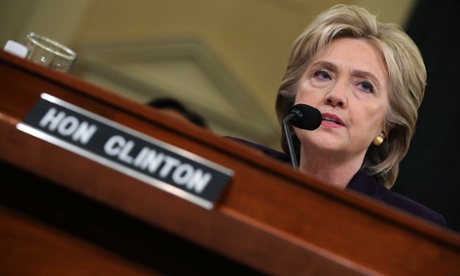
She noted that his mother used to say he had “sand in his shoes” because he was always traveling. She also spoke of Sean Smith, Tyrone Wood and Glen Doherty, the State Department official and two CIA contractors killed.
She smartly chose to avoid any reference to the partisan bickering that has engulfed the committee, instead keeping the focus on the Americans who died.
Clinton concluded: “So I’m here ... I’m here to honor those we lost and to do what I can to aid those who serve us still.”
Roskam finally up and articulates the rhetorical point he’s been struggling to make: pinning US policy on Libya on Clinton, and saying she contributed to the dissolution of order around the Middle East and North Africa.
"Our Libya policy couldn't have happened without you, because you were its chief architect.." @PeterRoskam to @HillaryClinton
— Kelly O'Donnell (@KellyO) October 22, 2015
Clinton again says that it was Obama’s decision, and that she supported what the Europeans and Arab allies recommended.
She brings up being “the situation room decision to send in the navy Seals” to the Abbottabad compound that housed Osama bin Laden, though it’s not entirely clear what relevance being in that room has to the matter at hand.
Roskam keeps offering to let Clinton read her notes and she keeps waiting for him to finish whatever he’s trying to ask.
Rep Roskam paused to wait for Clinton to read her notes. No need, HRC says: "I can do more than one thing at a time Congressman, thanks."
— Lauren Gambino (@LGamGam) October 22, 2015
“I think it’s important to point out that it was very much in American interests and a furtherance of our values to protect the Libyan people.”
She mentions the previous ambassador to Libya as “a strong advocate” to American intervention into Libya, then says it was really Barack Obama’s call, “At the end of the day this was the president’s decision and all of us fed in our views. I did notf avor it until I did the due diligence.”
Then Clinton downplays American action again, saying that European and Arab countries took the lead on supporting the rebels. Only after “due diligence” does she say her reasoning changed, and she turned to favor intervention.
“It is of course fair to say this was a difficult decision … but at the end of the day in large measure, because of strong appeals from our European allies, because the Arab League passing a resolution … we did decide to recommend to the president to do it.”
Updated
Gowdy makes an odd comment about how he won’t cut off Clinton during her answers and didn’t interrupt her opening statement, then passes the mic to Peter Roskam, a Republican from Illinois.
Roskam asks a circuitous question that Clinton boils down to “why were we in Libya”.
“There were a number of reasons for that,” she says, including that Libyan dictator Muammar Gaddafi “threatened [Libyans] with genocide, hunted them down like cockroaches”, after they rose up in pro-democracy protests.
“We had experienced diplomats who were digging deep into what was happening in Libya,” she goes on, and says the US put “very limited” efforts into Libya, “not one American soldier on the ground”.
Finally Clinton makes a plea for unity, at least on foreign policy: “We do come together when it counts.
As secretary of state I worked with the Republican chairman of the Senate arms committee to [pass a nuclear arms treaty] with Russia. … I know it’s possible to find common ground because I have done it. We should debate on the basis of fact, not fear. We should resist denigrating the patriotism or loyalty of those we disagree.
So I’m here. Despite all the previous investigations and all the talk about partisan agendas, I’m here to honor those we lost … and my challenge to you, members of the committee, is the same challenge I put on myself: let’s be worthy of the trust we’ve been bestowed upon the American people.”
"[American people] expect us to rise above partisanship and reach for statesmanship," says Clinton at close of powerful opening statement.
— Dan Roberts (@RobertsDan) October 22, 2015
Updated
She now compares the 1983 attacks in Lebanon under Ronald Reagan, which killed 258 Americans. “Part of America’s strength is we learn, we adapt, and we get stronger.”
Clinton says that the review board immediately after the Benghazi attacks found “systemic” problems and recommended 29 reforms, all of which she says she began while still in charge as secretary of state.
She then puts the onus on Congress, saying that they’ve held up some of the reform measures – and that American diplomats and soldiers “deserve better” from them.
Clinton is turning her opening statement into something of a foreign policy campaign speech, arguing for an active, engaged diplomacy abroad and military force “as a last resort”.
“Above all Chris understood that most people in Libya and everywhere reject the extremist argument that violence can ever be a path for dignity and justice. That’s what those thousands of Libyans were saying in the aftermath of his death. And he understood that there is no substitute for going beyond the embassy walls and doing the hard work of building relationships.”
Clinton makes case for active FP: America must lead in a dangerous world and our diplomats must continue representing us in dangerous places
— Dan Roberts (@RobertsDan) October 22, 2015
“We have a responsibility to provide our diplomats [and contractors] on the ground with the resources they need.”
Clinton begins talking about what she sees as the lessons of the Benghazi attacks, and for American diplomacy write large.
“Chris Stevens understood that our diplomats must operate in many places where soldiers are not, where there are no other boots on the ground and where safety is not guaranteed. In fact he volunteered.”
“Make no mistake, the risks are real. Terrorists have killed more than 65 diplomatic personnel since the 1970s, and more than 100 contractors and locally employed staff.”
Clinton says that diplomats and security staff will “tell you they can’t do their jobs for us from bunkers.”
“It would compound the tragedy,” she says, if the attacks “ended up undermining the work to which he and others devoted their lives”.
She then offers small biographies of Sean Smith, Tyrone Wood and Glen Doherty, the State Department official and two CIA contractors killed.
Clinton says she was the one who recommended Stevens to go to Libya, and that after the attacks she was there when the four bodies arrived back in the United States.
“I took responsibility, and as part of that before I left office I launched reforms to better protect our people in the field and to help reduce the chance of another tragedy from happening in the future.”
“What happened in Benghazi has been scrutinized,” she says, by a review board, Congress, and news organizations.
Clinton's opening statement focuses on lives lost in Libya
Clinton begins her opening statement, saying: “I’m here to honor the service of those four men.
“The courage of the diplomatic security agency and the CIA officers who risked their lives that night, and the work their colleagues do every single day all over the world.
I knew and admired Chris Stevens. He was one of our nations most accomplished diplomats.
She says “there was no easy way” to get Stevens into Libya, but that “he found a way on a Greek cargo ship, just like a 19th century American envoy.” Clinton then talks about how thousands of Libyans took to the streets in protest of the attacks in their aftermath.

Updated
Cummings wraps up his opening remarks, saying that yes, the investigation has turned up new material “But these documents and interviews do not show any nefarious activity.
In fact, it’s just the opposite. The new information we have obtained confirms and corroborates the core facts we already knew from the eight previous investigations. They provide more detail, but they do not change the basic conclusions.
It is time for Republicans to end this taxpayer-funded fishing expedition.
Cummings notes that even Republican representative Kevin McCarthy, who was briefly the likely heir to lead the party, has himself suggested the committee has political motives.
Cummings to Gowdy: "Why tell Republicans to shut up ... when they are telling the truth?"
— Manu Raju (@mkraju) October 22, 2015
He attacks Republicans’ willingness to rearrange meetings and cancel hearings except to bring attention to Clinton, and says that they say they’re interested in the truth except “when they are attacking secretary Clinton with reckless accusations that are demonstrably false.”
.@RepCummings calls out Fiorina, Huckabee, etc. for "wild Republican claims" about Clinton's involvement in Benghazi. #BenghaziCommittee
— Amy Chozick (@amychozick) October 22, 2015
Gowdy closes his opening statement: “We’re gonna find the truth because there is no statute of limitations on the truth.”
Democratic representative Elijah Cummings, second-in-charge on the committee, takes over, saying he has “great respect” for Gowdy but says the chairman is wrong about the purpose of the committee itself.
He takes Gowdy’s tone of righteous indignation and raises it several notches, turning the ire onto the Republicans who insisted on a committee after seven earlier investigation.
The problem is that the Republican caucus did not like the answers they got from those investigations, so they set up this select committee with no rules, no deadline and an unlimited budget. And they set them loose, madame secretary, because you’re running for presdient. Clearly it is possible to conduct a serious bipartisan einvestigation. What is impossible is to deny that Republicans are spending millions of taxpayers’ dollars to derail secretary Clinton’s presidential campaign.”
Gowdy defends the committee’s purpose, telling Clinton that it’s not about her, even if she’s “an important witness among half a hundred witnesses”.
Let me assure you it is not [about you] and let me assure you why it is not. This investigation is about four people who were killed representing our country on foreign soil. It is about what happened before during and after the attacks that killed them. It is about what this country owes to those who risk their lives to serve it. And it is about a government’s obligation to tell the truth to the people that it purports to represent. …
Not a single member of this committee signed up to investigate you or your email.
Gowdy mentions that Clinton swore-in in private – but doesn’t say she swore-in on. Was it a Bible or a binder of talking points? A copy of Batman: The Dark Knight Returns? Truthers out there, let your imagination fly.
Gowdy says Hillary has already been sworn-in in private — so no fresh ad footage of Clinton with her hand raised...
— Zeke Miller (@ZekeJMiller) October 22, 2015
Gowdy begins in a somber note, remembering the four Americans who died in Libya. He’s framing the mission of the Benghazi committee in the most exalted terms: “We owe them and each other the truth. The truth about why we were in Libya, the truth about what we were doing in Libya.”
He talks about additional security, personnel, equipment requests, questions about where the military was positioned, and segues decently enough into a tone of outrage: “why was it so hard to get information from the very four men that these men served and sacrificed for.”
Then he condemns previous investigations for not being “thorough” and were “either incapable or unwilling” to answer all the questions. He spins the committee’s doggedness – or pathological obsession, depending on your sympathies – as an admirable commitment to all the details, emails, documents, witnesses, etc.
Clinton is in the chamber. She walks up to the committee members and shakes all their hands. She gives a little wave to the horde of photographers and iPhone photographers (ie reporters) reaching to take photos of her.
So it begins. With “a couple administrative matters” from Gowdy. Who says “we can take a break for any reason or no reason. If you or any one alerts me, we can take a break for any reason or for no reason.”
The atmosphere is electric. With the opportunity for breaks. If anyone needs one. Anyone?

Updated
Let the cover-up conspiracy theories begin! Why won’t Clinton answer CNN’s questions?
As she walked in, Hillary ignored my question and just said, "Good morning."
— Manu Raju (@mkraju) October 22, 2015
Another committee chair we’ll be seeing a lot of today.
That's the chair @HillaryClinton will testify from at today's #BenghaziCommittee hearing. pic.twitter.com/Fzle5fss5z
— Lauren Gambino (@LGamGam) October 22, 2015
Who sits on the gallery of rogues of the Benghazi committee? My colleague Lauren Gambino (@lgamgam), with the bunch in the hearing room in Washington, writes in with a look at the two at the top.
Representative Trey Gowdy: Known for his prosecutorial style and platinum hair, the South Carolina Republican was chosen to lead the committee’s investigation into Benghazi to do precisely the opposite of what critics accuse him of doing: staging political theater.
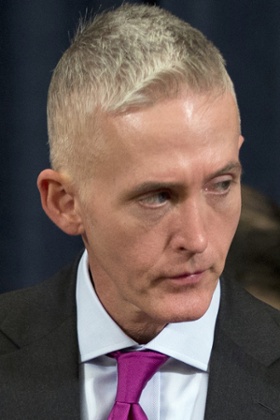
From the outset, Gowdy promised his pursuit would be nonpartisan and “fact-centric” with a focus in finding out what happened during the deadly 2012 attack, but recent accusations, by members of his party and a former staffer, suggest that the investigation has evolved into a partisan attack on Hillary Clinton.
Meanwhile, Democrats and newspaper editorial boards have called for the committee to be disbanded, putting the hard-nosed former federal prosecutor on the defensive. In a recent interview with Politico, Gowdy said that the run-up to Thursday’s hearing have been “among the worst weeks of my life”. The Republican knows the stakes are high – the showdown with Clinton promises to be among the biggest of his political career.
Representative Elijah Cummings: Top Democrat on the oversight committee, Cummings has made waves acting as one of the Obama administration’s fiercest defenders and routinely clashing with Republicans over high-profile investigations. A Republican once muted his microphone to keep him from asking questions.
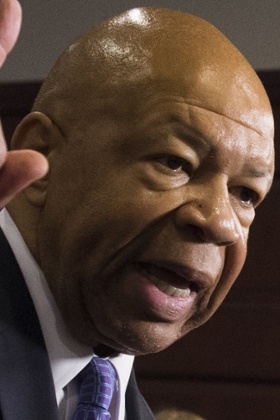
Cummings, a ranking member of the Benghazi committee, has long-called the panel a “charade” and accused Republicans of using it to try to hurt Clinton’s 2016 campaign. He has also urged Republicans to release the transcripts from closed-door testimonies. In a recent interview on CBS’s Face the Nation on Sunday, Cummings predicted that Thursday would be a “sad day for all of us”. He added later: “We have strayed away from what we were supposed to be doing.”
Updated
Things are already getting a little weird on Capitol Hill. Republican language guru and all-round consultant Frank Luntz is at the scene, apparently ready to sprint into action in his colorful sneakers.
Why is @FrankLuntz at the #Benghazi hearing? pic.twitter.com/L6F59tpByt
— Jennifer Epstein (@jeneps) October 22, 2015
Reporters are also predicting that Clinton will have to endure eight to 10 hours of questioning, with a lunch break at 1pm ET. But at least there’s taco salad.
Rejoice, Hillary press corps. It's taco salad day on Capitol Hill.
— Byron Tau (@ByronTau) October 22, 2015
After three years, 50 witnesses and 70,000 documents, Republican representatives still have questions for Hillary Clinton, and the American public has questions for everyone: what are they all even going to talk about at this point?
My colleagues Dan Roberts (@robertsdan) and Ben Jacobs (@bencjacobs) answer the question about the questions.
- Was it a good idea to intervene in Libya in the first place? The very notion of western intervention in Libya has become increasingly controversial in recent years. … While the question is a legitimate one, her critics would have to show that letting Gaddafi rout the rebels would have been a better policy. Worry factor: 4/10
- Was the attack on the US consulate in Benghazi planned? … This was a particularly worry for Obama’s administration at the outset of the crisis, when the US ambassador to the UN, Susan Rice, was given media talking points that erroneously downplayed any terrorist link. This has proved more of a headache for the White House than Clinton personally. Worry factor 3/10
- Did Clinton ignore calls for better security from Ambassador Stevens? New documents mysteriously obtained by Fox News in recent days suggest that Stevens called on the State Department to provide him with more security in the weeks leading up to the fatal attack. … Even if it could be shown to be an unreasonable decision with hindsight, Republicans are also vulnerable to the charge that they too have cut funding for embassy security. Worry factor 5/10
- Did Clinton’s use of a private email server expose classified information to potential compromise? An FBI investigation into whether classified information was potentially exposed may prove the ultimate arbiter of this question … Clinton’s claim not to have handled classified material through the server is always vulnerable to contradiction, but critics also risk looking like they are moving the goalposts by retroactively reassessing the security status of emails sent long ago. Worry factor 7/10
- Did the State Department frustrate response efforts that could have saved Ambassador Stevens? In theory, this is the most damning charge … Unfortunately for her critics, this is also one of the areas that has been mostly heavily explored … Unless Republicans on the committee have any last-minute evidence up their sleeves that they have kept from their colleagues, this is territory that is looking more and more secure for Clinton. Worry factor 2/10
- What difference at this point does it make? … The committee chairman, Trey Gowdy, insists that the Benghazi attack, not Clinton’s email server remains the focus of his investigations, but it is unfortunate that the weakest area for her is the one furthest from his core remit. The onus is increasingly on the committee to show why it, not Clinton’s behaviour while secretary of state, is still relevant in 2015. Worry factor 1/10
Clinton, Benghazi, emails, deja vu – but 22 months and millions of dollars after the first round of Republicans vs (de facto) Democratic frontrunner, the stakes are higher for everyone involved, writes my colleague Lauren Gambino (@lgamgam) from the Capitol.
While the date has been marked for some time, the circumstances of the hearing have changed dramatically in the past few weeks. Bolstered by a sharp debate performance, the security that vice-president Joe Biden will not launch a presidential run, and Republican comments that the panel is a political show aimed at damaging her poll numbers, Clinton heads into the hearing perhaps at her strongest since she announced her bid for the democratic nomination in April.
But with more to gain and lose from the hearing than Republicans, Clinton is under pressure to perform at her best.
She will begin her testimony by reflecting on the four Americans who lost their lives in the attack on the US’s outpost in Benghazi on 11 September 2012, according to a preview of her opening statement. In her testimony, Clinton is also expected to say that Benghazi was a tragedy that must be learned from, but that it should not stop America from continuing to send diplomats into dangerous places around the world, according to the summary provided by the campaign. To do so would be to learn the wrong lesson from the attack, she will say.
The course of hearing, which is expected to last several hours, will depend on what questions are raised, and if the committee has any new information to present.
But as Clinton told CNN’s Jake Tapper: “I’ve already testified about Benghazi. I’ve testified to the best of my ability before the Senate and the House. I don’t know that I have very much to add. This is, after all, the eighth investigation.”
Updated
Hello and welcome to our live coverage of Hillary Clinton’s testimony before the House committee investigating the 2012 terrorist attacks in Benghazi, Libya, during which four Americans, including an ambassador, were killed.
Although Congress has on seven occasions investigated the attacks, House Republicans have insisted on a special committee, led by conservative representative Trey Gowdy, meant to answer any remaining questions. But after revelations that Clinton, then secretary of state, used a private email server while in office, the committee has fixated on her email habits and archives in search of any misbehavior.
Democrats, including Clinton, have accused Republicans of using the committee to undermine the former secretary of state’s standing and weaken her presidential campaign. Gowdy has defended the committee’s meandering attention: “we’re going to follow the facts wherever they go.”
Republicans will likely interrogate Clinton about what warning she may have had and about the confusion in the aftermath of the attack, in particular the mixed messages of the Obama administration. They will also likely question her about security for ambassador Christopher Stevens, although Congress also played a role in weak security funding.
Clinton has testified before Congress on the attacks before, and her campaign hopes that she can use today’s hearing to quash persistent questions about her use of private email and role in the Benghazi response. Republicans hope to catch Clinton in a mistake over the course of several hours of questioning – and also to justify the existence of a highly criticized committee. She is due to begin testimony at 10am ET.
Updated