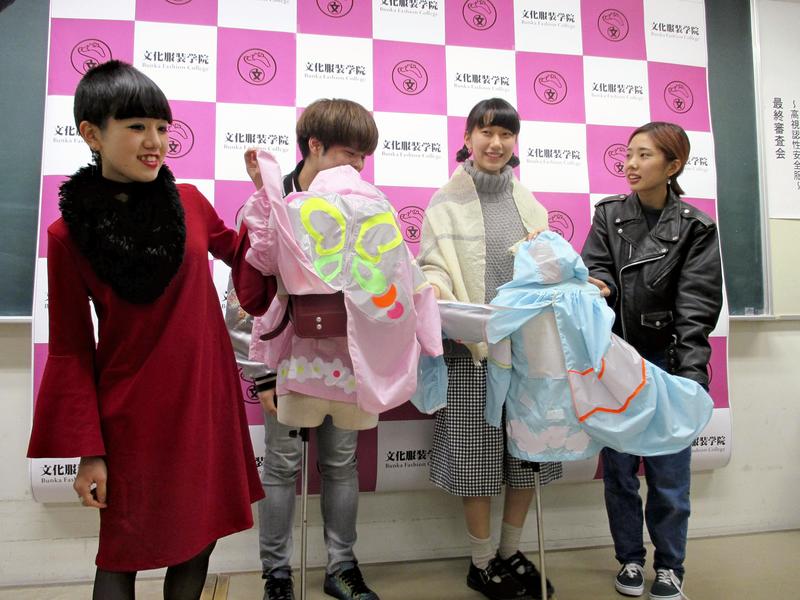
Students at Bunka Fashion College in Tokyo participated in an unusual contest last November, presenting clothing they designed to protect children by making them highly visible through such elements as reflective materials and fluorescent colors.
The contest was held as part of efforts to introduce high-visibility safety designs for children's wear to help safeguard children from traffic accidents, by making it easier for drivers to see the wearer, even at night or in bad weather conditions. Companies and other entities are trying to improve the designs as well as the functions of such apparel in the hope that children will wear it every day.
First prize in the contest went to a pair of raincoats using the motifs of a beetle for boys and a butterfly for girls. The "wings" employ reflective materials and can even cover the body of a child who is wearing a schoolbag on their back -- a feature to ensure the safety of children when traveling to and from school on rainy days.
"Sewing water-repellent fabric was not easy, but we were able to blend good designs [and functions]," said Hana Inoue, 19, the leader of the winning team.
Preschoolers and elementary school students in the lower grades were the most vulnerable to deaths or injuries from traffic accidents while walking in 2015, according to a study by the Institute for Traffic Accident Research and Data Analysis. The largest age group in terms of such victims was 7-year-olds -- at 1,462 -- followed by children aged 8 and 6.
To protect children from traffic accidents, the Japan Traffic Safety Education Association compiled in 2016 its own standards for children's clothing, based on the Japanese Industrial Standards (JIS) for high-visibility clothing. Under the association's standards, for example, long sleeves should incorporate two or more reflective materials that are 50 millimeters or more apart from each other. Green, yellow and six other colors are recommended for fluorescent fabrics.
Yet design is an important factor to encourage children to wear such apparel in their daily life. The Nissenken Quality Evaluation Center, which tests the quality of textile products, therefore sought help from Bunka Fashion College, a school known for producing such renowned designers as Hiroko Koshino and Kenzo Takada.
Products put to practical use
Some companies are already marketing safety clothing designed for children.
In mid-February, Arch Co. released a jacket for 5- to 8-year-olds under its Arch&Line brand mainly for children. The product looks like a regular jacket, but it meets the JIS standards for high-visibility safety clothing by using a special fabric coated with glass, which can reflect even faint light.
This feature can make it easier for the wearer to be seen not only at night, but also if they were trapped under a collapsed building in case of a disaster, according to the Tokyo-based firm.
The jacket is currently available only at Arch's outlet in Osaka. "We can meet the needs of parents who want to protect their children," an Arch public relations officer said.
Kanko Gakuseifuku Co., a major manufacturer for school uniforms based in Okayama, worked with major textile firm Toray Industries, Inc. and a uniform maker in Yokohama to develop high-visibility safety vests, which were donated to elementary school students in Yokohama.
The vests have reflective materials around the waistline, and the garments' high collars and wide shoulders are designed to make children plainly visible even when they carry a schoolbag on their back.
The Japan Traffic Safety Education Association has been receiving an increasing number of requests from manufacturers who want their products accredited as meeting the association's standards for high-visibility safety clothing for children.
"We want to devise more ideas [for such products], so that parents and area residents will think that it's better for kids to wear this type of apparel for safety," said Shigeki Kato, a senior association official.
Read more from The Japan News at https://japannews.yomiuri.co.jp/