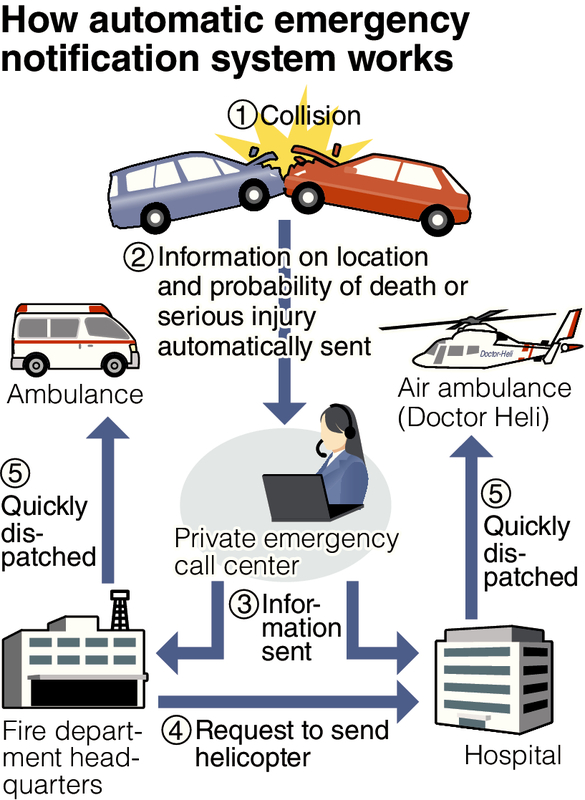
An automatic notification system designed to expedite emergency services' responses to traffic accidents has been launched this fiscal year, and while it is expected to lower the road death toll, only a fraction of vehicles have the necessary equipment.
The D-Call Net system, the first of its kind in the world, uses data automatically sent from vehicles involved in a collision. Information about the vehicle's location and the probability of deaths or serious injuries among the passengers is sent automatically to hospitals and fire department headquarters. Based on this information, an ambulance or air ambulance -- called Doctor Heli (see below) -- can be dispatched if necessary. This system has shortened the time between a crash and when initial medical treatment is provided by 10 minutes to 20 minutes, which could be the difference between life and death for an injured passenger.
Equipping more vehicles with this technology is an issue to be addressed.
During a trial of the system in January, an automatic notification flashed on a monitor at the call center of an emergency response operations company in Tokyo: "Probability of death or serious injury is 19 percent." One vehicle involved in a head-on collision in Chiba Prefecture was equipped with the system.
After detecting that a collision had occurred, the system transmitted information about the crash location and estimated the severity of injuries using an algorithm based on the data from 2.8 million accidents in the past. The call center concluded the crash required a response by emergency services and relayed the information to Nippon Medical School Chiba Hokusoh Hospital in Inzai, Chiba Prefecture.
Nineteen minutes after the collision, an air ambulance arrived in the air above the crash site, and emergency treatment was soon started on two injured people. One person had a broken leg and ribs, and the other suffered a chest contusion, but these injuries were not life-threatening.
"If the injured had been elderly and their treatment had started later, the broken ribs could have damaged the patient's heart or lungs, which could even have been fatal," said Tomokazu Motomura, the hospital's flight doctor.
==
36 hospitals involved
The new system is being jointly operated by the Tokyo-based nonprofit organization Emergency Medical Network of Helicopter and Hospital (HEM-Net), Toyota Motor Corp., Honda Motor Co. and other entities. Thirty-six hospitals in Hokkaido and 29 other prefectures have officially started using the system from April.
When an accident occurs in which airbags are deployed, the call center automatically receives information including the probability of deaths or injuries, the crash location, vehicle type and damaged section, number of passengers, and whether the passengers were wearing seat belts. If the probability of serious injury exceeds 5 percent and there is a suitable space for a helicopter to land, dispatching a Doctor Heli will be considered.
According to HEM-Net estimates, it previously took an average of 38 minutes until personnel on an air ambulance started providing treatment to an injured person. The new system has cut that time to between 20 minutes and 29 minutes. The 60 minutes after a person is seriously injured is called the "golden hour," as being able to provide treatment more quickly during this period can make the difference between life and death. The Japan Automobile Research Institute estimates that if this system had been in place in 2010, the lives of 282 of the 4,948 people who died in traffic accidents that year could have been saved.
==
1% of cars use system
Currently, this new technology is installed only in some new vehicles made by Toyota and Honda. The several hundred thousand vehicles able to use this system account for about 1 percent of all vehicles owned in Japan. Some regions, such as Tokyo and Fukui Prefecture, do not have hospitals with Doctor Heli helicopters, which means air ambulances cannot be quickly dispatched to these areas. Securing locations where helicopters can take off and land is also a pressing issue.
In a bid to boost the number of vehicles equipped with the system, the Land, Infrastructure, Transport and Tourism Ministry decided on a plan to add it to the car assessment scheme that evaluates a vehicle's safety features. The ministry also is considering installing the system in driving recorders so it can also be used in vehicles that are not new.
"Providing emergency medical treatment is a race against time," said Kunihiro Mashiko, a HEM-Net director and also head of Minamitama Hospital in Hachioji, Tokyo. "A difference of a split second can mean the difference between life and death. I hope this system will be more widely used, as it also would help achieve the government's target of cutting annual traffic fatalities to below 2,500 by 2020."
--"Doctor Heli" air ambulance
Helicopters stationed at emergency hospitals for quick deployment to take doctors and nurses to the scene of a disaster or an accident. With an artificial respirator, infusion pump and other medical equipment inside, the helicopters can provide initial treatment to injured people on board. The Doctor Heli scheme started full operations in 2001, and now 52 helicopters are stationed in Hokkaido and 41 other prefectures. Operating costs are shared evenly by the central and local governments.
Read more from The Japan News at https://japannews.yomiuri.co.jp/