The official orange color of the Yomiuri Giants has again spread across the stands of Tokyo Dome, the baseball team's home field.
New technologies for preventing the spread of the novel coronavirus were used on a test basis for a game at the stadium on Nov. 7, as the central government looks to ease admission limits for large-scale events to about 80% of capacity. That night, attendance was 26,649, a little more than 60% of regular capacity.
The season started on June 19 with no spectators allowed in stadiums. From July 10, the government started to allow a maximum of 5,000 persons to enter each venue. Then from Sept. 19, the number was relaxed to 50% of capacity.
Similar test measures have been taken at Yokohama Stadium, home to the Yokohama DeNA BayStars, as professional sports teams continue to look for ways to prevent infections while attracting more spectators.
-- Measuring CO2
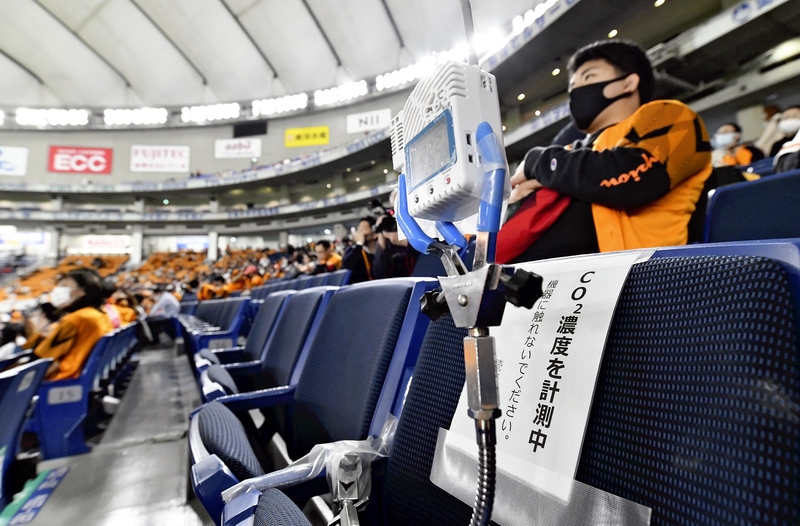
At Tokyo Dome, notices reading "CO2 concentration being measured" were put up at about 30 locations, including the stands and concourses. A device about the size of a smartphone was placed near each notice to measure carbon dioxide level, a proxy for exhaled breath, to determine the congestion level and the ventilation situation.
Officials from the organizing committee of the Tokyo Olympics and Paralympics also came to observe the game as they prepare to prevent novel coronavirus infections during next summer's Tokyo Games.
Spectators at the dome that night were said to have refrained from vocally cheering on the teams, clapping instead. There were also said to have been few complaints from people sitting side by side in the outfield seats.
Yasuo Suzuki, a company employee from Koshigaya, Saitama Prefecture, was in the stands that night after also having been to a game at the dome on Nov. 1.
"There were many more spectators, so I felt a stronger sense of togetherness, especially when we clapped together to cheer on the team," Suzuki said. "If scientific data is used to prevent infections, I'll be able to watch games without worry in the future, too."
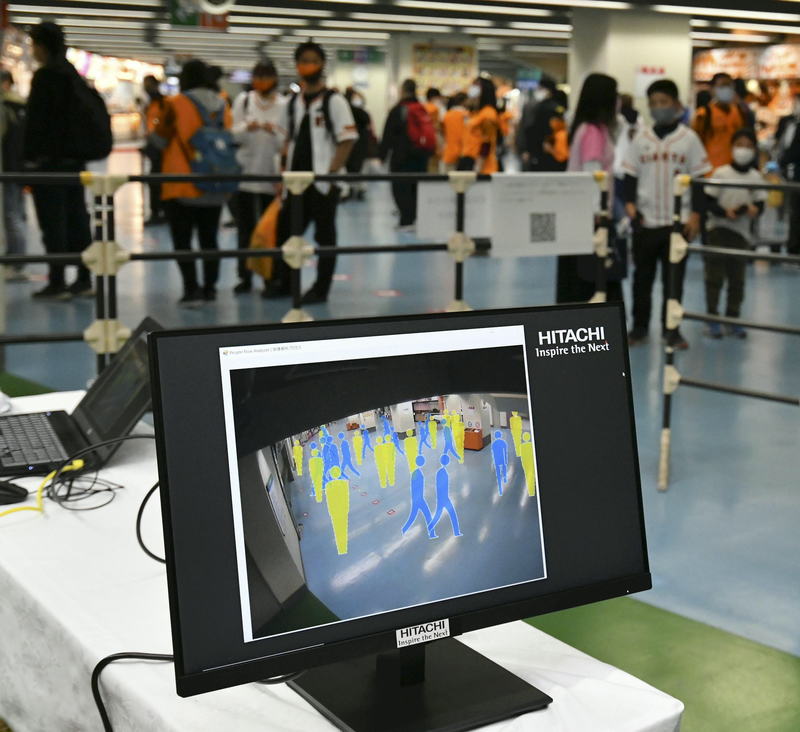
Measures were taken to monitor congestion at different times and areas with small receivers installed at about 100 locations to sense electromagnetic waves from mobile phones and 10 cameras to record the flow of people.
The video images did not identify individuals, only displaying people as human-shaped icons.
The measures taken had been approved by the government's subcommittee on measures to deal with the novel coronavirus. The data obtained will be used for future reference to guide spectators and disperse them when exiting a facility.
-- Analyzing data
Similar measures have been taken at Yokohama Stadium -- the main venue for baseball and softball for the Tokyo Olympics -- with the participation of entities including the BayStars, Kanagawa Prefecture and messaging app company LINE Corp.
The stadium's seating capacity for professional baseball is 32,402. Capacity was at 51% on Oct. 30, 76% on Oct. 31, and 86% on Nov. 1.
Thirteen cameras were installed to measure the rate of people wearing masks. Carbon dioxide levels and wind speeds were measured as well. The collected data will be analyzed using a supercomputer to determine the situation regarding spectators' droplets, among other matters.
High-tech devices were installed in about 40 locations, including restrooms and shops, to obtain location information from spectators' mobile phones. People using an app were then informed of the degree of congestion to avoid crowding.
With the home fans accounting for the majority of spectators, the areas around restrooms were found to be more crowded during the top of innings, when the BayStars were on the field, rather than the bottom of innings when they were batting.
Some spectators said that they had a great time supporting the team with many other fans, but they also had concerns about the possibility of infection as so many people were present together.
A team official said, "Rather than using intuition, we want to use data to build convincing infection prevention measures."
Hidemasa Nakamura, an executive member of the organizing committee who is the Tokyo Games delivery officer, said after observing a game: "Evidence is better than theory. If we can show measures to prevent infections based on actual data to people at home and abroad, it will lead to a safe Tokyo Games."
"If we take thorough measures to prevent infections, such as cheering without using our voices, checking our temperature and disinfecting, the risk of infection at stadiums is not high," said Toho University Prof. Kazuhiro Tateda, a specialist in infectious diseases and head of the Japanese Association for Infectious Diseases. "If we collect data by using new technologies and solve the problems revealed by the data one by one, it may be possible to admit 80% or 100% of the seating capacity."
Read more from The Japan News at https://japannews.yomiuri.co.jp/