Formula E? Sounds like a soap powder
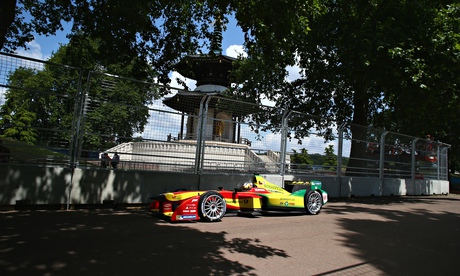
Formula E is a single-make racing series using cars powered by electrical energy. The two rounds in London this weekend are the finale to a season that began in September. Ten teams, including one co-owned by Leonardo DiCaprio and another by Richard Branson, are contesting the championship, with two drivers per team. It was set up by the Spanish fund manager Alejandro Agag.
Electric cars? Aren’t they a bit slow?
They have a top speed of 135mph. At maximum output they will use 200kw, generating around 270bhp. This is available in qualifying but in races it is restricted to 150kw, or 202.5bhp.
Battersea – not exactly Monte Carlo is it? Where else have these races been held?
All the races are on street circuits: in Beijing, Putrajaya in Malaysia, Uruguay’s Punta del Este, Buenos Aires, Miami, Long Beach, Berlin, Moscow and, yes, Monte Carlo. They last around 45 minutes and because of battery life require drivers to use two cars.
Say that again: two cars?
Yes, the drain on batteries means no single car can go the full race distance, so there is a pit stop mid-race for the drivers to change into a second car with a fully charged battery. The hope is that competitive development will push the technology to the point when a single car will complete a race.
They seem to have a few gimmicks up their sleeves. What exactly is a ‘fanboost’?
In a attempt to engage with fans via social media, three drivers with the most votes before a race each receive a five-second power boost during the race adding 90bhp to their car.
Will I have heard of any of the drivers?
There is plenty of pedigree on the grid: former F1 drivers Nick Heidfeld, Jarno Trulli, Jean-Éric Vergne, Bruno Senna (yes, a Senna, no less), Vitantonio Liuzzi, Jaime Alguersuari and Sébastien Buemi as well as Le Mans 24 Hours-winner Loïc Duval and Le Mans veteran Stéphane Sarrazin.
What about the bus lanes?
Built on the Carriage Drive circuit in Battersea Park, the circuit is 1.81 miles long and, with 17 turns, is extremely tight and extremely testing. The original road surface has not been altered so it is very bumpy. Heavy braking zones and tight chicanes are all flanked by concrete walls, making for an unforgiving challenge.