LOS ANGELES _ Officials said there was a high risk of flooding in parts of already-saturated Northern California as the latest "atmospheric river" storm moved in.
The National Weather Service on Sunday said the highest risk for flooding was in a large swath of the region from Monterey to Marin County on the coast then into the Sacramento Valley and Sierra Nevadas. The storm is expected to put added stress on levees, streams, creeks and rivers that are already approaching dangerously high water levels.
Parts of Northern California are already on track to have the wettest winter ever recorded.
On Sunday, the NWS warned that the San Joaquin River at Vernalis "has reached danger stage. Greater risk for levee problems."
On Saturday, water stood a foot high in Maxwell, a small rural town in Northern California's Colusa County. Crews had to evacuate 100 people in the town about 2 a.m. because of flooding, some by boat.
Maxwell is about 50 miles from Oroville, which for the last week has been the scene of a national drama as both spillways at the Oroville Dam were damaged, sparking fears of a catastrophic flood and forcing the evacuation of more than 100,000 people.
Officials were able to reduce the water levels in the reservoir this week and say they are prepared for the new storms.
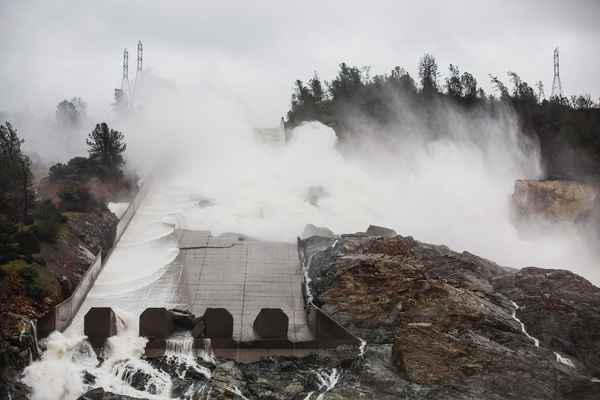
As the sun rose over the beleaguered Oroville Dam on Saturday, an aerial lineman performed the high-risk task of cutting power lines over the facility's damaged main spillway while attached to the end of a cable dangling from a helicopter.
Hundreds of feet below, construction workers manning trucks, cranes, skip loaders and dredging equipment gathered near a pool of turbulent murky water churning at the bottom of that spillway, preparing to remove a mountain of debris piled up beneath the surface.
At the same time, state Department of Water Resources engineers began incrementally decreasing the flow of water in the spillway from 70,000 cubic feet per second to 55,000 cfs to give crews room to remove the estimated 150,000 square yards of debris.
It was all part of the effort to pump enough water out of the lake to absorb runoff from incoming storms and to keep the lake from overflowing as it did last weekend. That overflow badly eroded an emergency spillway and sent debris flowing into a pool at the bottom, forcing the closure of an underground hydroelectric plant.
As of Saturday, the estimated costs of shoring up the dam's main spillway and adjacent emergency spillway had climbed to roughly $10 million, according to a report reviewed by The Times.