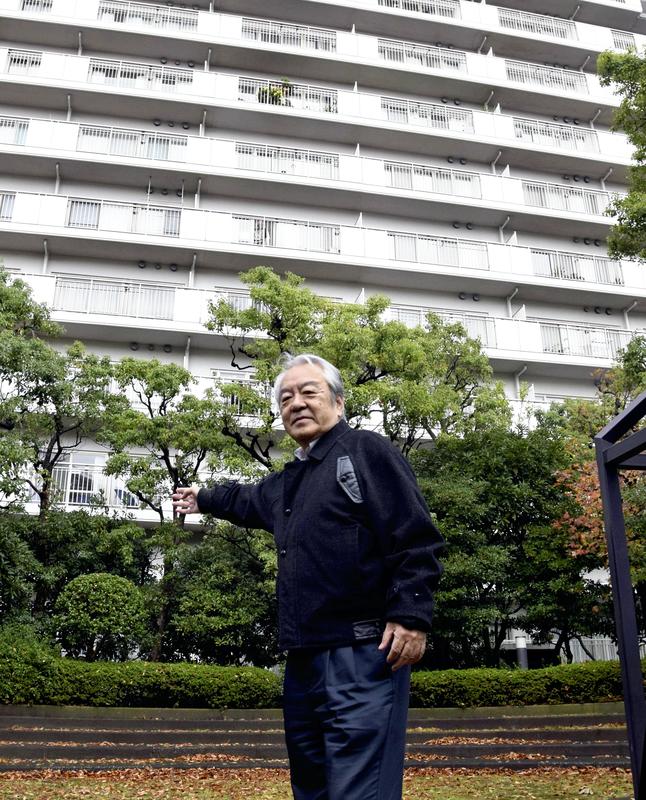
About a dozen residents gathered on Nov. 2 at a unit in an 88-meter-high, 28-story high-rise condominium in Koto Ward, Tokyo.
The conversation included comments like: "I think we should stay in the condominium," and "Well, maybe I should run off to stay at my son's place in the surrounding area."
Discussion sessions for exchange of opinions among residents are held twice a month at the condominium, which has about 260 units. Participants usually only engage in casual conversation, but the atmosphere was a bit different that day. The subject matter during their talk included the idea of a typhoon hitting the Tokyo metropolitan area this autumn, and the subsequent means of evacuation in case of emergency.
Said Keiji Suzuki, 69, the director of the condominium's management association: "I felt fear over the possibility of a storm hitting that I had never experienced. Interest in disaster preparedness is growing among residents."
The condominium is located in an area at sea level, about 1 kilometer from Arakawa river. If the river overflows, the building could be flooded as high as the second floor.
In a worst-case scenario, residents on lower floors would have no choice but to escape to higher floors. In 2018, the management association compiled its own disaster preparedness manual, which recommends residents store enough water and food for at least three days.
However, in the case of a prolonged power outage, the residents could become isolated because of an interruption of elevator service, rendering the tenants "high-rise refugees." Stockpiles also could be exhausted.
"Even if we manage to evacuate from the condominium, the nearby evacuation shelter cannot accommodate all the residents. If we have to take refuge for an extended period, there is nothing we could do but rely on public support," Suzuki said.
In highly populated urban areas, many citizens reside in multi-unit housing such as condominiums. Multi-unit housing accounts for more than 50 percent of all residences in Kanagawa, Osaka, Fukuoka and other prefectures, while in Tokyo, 70 percent of such housing makes up residences.
Since the second half of the 1950s, large-scale housing complexes and new towns have been built, and apartment buildings more than 10 stories high have sprung up.
In the 1997 revision of the Building Standards Law, communal areas, such as corridors, are excluded when calculating a floor-area ratio, which is the ratio of the total floor area of the building to the site area.
As a result, the number of huge high-rise condominium towers featuring luxurious communal spaces have increased.
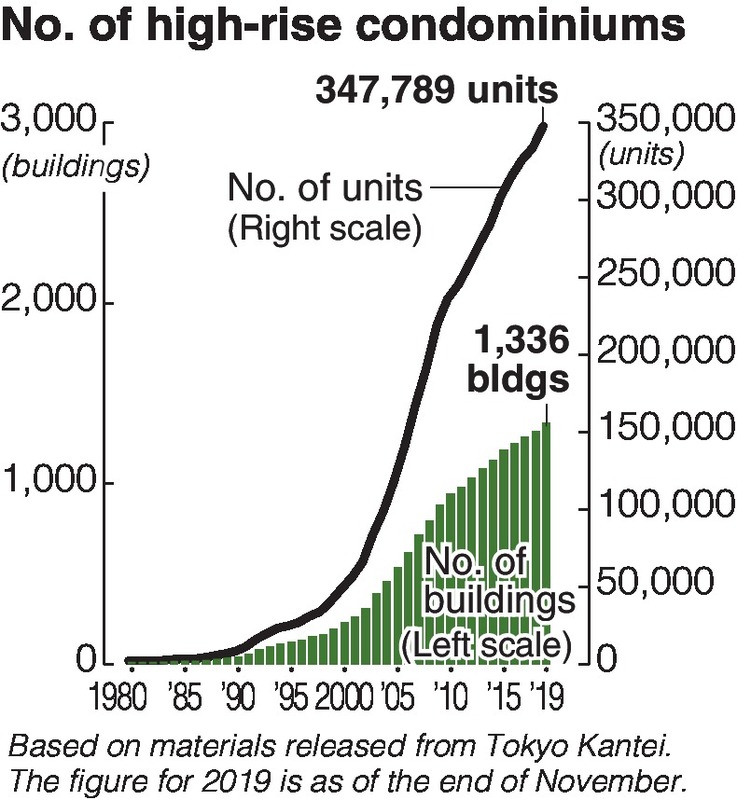
Generally, high-rise condominiums refer to residential buildings with a height of more than 60 meters and at least 20 stories. According to Tokyo Kantei Co., a real estate research company, as of the end of November there are 1,336 high-rise buildings nationwide, up nearly seven times from 193 in 1999.
In Tokyo, there are 433 high-rise condominiums (137,327 units), accounting for more than 30 percent of the total.
With the number of high-rise buildings shooting up, the number of people living in such buildings skyrocketed. The Olympic village that will be constructed in Tokyo's Harumi district for next summer's Tokyo Olympics and Paralympics will be transformed into a town where about 12,000 people are expected live after the construction of high-rise condominiums and other facilities.
However, since many people reside in high-rise condominiums, if a natural disaster strikes, it could have a tremendous impact.
When Typhoon No. 19 hit in October, a high-rise condominium in the Musashikosugi district of Kawasaki was flooded, and its electrical equipment on an underground floor experienced failure, leading to interruption of elevator and water services. This caused serious problems for the residents.
The Tokyo-based Condominium Life Continuity Association, comprised of real estate companies and other entities, aims to create and spread a condominium version of a business continuity plan (BCP) introduced by companies so residents can take refuge in their own homes for an extended period. This fiscal year, the association received a subsidy from the Land, Infrastructure, Transport and Tourism Ministry and is now studying ways to evacuate residents as well as means for reconstruction at a 14-story condominium in Tokyo's Edogawa Ward.
Some municipalities have begun reviewing the positioning of high-rise condominiums in their city planning. The Kobe municipal government revised an ordinance in July to regulate the construction of residences including high-rise condominiums in the city's central area. According to the municipal government, of 69 high-rise condominiums in the city, 24 are concentrated in Chuo Ward, the city center. Because of a rapid population increase, the number of concerns have arisen, such as that it will be difficult to take disaster-related measures.
"If a high-rise condominium is affected by a disaster, it will also have a significant impact on surrounding areas because of its size," said Masayuki Suzuki, an associate professor at Chiba University who is knowledgeable about housing policy. " It is necessary to also take disasters into account when planning for a town's future."
Read more from The Japan News at https://japannews.yomiuri.co.jp/