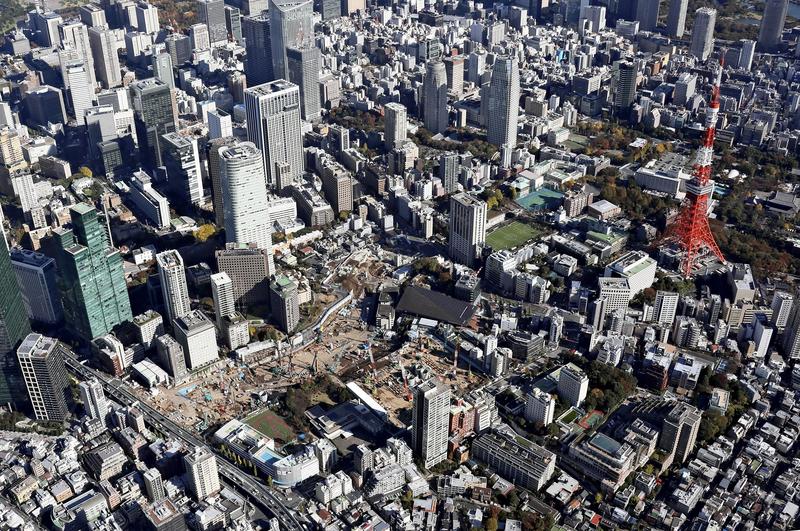
The sound of hammering resonates from a flatland of about 8.1 hectares in a place that used to be home to craftworkers since before World War II. Now, there are the surrounding Tokyo Tower and the Roppongi Hills complex in the Toranomon and Azabudai districts of Minato Ward, Tokyo.
Planned for this flatland in 2023 is a new "town," in which 20,000 people will work, with a 330-meter-tall building at its center.
"Many children used to frolic in these alleyways," 95-year-old resident Kenichi Magatani, whose family has lived in the area for generations, said as he looked at the construction site.
When he came home from the battlefront at the end of the war, the young Magatani found his neighborhood all burned out. However, the reconstruction of the area later generated momentum, particularly around the time of the 1964 Tokyo Olympics, ushering in the high-rise buildings that surround the Toranomon and Azabudai districts.
The neighborhood now has only three children -- all of whom are great-grandchildren of Magatani -- but will soon become globalized and see more children because an international school set to open at the new complex.
"I will live long, till I can see my neighborhood regain its vigor," he said.
Urban development has been led by the construction of towering buildings. These huge structures have attracted many companies and working people, thus helping to revitalize their neighborhoods. This history is traced back to 1963, the year before the Tokyo Games.
Prior to that year, restrictions regarding the scale of buildings were based mainly on height. However, in 1963 the Building Standards Law -- under which those restrictions were based on the floor-area ratio or the ratio of the total floor space of a building to a plot of land on which it is constructed -- was revised. The higher the floor-area ratio is, the higher building that can be erected.
In 2002, the government launched a new system aimed to rejuvenate urban areas, under which the floor-area ratio is allowed to increase as long as an envisaged construction project is expected to contribute to the urban development. This scheme has paved the way for the construction of a number of towering buildings in the Otemachi and Marunouchi districts in central Tokyo, Abeno Harukas in Osaka, and Midland Square near Nagoya Station.
According to Sanko Estate Co., a leading office building broker in Tokyo, the capital's 23 wards saw office space of 93 hectares newly created in 2018 alone, while the office vacancy rate hit about 1 percent, a record low.
Yet future prospects look uncertain. An increasing number of companies are adopting teleworking -- whereby people work at home or from alternative locations instead of their offices, and there's also an expected population decline in Tokyo after a peak in 2025. "A hollowing-out of the buildings might commence," said a real estate brokerage in Tokyo.
Opposite direction
Urban development is not just about erecting skyscrapers.
The Shimokitazawa district of Tokyo is home to various genres of subcultures with its narrow alleyways interlaced with music clubs, secondhand clothing stores and theaters. Shimokitazawa Station moved underground in 2013, creating a vacant plot of land measuring about 2.75 hectares. New low-rise buildings are being constructed, in which cafes and a nursery and other facilities will open by the spring of 2021.
Odakyu Electric Railway Co., which is working on the redevelopment project, has decided to maintain the features of the existing local community, through continuing discussions with residents.
"Some areas are a match for high-rise buildings, while others are not," an Odakyu official said. "The Shimokitazawa district, where people can enjoy a variety of settings as they stroll through the area, is a place where low buildings fit in better."
"I hope our town will continue to develop, while keeping Shimokita's [a shortened form of the area's name] charm," said Tomohiro Otsuka, 55, who runs a stationery shop near the station.
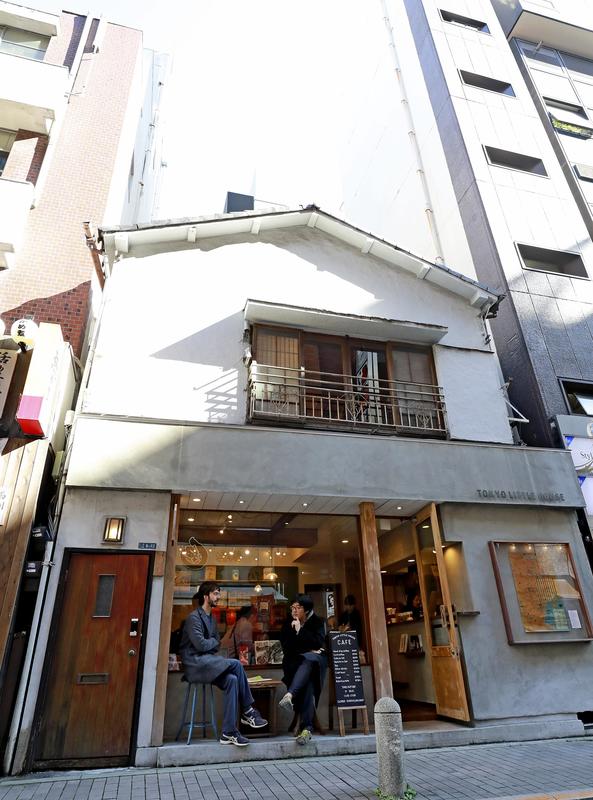
Meanwhile, a two-story wooden building stands on a neon-lit street in Akasaka, Tokyo, and is frequented by foreign tourists. Tokyo Little House opened as a lodging facility in 2018 after Kohei Fukazawa renovated his grandparents' house that was built more than 70 years ago.
"I want people from around the world to know the history and culture of Tokyo," the 41-year-old editor said. In fact, many customers said staying at the building has helped them experience a new aspect of Tokyo, that it's not just about a cluster of tall buildings.
"I believe the charm of Tokyo can be enhanced even more through various attempts to link cities and their cultures, not just through carrying out large-scale redevelopment projects," said Fukazawa, who has done research on the history and geography of various cities.
Atsushi Deguchi, professor at the University of Tokyo, pointed out that it is true the development of high-rise buildings has contributed to the growth of cities. "However, the uniqueness of the city doesn't stand out if buildings constructed look similar.
"The bottom line is what should be realized through buildings constructed on appropriate scales," continued the expert on urban planning. "The time has come for us to consider what we should plan around next after the floor-area ratio."
Read more from The Japan News at https://japannews.yomiuri.co.jp/