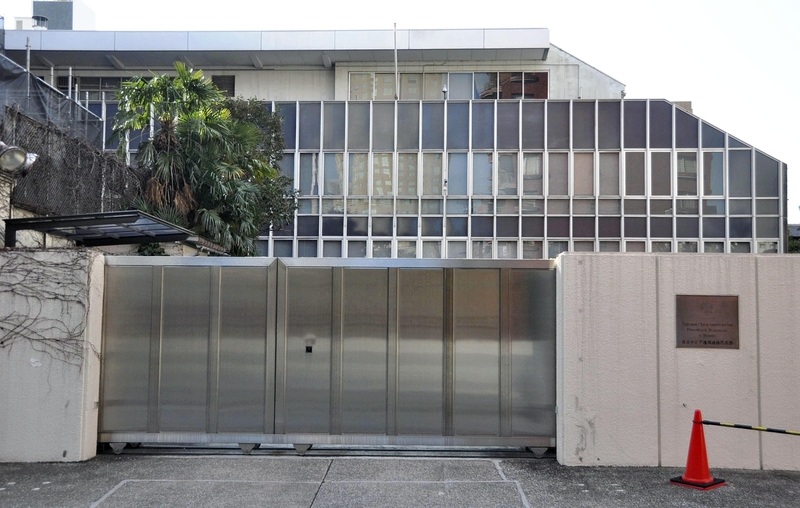
The No. 2-ranked member of the Russian trade office in Japan is suspected of abetting a former SoftBank Corp. employee arrested for handing over company secrets, according to sources.
The employee, Yutaka Araki, was arrested last month on suspicion of illegally obtaining trade secrets of the firm at the instigation of officials at the Trade Representation of the Russian Federation in Japan. In regard to the high-ranking Russian official, as diplomats have immunity from arrest, the Metropolitan Police Department is considering sending papers to prosecutors on suspicion of a violation of the Unfair Competition Prevention Law for encouraging the employee to get the trade secrets.
Classic technique
"I thought he may be a Russian spy, but he gave me money and I enjoyed talking with him, so I didn't think about it so seriously," Araki, 48, who was arrested on suspicion of violating the law, told the MPD's public security bureau, the sources said.
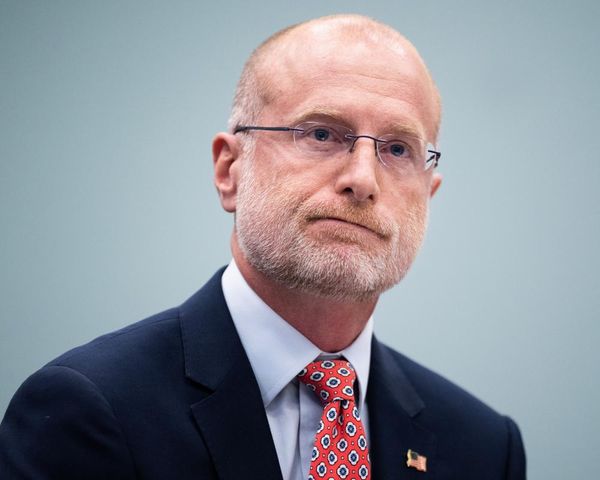
The person Araki interacted with was Anton Kalinin, 52, a senior trade representative official who is believed to be a member of Russia's Foreign Intelligence Service (SVR), which is descended from the former KGB. Kalinin is known as a "big fish" among Western intelligence agencies, according to the sources.
It appears that Kalinin came to Japan sometime around February 2017, and a colleague who had already returned to Russia allegedly introduced Araki to him.
Kalinin allegedly entertained Araki with food and drinks without revealing his position and title. The Russian official did not giving out any contact information, such as email or phone number to Araki, and only set a time and place for the next meeting each time the two met. Investigative sources said, "It's a classic technique of a Russian spy."
Telecom infrastructure a target
Kalinin initially asked Araki to provide information about his company along with other publicly available documents, and gradually began requesting highly confidential information. Whenever Araki handed over the documents requested, Kalinin gave him tens of thousands of yen in cash at the following meeting. The amount of money changed according to the contents of the documents, which spurred Araki to bring more confidential documents.
In February last year, Araki handed over trade secrets, including work procedures regarding the firm's phone base stations, this becoming the charge in his arrest. According to an industry source, the information provided to the Russian side had nothing to do with the latest technology related to 5G next-generation telecommunications standards, so it is unlikely that the information will be used to improve Russia's telecommunications infrastructure.
Asked about Russia's intention, the investigative sources said: "They are extensively collecting information on telecommunications infrastructure around the world for intelligence activities, including wiretapping, and this latest case is probably part of that effort."
The MPD believes other domestic telecommunications companies may also be targets of espionage.
Persona non grata
In conjunction with Araki's arrest, the MPD public security bureau on Jan. 25 demanded the Russian Embassy have Kalinin and his predecessor who had already returned to Russia surrender to the MPD. The embassy has not responded, although Kalinin is believed to still be in Japan.
If Kalinin does not leave Japan, the government of Japan would notify Russia of the senior official's classification as a "persona non grata" under the Vienna Convention on Diplomatic Relations and have him sent back to Russia. While Kalinin remains in Japan, the public security bureau is keeping a close eye on his movements.
Read more from The Japan News at https://japannews.yomiuri.co.jp/