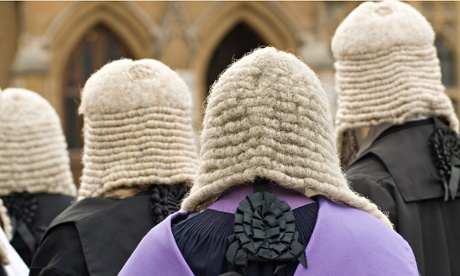
The first affirmative action drive to boost diversity among judges has been launched, promising support and mentoring for those from “non-traditional backgrounds”.
The initiative, led by the appeal court judge Lady Justice Hallett, is aimed at putting lawyers and legal academics with no previous judicial experience directly on to the high court’s benches.
Women, those from minority ethnic backgrounds, and “less advantaged” white applicants – who attended state school or whose parents did not go to university – will be eligible to join the training course.
Of 108 high court judges in England and Wales, only 21 are women and just three are recorded as being from minority ethnic backgrounds. The judiciary is becoming increasingly worried about how white, male, privately educated and unrepresentative it appears compared with the rest of society.
High court judges are more senior than crown court judges. Appointments to the court of appeal and supreme court are normally chosen from those on the high court. There is currently only one woman, Lady Hale, out of 12 justices on the supreme court.
The pilot programme stops short of positive discrimination or quotas, which are illegal. It precedes a selection process this summer that aims to recruit lawyers as deputy high court judges.
The selection procedure for these new high court judge positions will be open, as normal, to anyone with the right legal qualifications – as distinct from the preparatory mentoring programme, which is restricted to those from “non-traditional backgrounds”.
Deputy high court judges have the same responsibilities as high court judges but are paid fees rather than salaries. They would be expected to apply subsequently to become full-time high court judges.
Announcing the initiative in a video interview, Hallett said: “For the first time ever this July, the Judicial Appointments Commission will be running an exercise to appoint up to 14 people as deputy high court judges without the need for them to sit as recorders [more junior judges] first.
“They may also have also have little or no experience of attending or appearing in the high court – or any court for that matter – and the process of completing an application form and going through a selection process for judicial appointment may be completely alien to them – and quite frankly daunting.
“The judiciary are therefore offering a small number of top-quality candidates from diverse backgrounds, with no previous experience of judicial office, the opportunity to take part in a pilot programme of work-shadowing and mentoring to acquaint them with the culture and pace of the high court and a workshop to prepare them for the selection exercise.”
Participation in the programme will not guarantee selection and the appointment will ultimately be on individual merit. Hallett acknowledged that although the judiciary was becoming more diverse, “progress is slow”.
She added: “We fear we may be missing out on a pool of talent for whom the traditional route is not an option – top-flight solicitors and barristers, general counsel, academics and many more.
“They are also likely to be men and women from a broad spectrum of social and ethnic backgrounds with the potential for the high court and beyond.”
There are 30 places available on the programme, which will involve shadowing a high court judge for up to three days, providing candidates with advice and guidance and a workshop on preparing for the selection procedure.
Only women, those from a black, Asian or minority ethnic background and those “from less advantaged social or educational backgrounds” can apply for the pilot programme. The deadline is 21 April.
The questionnaire asks whether applicants attended a “non-fee-paying state school or college “and whether they are the “first generation in their family to attend university”.
In a separate development, Cherie Booth QC, who has been sitting occasionally as a recorder since 1999, announced this week that she is to step down from the bench.
“It has been an enormous privilege to serve as a judge for the last nearly 20 years,” she said, “but I’ve decided it’s time to focus more on my work with Omnia Strategy, the international law firm I founded, and on my work as an independent arbitrator.” Last year Booth left Matrix Chambers, of which she was a founding member, explaining that she wanted to concentrate on her work at Omnia.