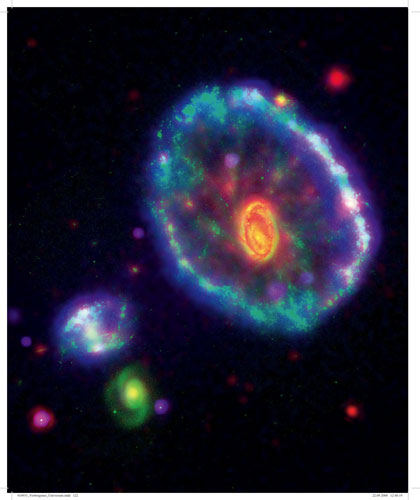
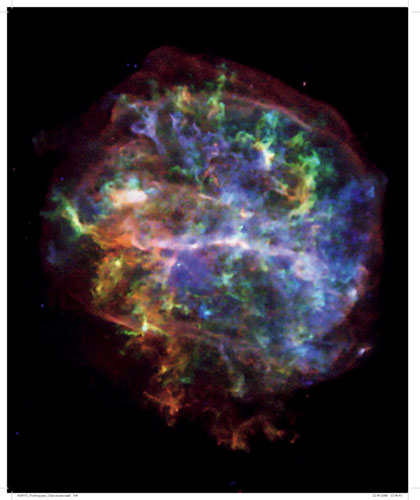
This illustration shows the Nasa/ESA Hubble Space Telescope – from whose data many of these images were assembled – in its high orbit 600km above EarthPhotograph: Wiley-VCHMulti-wavelength view of the Cartwheel galaxy. A few hundred million years ago a smaller galaxy plunged through the heart of a large spiral galaxy, creating expanding ripples of star formation. In this image, the first ripple appears as an ultraviolet bright blue outer ring where associations of stars 10 times as massive as the sun are forming Photograph: Wiley-VCHSupernova remnant G292.0+1.8 in x-rays. This image shows the aftermath of the death of a massive star. Ejected material from the supernova races outwards and slams in to the surrounding gas creating intense shockwaves that heat the material and make it emit x-raysPhotograph: Wiley-VCH
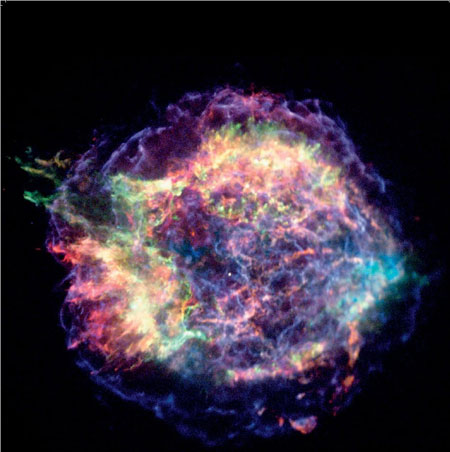
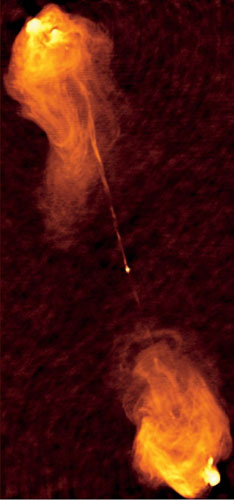
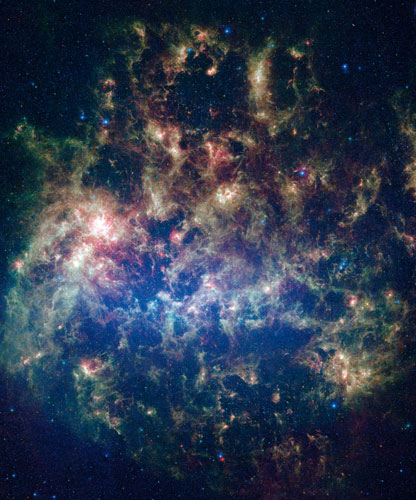
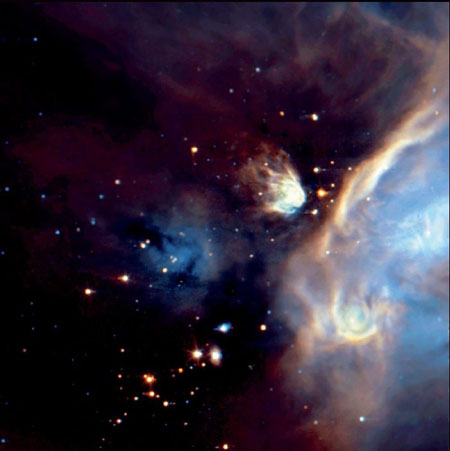
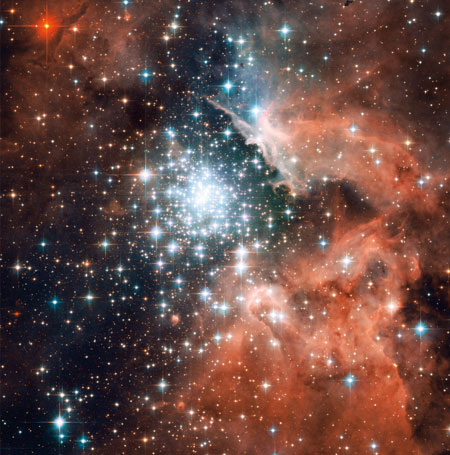
Cassiopeia A in x-rays. Taken with the Chandra satellite, this image shows the youngest supernova remnant in the Milky Way galaxy. Called Cassiopeia A, it is a distance of some 11,000 light years and – were it not for the fact that it was shrouded in a dense cocoon of dust when the massive star exploded – would have been easily seen by observers just over three centuries ago. It is the most brilliant radio source in the sky apart from the sunPhotograph: Wiley-VCHRadio images of Cygnus A. Cygnus A was one of the first sources of cosmic radio radiation to be identified with a visible-light object in the sky. Seen in visible light it is a nondescript elliptical galaxy, a faint smudge like multitudes of others that provides no hint that it is by far the most powerful radio source in our reasonably local neighbourhood (that's local as in a mere 800m light years)Photograph: Wiley-VCHAn untraditional view of the Large Magellanic Cloud. This vibrant image from Nasa's Spitzer Space Telescope shows the Large Magellanic Cloud, a satellite galaxy of our own Milky Way. The infrared image, a mosaic of 300,000 individual tiles, offers astronomers a unique chance to study the life cycle of stars and dust in a single galaxy Photograph: Wiley-VCHThe Rho Ophiuchi Cloud. This is one of the heavenly meeting points for astronomers in search of young stars. Located 540 light years away in the constellation of Ophiucus, near the celestial equator, this dusty region is the nest of more than 100 newborn stars. This image was made with ESA's Infrared Space Observatory from a 7.7-micrometre infrared exposure and a 14.5-micrometre infrared exposurePhotograph: Wiley-VCHTarantula Nebula. This is the youngest, most active star-forming region in our local group of galaxies and it is hot enough to excite oxygen atoms to glow green. The red parts of the nebula emit light from excited hydrogen atoms, glowing with the light of somewhat older, cooler stars. The blue stars clustered sprinkled over the field are even older. The huge, dusty molecular cloud that mothered all of this activity can still be seen obscuring the background starsPhotograph: Wiley-VCH
Sign up to read this article
Read news from 100’s of titles, curated specifically for you.