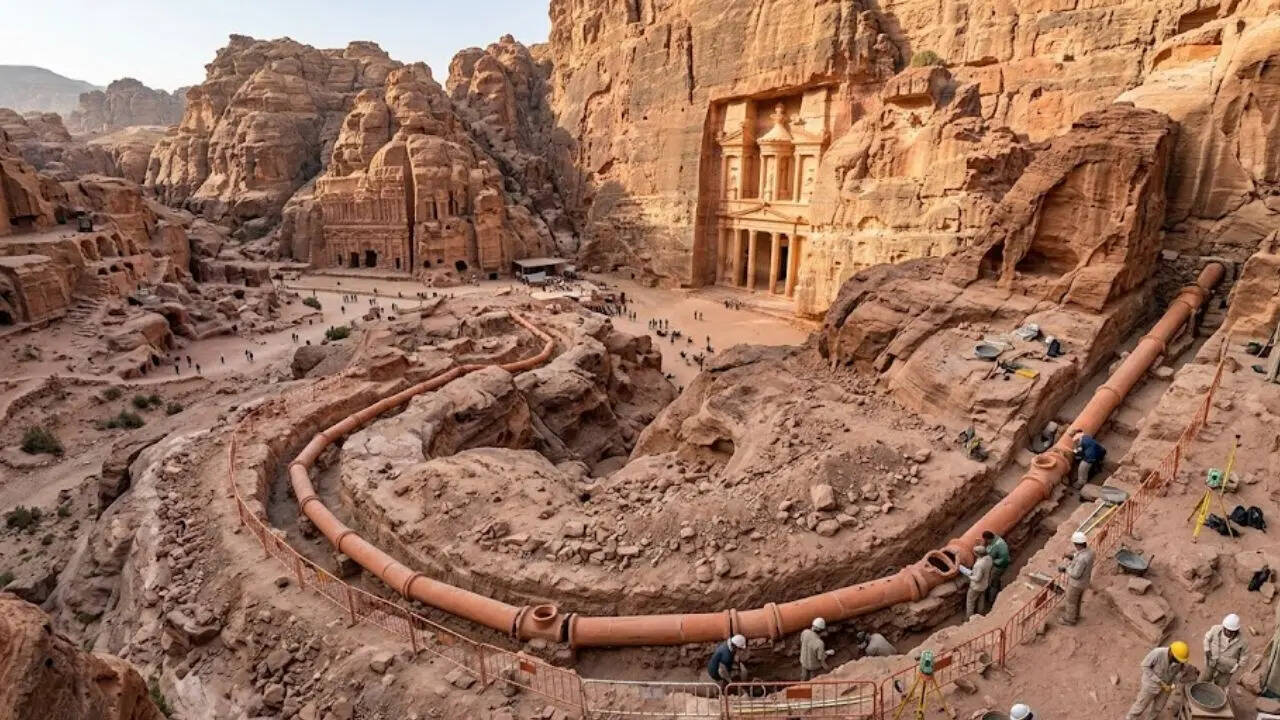
Archaeologists have made an incredible discovery at Petra, the Nabataean capital in Jordan. They found a highly developed hydraulic system that challenges the long-held belief that advanced hydraulics in the region were exclusively Roman. Niklas Jungmann from Humboldt-Universität zu Berlin led the research team that identified the 116-meter imprint of a welded lead pipeline encased in mortar within the 'Ain Braq aqueduct system. This rare find in the Jabal al-Madhbah massif shows how ancient engineers managed water pressure using techniques like inverted siphons to move water through Petra’s challenging desert landscape.
The use of lead pipes, which were both expensive and complex to produce at that time, demonstrates the Nabataeans' expertise in fluid dynamics and urban planning, as noted in a report on Phys.org. This level of skill challenges what we previously thought about ancient infrastructure and even compares to the famous hydraulic works of the Roman Empire. Such sophisticated engineering reflects a civilisation that mastered its environment, proving the Nabataeans were pioneers of liquid gold management.
116-meter-long lead pipeline discovery in Petra reveals advanced ancient engineering
The highlight of this discovery is a 116-meter lead pipeline, a very rare find in Nabataean archaeology. This pipe was an integral part of the 'Ain Braq aqueduct, designed to supply the Great Temple and Garden and Pool Complex during the reign of King Aretas IV, as noted in a published journal, Levant. Researchers pointed out that using lead enabled the creation of an inverted siphon system, likely used to transport water to the elevated az-Zantur ridge and rise to higher ground. This technical achievement indicates that the Nabataeans had advanced skills in managing pressurised water systems, far beyond what was previously known in this region.
Strategic redundancy: The dual-conduit system of Jabal al-Madhbah
The excavations focused on the Jabal al-Madhbah massif, covering a 2,500-square-meter area that played a key role in distributing water throughout the city, as noted in a report on Phys.org. The research team found out that a hidden system worked alongside the traditional terracotta channels. This setup provided a backup and made the water supply very reliable.
Discovering these two kinds of conduits shows that Petra's approach to managing water happened in several stages. It likely aimed to support both the city's growing elite population and its agricultural demands during times of severe droughts.
The Nabataeans mastered hydraulics on their own
Before this discovery, many believed that Petra's advanced plumbing was due to Roman influence. Yet, the dating of this lead pipeline reveals something different. It shows that the Nabataeans had already mastered high-pressure techniques on their own, demonstrating technical autonomy before the Roman annexation of 106 CE. This use of costly materials in the 'Ain Braq system demonstrates not only their wealth but also their technical independence. The Nabataean Kingdom thus emerges as a leader in sustainable practices in the desert.