NAGASAKI -- "Hidden Christian Sites in the Nagasaki Region" have been added to the UNESCO World Heritage list of cultural assets. What has been recognized as valuable, in fact, is not church buildings but communities that had been home to hidden Christians for about 250 years and supported their faith. These people are identified as "hidden" because they continued to practice Christianity in secret during the time of a ban on Christianity.
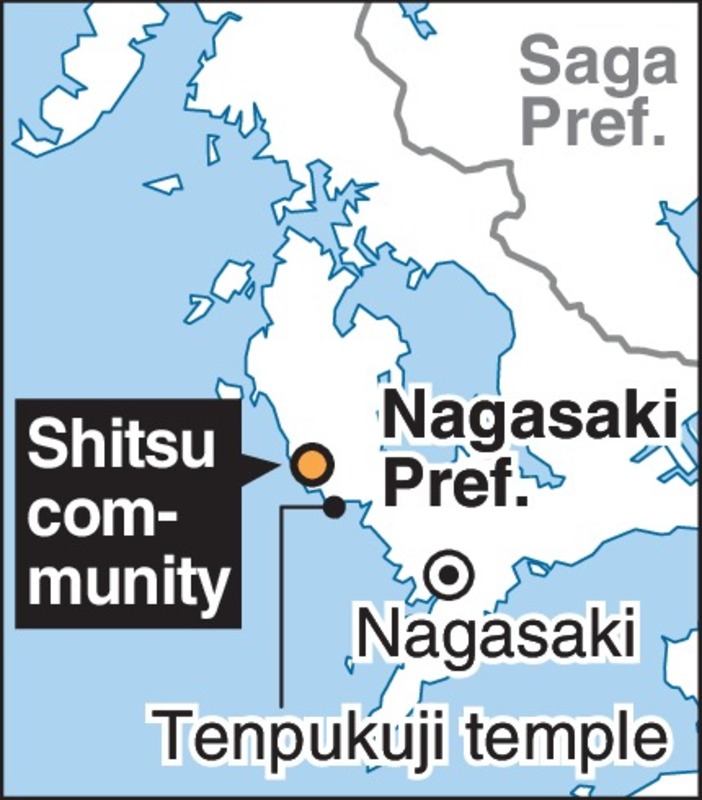
I recently visited Nagasaki to go for a walk in and around the local Shitsu community in the Sotome district, which is included in the sites.
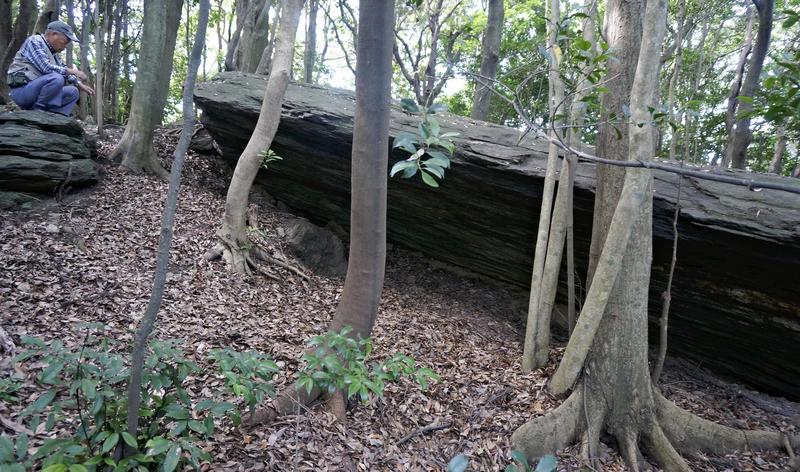
"Hidden Christians usually muttered the oratio [a form of prayer] faintly even at home so as not to reveal their faith," Takaharu Matsukawa, 78, said on a mountain in the district in the Nishisonogi Peninsula. "As that way wasn't enough to transmit [their belief] to their children, they got together here" -- he pointed to a void under a huge flat rock about 10 meters wide -- "during 'Kanashimi-setsu' [equivalent to Lent], which lasts about a month before Easter to teach it to them."
Matsukawa himself used to live according to the hidden Christian tradition. Even after the ban on the religion was lifted, some people continued to hold on to their faith without belonging to any formal church. He said that lifestyle had existed until the early years of the Showa era (1926-89).
This place in the mountain is located in the Kurosaki community, which is next to the Shitsu community but not included in the UNESCO sites. Here too there are many traces of hidden Christians.
We walked a little through a secluded forest to reach the Karematsu Shrine. Although its name sounds like a Shinto shrine, it actually enshrines the grave of a Christian missionary who remained in the community even after Christianity was banned nationwide in 1614 and encouraged local secret Christians to keep their faith.
People of the hidden Christian faith still regard this place as a sacred site and come to offer a prayer whenever they have the opportunity.
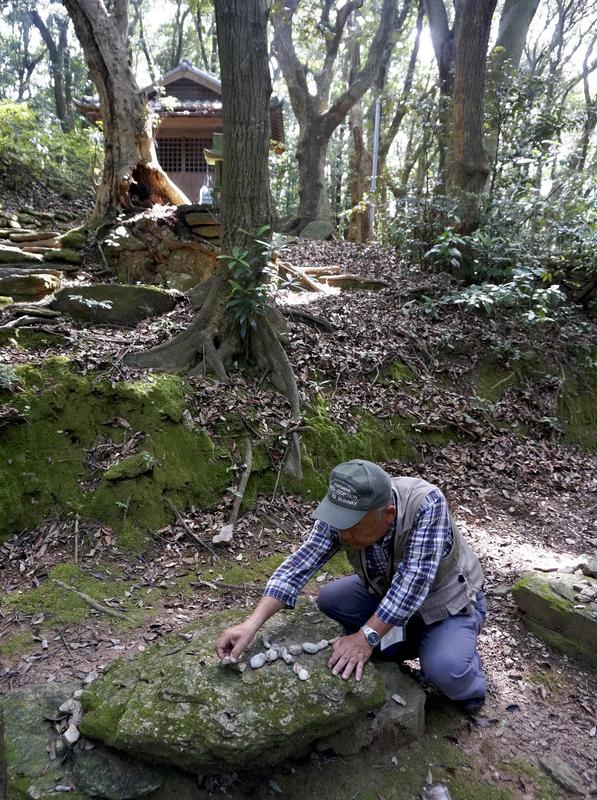
Lying near the grave are several rectangular gravestones that date from the ban period. No crosses or Christian names are inscribed on them. Instead, about a dozen small stones are placed on each of them.
Matsukawa crouched at one of the gravestones to arrange those small stones in the shape of a cross. He then gave a silent prayer. "When you finish praying, you are supposed to disarrange the stones to delete the cross," he said. "It's a hidden Christian custom."
During the Sengoku warring states period, what is now Nagasaki, encompassing the Sotome district and its neighborhood, was ruled by Omura Sumitada (1533-87), the first daimyo lord to become a Christian. Under his rule, it is said all of the about 60,000 people in the domain were Christians at one time. However, Christianity was banned after he died in 1587.
When the Tokugawa shogunate in the Edo period issued a nationwide ban on Christianity in 1614, the domain forced its people to renounce their belief much more intensely than other domains because it faced the shogunate's suspicion. In 1657, the domain apprehended 608 people who did not obey the order, and 411 of them were beheaded when they refused to give in.
Some Christians, however, managed to survive. It is largely because some places within the domain were actually detached territories of neighboring Saga domain. Saga domain was tolerant toward the Christian faith, although it set up Tenpukuji temple of the Soto school of Zen Buddhism and made local Christians the temple's parishioners in line with the shogunate's system to eliminate Christians. Another contributing factor is the local geography, with extensive mountains separating the area from the outside world.
On the other hand, about 3,000 Christians moved to the Goto island chain in Nagasaki Prefecture during the Edo period in search of the freedom of belief.
In the Kurosaki community, a museum displays hidden Christian memorabilia. They include a cross that mentally supported hidden Christians in the absence of Christian priests, a bamboo tube to hide the cross, a book titled "Tenchi Hajimari no Koto" (The creation of heaven and earth) with handwritten stories from the Bible and a booklet of the oratio.
Indispensable for maintaining their faith was a church calendar called Bastian-reki, which was brought by a Japanese missionary who became a martyr during the prohibition period. Based on this calendar, local Christians strictly observed annual events and religious rites under the instruction of the people holding the three essential posts of their organization, including the leader and a person to perform baptisms.
They strengthened their faith all the more while struggling to live in an environment that was not suited to agriculture or fishery.
When the prohibition was lifted in 1873 a little after the Meiji Restoration, hidden Christians were freed from hiding their belief, and many of them reunited with the Catholic Church. In the Sotome district, the number was 2,913 as of the year 1879. About 5,000 hidden Christians, however, are said to have remained apart. Their choice partly stemmed from their desire to keep the souls of their ancestors at peace by maintaining the style of their hidden Christian faith. Thus, the path of hidden Christians was separated into two.
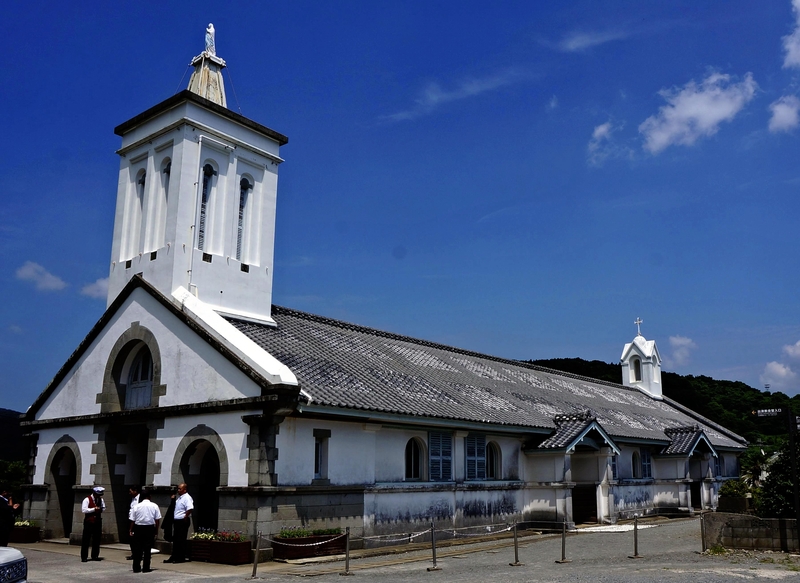
In response to their rejoining the Church, a Father de Rotz from France arrived here in 1879. To improve the impoverished lives of former hidden Christians, he built a church, an aid facility for women to make woven products and pasta, a wheat and cotton workshop, a medical facility and more, doing so at his own expense.
By contrast, people who did not rejoin the formal church continued observing their inherited faith.
However, when young members of their communities left their home for urban areas to live permanently there during Japan's postwar period of high economic growth, the population of these communities started to decrease and become older. Because there was nobody to perform baptisms, their inherited faith was not able to be maintained. Thus, the number of their religious organizations has decreased to only two across the district.
In another trend, some who eventually gave up their old practices did not join a mainstream Christian group but converted to Buddhism instead.
Shuken Shioya, 65, chief priest of Tenpukuji temple, said: "I heard they did so because they thanked our temple for helping their ancestors maintain their faith for a long period of time." Shioya also said that when the temple was renovated, some of the people who had rejoined the church donated money to the temple.
Regrettably, many facilities and sites are not included on the UNESCO World Heritage list, even though they vividly show the history and lifestyle of hidden Christians.
During my visits to these places, I was able to feel the passions of people who maintained their faith while persevering amid cruel persecution.
Read more from The Japan News at https://japannews.yomiuri.co.jp/