

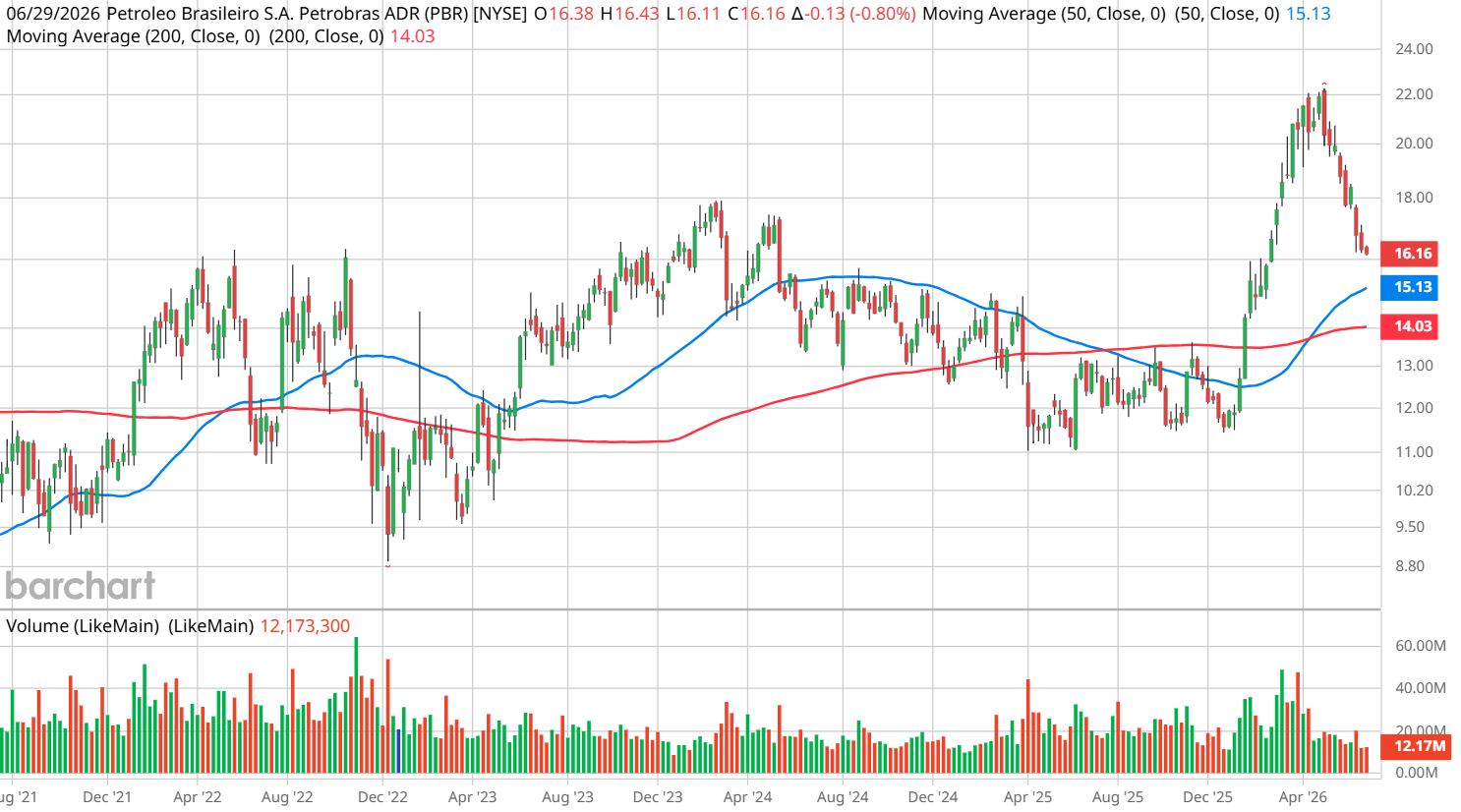
Thanks to the preliminary peace deal between the U.S. and Iran, it’s no surprise that fossil-fuel giants like Petrobras (PBR) have suffered a steep decline in recent sessions. In the case of PBR stock, the security lost more than 14% of market value in the trailing month, leading to state-owned Brazilian petroleum company to be ranked as a Weak Sell.
However, there’s a common assumption within the financial publication sphere that the selloff could be overdone. Based on the mean reversion concept, it’s very possible that PBR stock could swing higher. Rather than justifying this positive rerating through Petrobras’ fundamentals, I’m going to make a bullish case using non-parametric conditional sequence simulation or path-dependent conditioning.
Why Not Stick with a Traditional Analysis of PBR Stock?
Invariably, if I throw around terms like non-parametric conditioning, it raises an obvious question: what’s wrong with a traditional analysis of PBR stock?
Objectively, there’s nothing wrong about going over the fundamentals that drive Petrobras. Indeed, if you didn’t know much about the opportunity, an aggregation of compelling talking points for PBR stock may spark further investigatory interest. But the edge that such content provides is epistemologically constrained.
Arguably the most powerful fundamental argument favoring bullish exposure to Petrobras stock is the underlying company’s pre-salt cost of supply moat. Essentially, the energy giant’s mainline assets feature some of the lowest lifting costs globally outside of the Middle East. We’re talking about technical breakeven costs sitting below $40 per barrel.
Translation? Even with the crude oil market experiencing a sharp pullback, Petrobras’ margins remain massively profitable. Despite the geopolitical noise — which will almost certainly be loud irrespective of the peace agreement — PBR stock appears to be a compelling discount.
There are other positive catalysts as well but no matter how many of them I list, I run into an epistemological wall: unless there is compelling evidence to suggest otherwise, these elements have already been reflected in the Petrobras stock price.
To say that PBR is undervalued right now would mean that there is a portion of the good news that has yet to be integrated into the share price. Because I’m making the claim, I would have to provide evidence. Unfortunately, I don’t know where I would begin, which brings me to path-dependent conditioning.
Asking the Right Question for PBR Stock
For an analysis of a non-determinative system like the equities market to be productive, we need to ask the right question. Frankly, asking whether PBR stock is undervalued is not the right question because it’s unanswerable. A security does not move on any one single metric like revenue or cash flow but a range of dynamic elements.
These elements are non-linear, volatile and inconsistent, meaning that the cause of share price movements stems from a probabilistic cluster of scenarios. Attempting to map the full volume of such variances would likely require the use of a quantum computer, which goes beyond most people’s capabilities.
So, what is the right question? For me, it’s determining what the baseline performance expectation is for PBR stock if I buy the security randomly. From there, if I buy PBR based on a specific condition or signal, the subsequent performance must reasonably be expected to perform better than the baseline; otherwise, there’s no edge.
Using a dataset going back to January 2019, if I were to randomly buy PBR stock and hold it for a 10-week period, the expected forward distribution would land between $16.10 and $16.45 (assuming a starting price of $16.16, Tuesday’s close). With most of the probability mass standing above the starting point, PBR features an upward bias.
This is the random baseline. Any proposed signal must beat this expected performance.
As stated earlier, PBR stock is suffering from a bearish cycle. In weekly candlestick terms, over the last 10 weeks, PBR has printed only three up weeks, leading to a downward slope. Conditioned for this 3-7-D signal, the expected pathway for PBR over the next 10 weeks is a distribution ranging between $15 and $20.50. Overall, that’s a much higher expected performance relative to baseline, potentially providing you with an edge.
What’s really interesting is that, in the first three to four weeks following the flashing of the 3-7-D signal, PBR stock tends to pop higher by about 5%. If this observed pattern were to repeat again, you might be looking at shares crossing the $17 level.
A Trade and a Caveat
If the inductive inference turns out to be true, then the 16.50/17 bull call spread expiring July 17 would be a tempting proposition. Basically, past pattern recognition suggests that PBR stock may rise through the second-leg strike at expiration. If so, you’re looking at a maximum payout of nearly 178%. For a net debit of only $18 a spread, that’s going to get the speculative wheels turning.
However, there’s a massive caveat with any financial modeling that relies on pattern recognition. Just because something happens a hundred times does not necessarily mean that the next time will yield a similar result. That 101st spin of the wheel? You could get an outlier, making the trade a failure.
Sadly, as I said earlier, the equities market is a non-determinative system; that means you can’t determine (calculate) the right answer. Instead, you have to speculate on a cluster of probabilities. Given this massive limitation, I’m proposing that pattern recognition is the best (albeit imperfect) solution. And if that is the case, PBR stock does seem to be favorably mispriced.