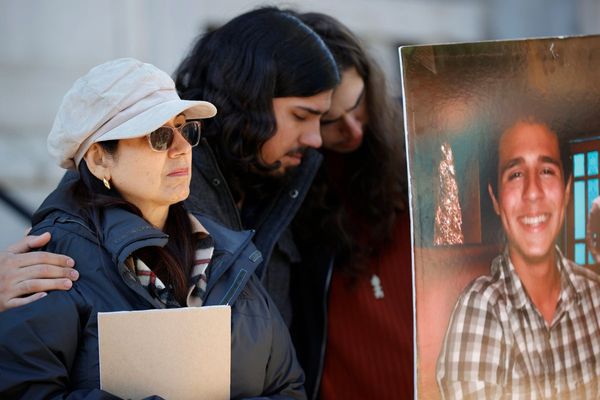
When officers showed up at Edward Fetterolf’s job and said they wanted to talk about a murder investigation, he knew exactly what they were talking about.
Then, they showed him a photo.
“As soon as I saw it, I immediately knew it was her,” he said. “In my mind, I remember her as when I last saw her. She never grew up in my mind.”
Last month, detectives told Fetterolf that after 45 years they finally figured out who the “Woodlawn Jane Doe” was — his sister.
Margaret Fetterolf was just 16 years old when she was killed. Family members told detectives that the teen went missing in 1975. About a year later, they found her body was found strangled, wrapped in a white sheet with her hands bound behind her back near Lorraine Park Cemetery — but police wouldn’t identify the body as Margaret until 2021.
A woman on her way to church on Sept. 12, 1976, reported spotting a van near the cemetery to police. Officers found the body they would identify decades later as Margaret wearing beige jeans, a white short-sleeved shirt and a rawhide necklace. Police at the time thought she was in her late teens or 20s. She was about 5 feet 8 and weighed 159 pounds.
The brown-eyed and brown-haired girl was believed to have been sexually assaulted. The drug chlorpromazine, an antipsychotic medication, was found in her system.
It would be more than four decades before police were able to accurately determine her age or name.
Tips initially poured in, but waned as the years passed. Then earlier this year, county police had a breakthrough with additional DNA testing. Those results were crucial in helping identify Fetterolf, authorities said.
About 7,800 of Maryland’s more than 24,500 homicides have gone unsolved from 1980 to 2019, according to Project: Cold Case analysis of the Federal Bureau of Investigation’s Uniform Crime Report. But with each passing year, the ability to solve more cases because of DNA and other breakthrough technology has increased.
Margaret was “rebellious,” her younger brother said, and often smoked cigarettes and hung out with the kids who smoked marijuana.
Fetterolf, who still lives in Alexandria, Virginia, where they grew up, described his sister as a “habitual runaway.” Since she was 12, she would occasionally go to a friend’s house without telling anyone, or hide in another neighborhood. Often, she was found by the cops or her dad.
So when she disappeared in 1975, family members assumed she was up to her usual antics.
“I always suspected the worst because I felt that anytime during those life moments of when you turn 18 or 21 or 50 that she would have tried to contact somebody,” the 57-year-old said. “You just always hold out hope that she’s just bitter and didn’t want contact with the family.”
Until talking with county police, Margaret’s brother had never heard of the “Woodlawn Jane Doe.” He was thankful to finally have closure, but he wondered why police had never contacted him in the 45 years that had gone by.
But back then, it was harder to access information. There was no way to plead on social media, warning people to be on the lookout. The internet didn’t become publicly available until 1993, Facebook didn’t exist until 2004 and Twitter until 2006.
Baltimore County Police did not respond to requests for further comment about the case.
Police initially thought the young girl may have been from the Boston area. The type of cloth seed bag pulled over Fetterolf’s head was sold only in Massachusetts. A key in her pocket was made by ILCO in Fitchburg, Massachusetts. And detectives thought a tattoo of the letters “JP” may have signified the Boston neighborhood of Jamaica Plain.
In 2016, the theory was reinforced after testing pollen particles that clung to her clothing. The blend of cedar and mountain hemlock pollen was a combination found only at the Arnold Arboretum in Boston or the New York Botanical Garden.
County police said it’s unclear whether Margaret Fetterolf was ever in Boston. Her brother said his family had no ties to the area.
Then, earlier this year, investigators got crucial information.
The National Center for Missing and Exploited Children — which has assisted county police with the investigation — helped get more DNA testing done.
Law enforcement contracted Bode Technology, one of the largest private forensic DNA laboratories in the United States, to do most of the work. That lab then tapped Othram Inc. to help develop a genetic profile that could be picked apart by Bode to identify potential family members.
David Mittelman, founder and CEO of Othram, said the company conducts all of its work in-house at its lab in Lorton, Virginia. And what sets it apart from others, he said, is that it is able to extract DNA “that would otherwise be inaccessible” because it might be too old or a low-quantity.
For the “Woodlawn Jane Doe” case, Othram was able to identify tens of thousands of DNA markers that allow researchers to piece together possible genealogical information.
The information was then passed back to Bode Technology, said Mittelman, who then started working to find family.
Fetterolf said county police told him the lab was able to track him down because other relatives had uploaded profiles to Ancestry.com.
“It was all just such a surprise after the length of time,” he said. “I think it’s incredible that somebody back then, before we even knew this much about DNA technology, had enough presence of mind to preserve evidence.”
______