Remember the ball-playing inside-centre? You know, the one Stuart Lancaster talked about almost from the day he took over. The one who would give England that missing ingredient, lift them out of the humdrum, make them complete. A few were tried over the years without lasting success. But what happens if Lancaster finds his man less than a month before a World Cup? When is it too late to change, especially if it means a general rethink of how England play the game?
Questions, questions. However, in the light of Twickenham last Saturday and what may happen in Paris on Saturday evening they ought to be asked.
To be honest I’m bored with Burgess; fed up with surmising about what Sam may or may not do. However, even when he is not playing, the man who England see as a centre and Bath see as a forward, commands attention. Does his absence from the squad in Paris mean he did enough at Twickenham last weekend? Normally a debutant who has done his case no harm could expect another run-out, even if it’s off the bench.
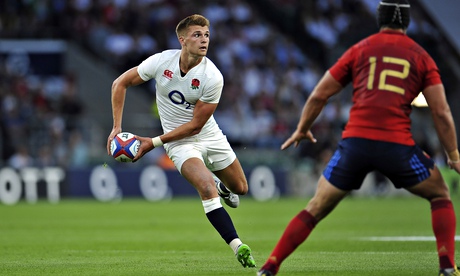
And just as importantly where does all this leave the rest of England’s midfield, notably Henry Slade, the guy who made an even bigger impression? Playing at 13 – not his preferred role and one which is among the more difficult berths in the backline – he not only looked at home on the Test stage (a “Test animal” as Sir Ian McGeechan calls such players) but he looked to have time and was instrumental in all three England tries.
No one would accuse England of being quick to spot talent, but had Slade performed last autumn as he did last weekend, then he would probably be nailed on for this World Cup not the next. The only question would be playing in what position?
Well, with Lancaster saying he is taking four centres, the assumption is that Luther Burrell is playing for his World Cup place on Saturday and that (not that Lancaster says as much) the preferred pairing is Brad Barritt and Jonathan Joseph, given that England have retreated from the ball-playing inside-centre and handed the role to a ball-carrier, a guy who can take it up, get over the gain line, pull in two or three defenders before offloading. Much as Burgess did against France. But what if?
The downside of last Saturday was the undoing of England’s “go-to” option – the set piece – when all but the best are on the field. The upside was that when England got ball they always looked dangerous and it was evident that the threat of Anthony Watson and Jonny May melted French minds. Watson got two tries, May one, Slade had a hand in all three. With Barritt and Joseph in the centre would the ball have reached the wings with such regularity?
Neither Barritt nor Joseph is a distributor. They have other assets, but passing – not just shifting the ball on, but putting a player into space or manipulating a defence – is not chief among them. Add Mike Brown to the starting XV and that makes three attacking weapons who are not ball players.
Last weekend England had a hatful. With Slade interchanging with Owen Farrell as first receiver and Alex Goode making a third option, as he did a couple of seasons ago when Lancaster did not have a ball-playing 12 and needed to increase his midfield threat, and suddenly England could go left or right to put Watson and May in space.
Add the kind of vision Slade displayed for Watson’s first try (I had the benefit of seven Sky screens so saw the move from the moment Slade spotted what was on and had the confidence to call for the ball) and the magnet for defenders Burgess became and you could understand French jitters. It was a bit like facing Australia when all the working parts are in sync and running well.
On Saturday night France may be more tested by a pack which is close to first choice, but the attack will necessarily be more predictable because, with Burrell (it could be Barritt) one side and Brown the other, everything goes through George Ford and, even though there are times when it looks like genius at work, that makes England more predictable. Twelve takes it up, Brown runs, Joseph runs.
It is tried and tested and so close to the big day the risk in tampering may seem huge. Less risky would to keep the option on the replacements’ bench lest England have to change things around on the hoof. However, if they wanted to go the whole hog, they would not be the only ones grasping a nettle so late in the day. Last Saturday we saw a sea change in New Zealand to wallop Australia.
Gone was the attempt which persisted through the Rugby Championship and for quite a while now that they could run any side off their feet. Instead, Dan Carter – seen by some as a fading force – reasserted himself and played hard ball.
Instead of carrying from anywhere, boot was put to ball, the chase was hard and those doing so were massively aggressive at the breakdown. Pressure was so intense that Australian mistakes were inevitable and when they came they were punished. After defeat the previous week, the change was impressive, but then again it came from a side which has the confidence of being the best for a decade.