Get all your news in one place.
100’s of premium titles.
One app.
Start reading
The Guardian - UK
The Guardian - UK
Lifestyle

Henry Moore: a monument to British art

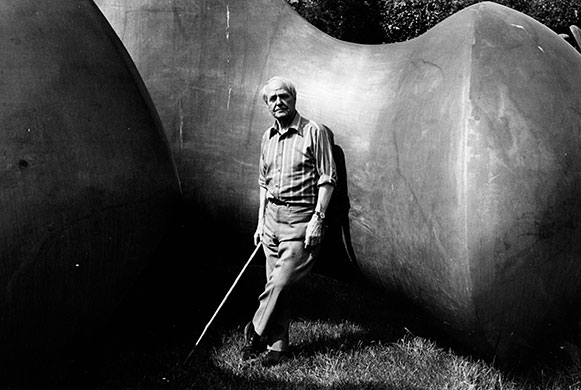
Henry Moore: Henry Moore with one of his sculptures
1898: Henry Moore's story begins in Castleford, West Yorkshire, where he was born; the son of a mining engineer
Photograph: Jane Bown
Henry Moore: Henry Moore, Hill Arches (1972-73)
1917: At the age of 18, while serving in the army during the first world war, Moore was injured in a gas attack at Cambrai – an experience which has been seen to have influenced his work. This late piece, Hill Arches, dates from 1972-73
Photograph: Penny Tweedie/Corbis
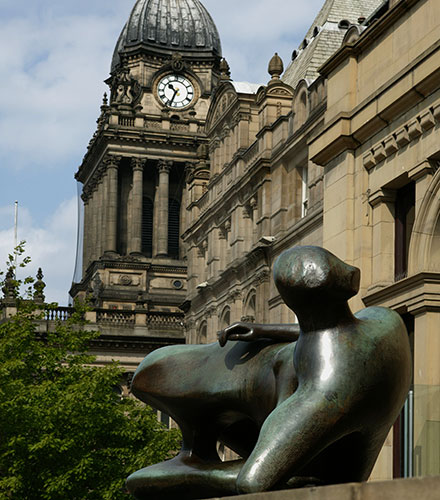
Henry Moore: Henry Moore Sculpture at Leeds City Art Gallery
1919: After the war, Moore received an ex-serviceman's grant to continue his education, and in 1919 he became the first student of sculpture at the Leeds School of Art. Here, one of his reclining figure sculptures stands outside the entrance of Leeds City Art Gallery
Photograph: PR
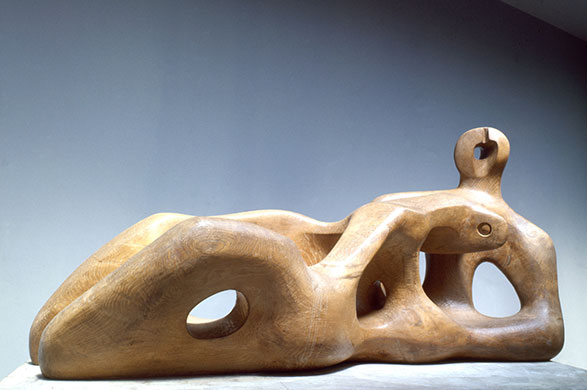
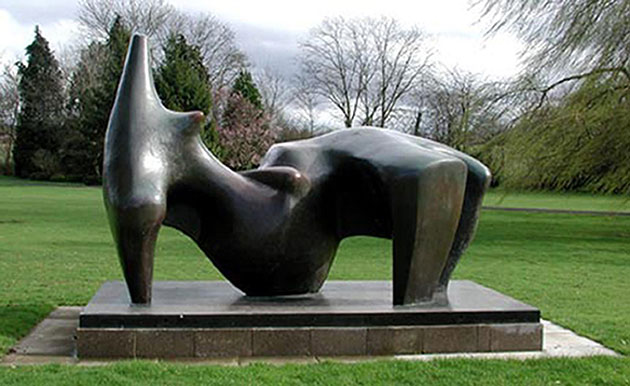
Henry Moore: Henry Moore, Reclining Figure 1939
1924: After further study in London, Moore won a six-month travelling scholarship which he spent in Italy and Paris. It was there, in the Louvre, that he came across a plaster cast of a Toltec-Mayan sculptural form, an example of the Chac Mool. The motif (echoed in this 1939 Reclining Figure) was to have a profound effect upon his work
Photograph: Detroit Institute of Arts/Henry Moore Foundation
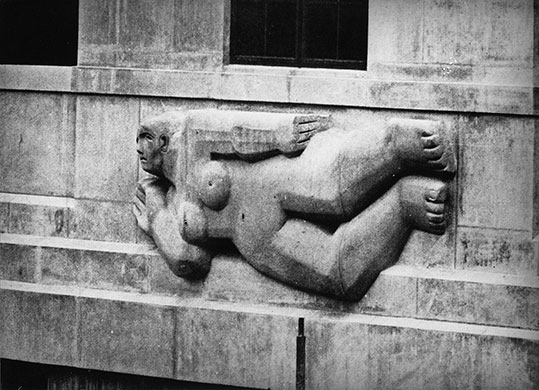
Henry Moore: West Wind 1928-29at St James's Park Underground Station, London
1928: His first public commission, West Wind (1928–29), which shows the influence of his contemporary Eric Gill, was placed high on the wall of St James's Park underground station in London
Photograph: Reproduced by permission of the Henry Moore Foundation
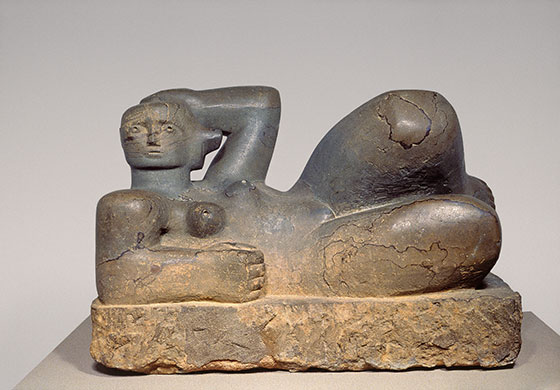
Henry Moore: Henry Moore, Reclining Figure 1929
1929: This was the year Moore married Irina Radetsky, a Russian-Polish painting student at the Royal College. Irina would pose for him, and is presumably the model for this reclining figure sculpture
Photograph: Leeds Museums and Galleries/Henry Moore Foundation
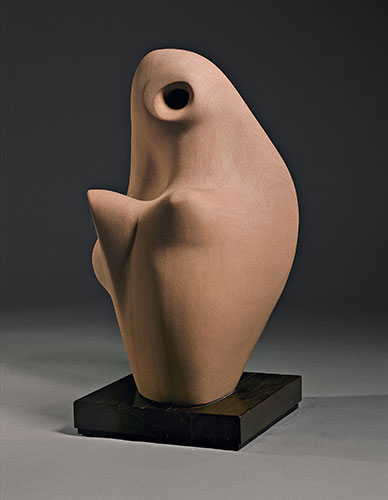
Henry Moore: Henry Moore, Figure 1933-34
1933: Moore, who was now living in Hampstead and working as head of sculpture at the Chelsea School of Art, joined painter Paul Nash's modern art movement, the Unit One Group. Surrealist influences crept into Moore's work around this time, as in this sculpture, Figure (1933-34)
Photograph: Courtesy Osborne Samuel Fine Art. Photograph Sotheby's /Courtesy Osborne Samuel Fine Art/Sotheby's
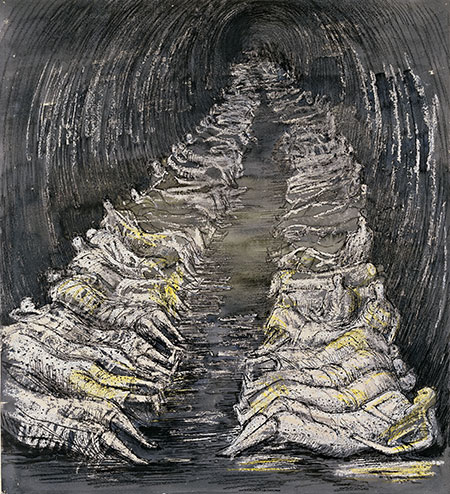
Henry Moore: Henry Moore, Tube Shelter Perspective (1941)
1939: At the outbreak of the second world war, Moore was commissioned as an official war artist, going on to produce evocative, troubling drawings of Londoners sleeping in the London underground during the blitz. This piece is entitled Tube Shelter Perspective: the Liverpool Street Extension (1941)
Photograph: Tate/Henry Moore Foundation
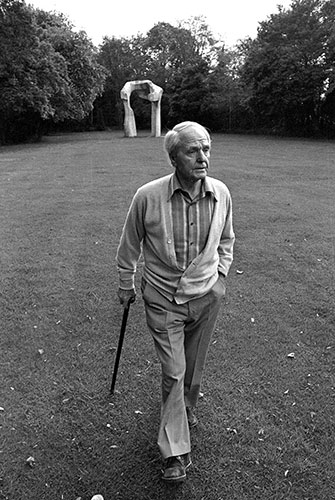
Henry Moore: Henry Moore in his garden at Perry Green, Hertfordshire
1940: After their Hampstead home was hit by bomb shrapnel, Moore and his wife moved out of London to live in a farmhouse called Hoglands in the hamlet of Perry Green, Hertfordshire. This was to become Moore's final home and workshop. Here he is pictured walking in its grounds
Photograph: Arnold Slater/Rex Features
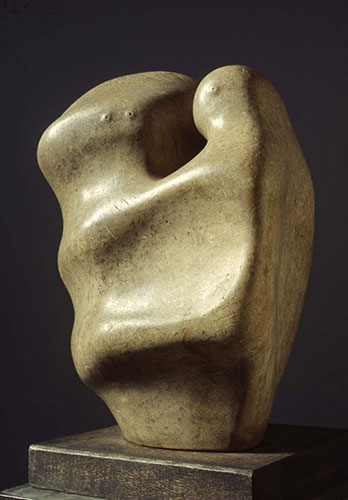
Henry Moore: Henry Moore, Mother and Child 1936
1946: The arrival of Moore and Irina's baby daughter, Mary, focused the sculptor's mind on themes of the family, which he expressed by producing several mother-and-child compositions
Photograph: Sheffield Galleries & Museums Trust
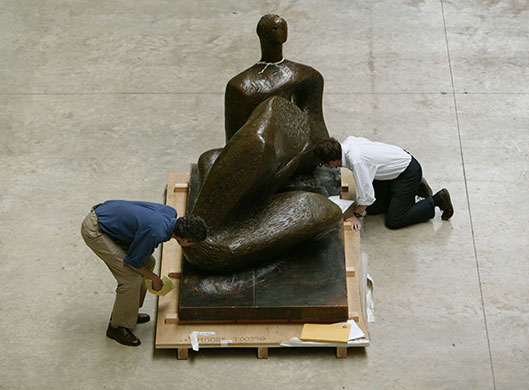
Henry Moore: Reclining Figure 1957, from the Unesco building in Paris
1957: A reclining figure for the Unesco building in Paris (a version of which is pictured here) was among Moore's increasingly significant commissions. As the decade progressed, the scale of his sculptures grew, and he started to employ a number of assistants to work with him at Perry Green, including Anthony Caro and Richard Wentworth
Photograph: Dan Chung
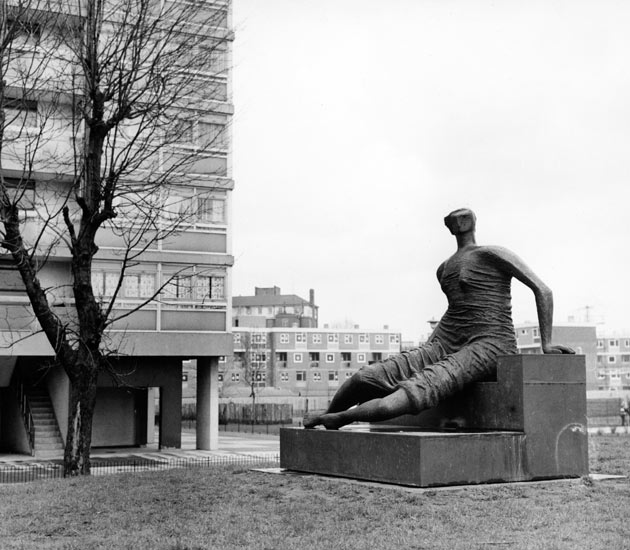
A statue by Henry Moore in Stepney, east London
From the 1950s onwards, Moore's public art became ever more visible on the streets of Britain, especially in cities. This figure of a woman was photographed in Stepney, east London, on 11 April 1963
Photograph: Jane Bown
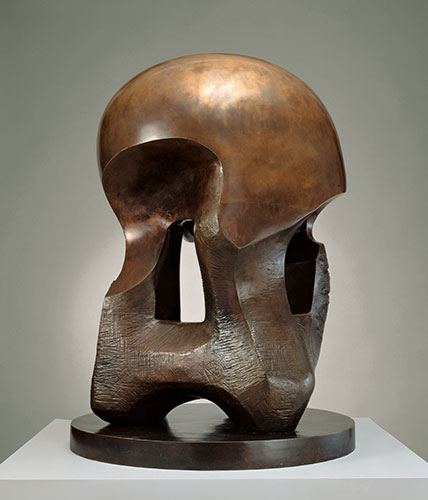
Henry Moore: Henry Moore, Atom Piece (Working Model for Nuclear Energy) 1964-5
1964: Twenty-five years to the minute after a team of physicists had achieved the first controlled nuclear chain reaction on the campus of the University of Chicago, Moore's Atom Piece (1964-5) was unveiled on the same site
Photograph: Tate/Henry Moore Foundation
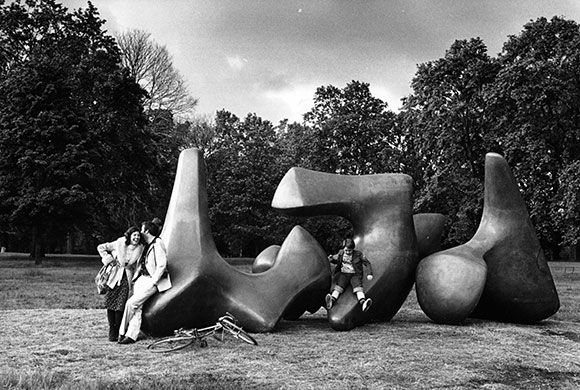
Henry Moore: Henry Moore, Vertebrae (1968-1969)
1972: In order to protect his estate from death duties, Moore set up the Henry Moore Trust with the help of his daughter, Mary. The foundation was also established to preserve his sculptures and promote the public's appreciation of art; and since Moore's death in 1988, it has run his home as a gallery and museum
Photograph: Jane Bown
Henry Moore: Henry Moore's stolen sculpture, Reclining Figure 1969-70
2005: Almost 20 years after his death, thieves broke into the grounds of the Henry Moore Foundation and stole one of Moore's bronze statues. The work, known as Reclining Figure (1969-70), weighed more than two tonnes. In 2009, British officials announced that the sculpture, once valued at £3m, had probably been sold for scrap metal, for which it would have fetched no greater price than £1,500
Photograph: Hertfordshire Constabulary/PA
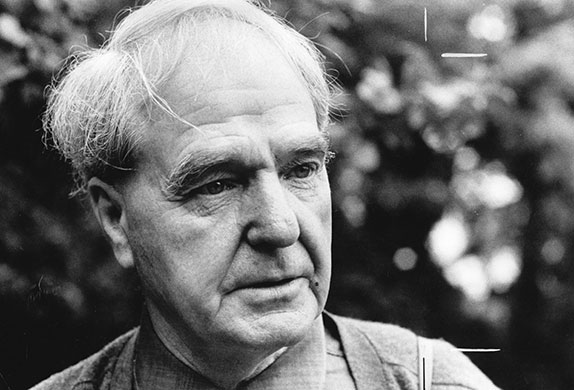
Henry Moore: Sculptor Henry Moore, July 1968
2010: Tate Britain's new show will open on 24 February and runs until 8 August 2010
Photograph: Jane Bown
Sign up to read this article
Read news from 100’s of titles, curated specifically for you.
Already a member? Sign in here
Related Stories
Top stories on inkl right now
One subscription that gives you access to news from hundreds of sites
Already a member? Sign in here
Our Picks
Fourteen days free
Download the app
One app. One membership.
100+ trusted global sources.