Well, that settles it. By re-electing David Cameron, the UK has committed itself to a referendum on whether we should leave the European Union. It will be held, the prime minister says, no later than the end of 2017, and perhaps as early as next year.
Nothing like a British exit – or Brexit – has ever happened before. It would mean the complete wrenching away of the third-largest national economy in the EU. For the UK, the legal changes alone would be bewildering and profound. “This is uncharted territory,” says Mark Paulson of the Law Society, “and no one knows for sure how it would pan out.” A recent German study suggested that the most benign Brexit they could imagine, in which Britain turned serenely into a giant Switzerland, would still cut 2% off the country’s GDP. Something painful, on the other hand, might reduce it by an utterly crippling 14%. That’s a Greek-scale catastrophe.
And paradoxically, Britain might also destroy one of its most beloved traditions – the tabloid staple of the EU scare story. Just as the union is a useful blame-hole for many Scots, so Europe has its uses for the English. Jobsworth bureaucrats and effete cucumber-straighteners, they’ve never understood our redder-blooded British ways, apparently. How would our newspapers cope without them? Would a Brexit bring new nightmares to panic over?
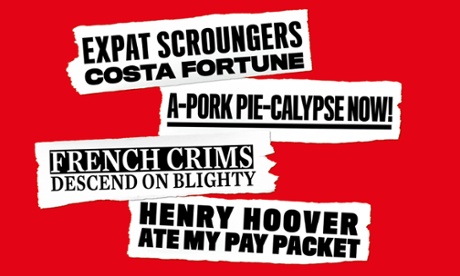
BRITS CHOKED BY ‘DEATH FOG’
Thousands ‘struggling to breathe’ in Brexit air-pollution nightmare
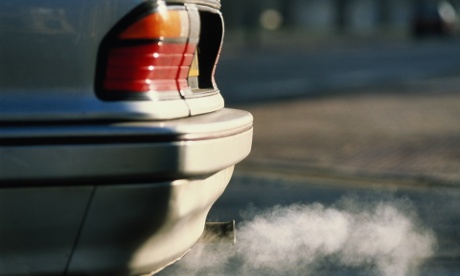
Britain’s record on air pollution is somewhere between appalling and disgraceful. When the EU adopted a set of healthy limits for various pollutants in 2008, this country had two years to comply with them. When levels of nitrogen dioxide, among other things, were tested in 2010 they were found to be above these limits in 40 out of the UK’s 43 zones – well over, in many cases. Four years later, through the heroic efforts of local authorities and central government, this had been brought down to 38 zones. The new deadline being limply offered for about 16 zones is 2020. London, the worst offender and home to some of the highest NO2 concentrations anywhere in Europe, is not expected to have healthy air until 2025. Air pollution causes asthma attacks and damages the lining of people’s lungs. Altogether it is believed to cause, or at least hasten, 29,000 deaths in the UK each year.
Nevertheless, the British public don’t seem to care. A few activists aside, the only real pressure to improve the situation has come from that European law, under which the UK government is now being sued in its own courts. Last month the supreme court finally ordered the Department for Environment, Food and Rural Affairs (Defra) to produce a plan to deal with the NO2 problem by the end of the year. Air pollution is, in short, a good example of why people sometimes benefit from having European bodies forcing their government to do something that is important, but which is too vague and boring to win them any votes. Should Brexit come to pass, of course, Defra can go back to its relaxed approach.
A-PORK PIE-CALYPSE NOW!
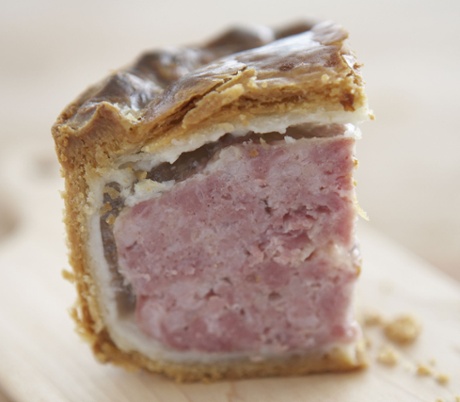
Knock-off Melton Mowbrays hit the UK and there’s nothing we can do to stop them
And not just pies. Upon Brexit, stilton cheese, cumberland sausages, Arbroath smokies, Cornish pasties and many other British regional specialities would suddenly lose their protected geographical status under EU Regulation No 1151/2012. Currently this prohibits anyone from marketing a product under one of those names if it’s been made outside the region in question, or with anything other than the traditional recipe. The EU also has bilateral agreements around the world, especially with regard to alcoholic drinks, which extend some of this protection globally. This is where things get really hazy, however. In Paulson’s opinion, “Scotch” and “Plymouth gin” would therefore probably continue to be protected, but the status of foods would be vague. After Brexit, therefore, at least in some cases, pretty much anybody around the world could make and sell phoney versions of our treasured British delicacies, and there would be little we could do about it.
On the plus side – probably – there would be nothing to stop dairy farmers in the Midlands from turning their hand to selling their own parmesan or camembert within the UK. It’s just that they wouldn’t be able to export it to anybody.
HELP! MY BUILDERS HELD ME TO RANSOM
Builder shortage leads to £100,000 quotes for new kitchens
As of April this year, with a very small number of exceptions in unusual professions, people from outside the EU can apply for general work visas in Britain only if they meet our strict “Tier 2” conditions. They must have an existing job offer and certificate of sponsorship from a licensed employer. Their work must be considered to meet or exceed the skill of an NVQ level 3 – roughly a vehicle electrician or a care home manager. In most cases, they must pay £564 for a three-year visa, plus a £600 healthcare surcharge (£200 for each of those three years). Finally, no more than 20,700 of these visas will be issued annually.
However, last year, 251,000 foreign EU citizens came to live in Britain without needing a visa, mostly to work, they said. From the moment of Brexit, therefore, the majority of the workers among them would either have to get a visa, thereby displacing an applicant from outside the EU, or stay at home. For employers, or anyone wanting to hire a Polish builder, the effect would be dramatic.
Yet even this would be a minor inconvenience compared with what the estimated 2.5 million foreign EU citizens already living here would have to do. (For what it’s worth, that is not an especially high number. In proportion to their populations, Italy and France host fewer EU nationals than Britain, but both Germany and Spain host plenty more.) Almost all these people would suddenly need visas, if they could pay the cost and meet the criteria, and if the Home Office did not implode under the strain of trying to process them. Overall, this country would either need to become suddenly and substantially more relaxed about immigration, or lose a large section of its skilled workforce overnight.
THEY’LL COSTA FORTUNE
Suntanned immigrant pensioners make YOU pay for their life of luxury
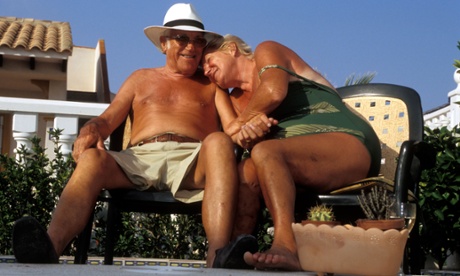
Or re-immigrants, we might more precisely call them, because Brexit will not just take away the right of EU citizens to stay in the UK; British nationals will no longer be automatically allowed to live in mainland Europe. In practice, large-scale forced repatriation probably wouldn’t happen. “International precedent allows people to continue to benefit from a right once they have exercised it,” Paulson says. “On that basis (and for very practical reasons) our understanding is that it would be unlikely that anybody is going to be sent home.”
But will they want to stay? As things stand, British expats living in Spain – one of the largest groups, at about 800,000 – are normally entitled to Spanish healthcare if they are above the retirement age. And many are. At least half are over 50, according to Spanish estimates, and the number who are over 60 quadrupled between 2000 and 2010. Without EU passports, the cost of switching to private healthcare might on its own be enough to send many of these people back to the UK – and at precisely the point in their lives when they represent the biggest burden on the NHS. Unlike the EU workers who have had to leave this country, they will also not be paying any income tax. The UK government does compensate Spain for the cost of treating British citizens, but whether the NHS would be prepared for their sudden arrival back home is another matter. Perhaps officials at the Department of Health could take advice on handling big projects from the Home Office, which, on top of all its work with visa applications, will have 49m British-EU passports to reissue as plain British ones.
HOME OFFICE PLOT TO DESTROY PREM
All so we can give football’s no-hopers a head start

One of Britain’s most successful exports could be changed utterly by a Brexit, which is something worth considering if you are a tabloid owner who, say, also has a 39% stake in Sky plc. As things stand, under the principle of freedom of movement, players from the EU are allowed free access to jobs in English football. (Clubs are bound by the home-grown players rule, but a European footballer can qualify as “home-grown” by spending three years at a British club before their 18th birthday – and indeed some do.)
Players from outside the EU, however, must obtain a work permit in order to play here professionally, and that permit must be renewed whenever the player’s contract changes. In both cases, this means satisfying the Home Office that they are an international player of the highest calibre. The Home Office defines this as having played in at least 75% of your home country’s competitive matches during the last two years in which you were available for selection. The country in question should also be one of the top 70 in the Fifa rankings. In practice, clubs often argue successfully that a player is of the highest calibre even if they do not quite meet these rules, but of course they have never had to argue about their EU players. And last season, footballers just from France, Spain, Ireland, the Netherlands and Belgium played more than a quarter of all the minutes of football in the Premier League. This season, even the champions Chelsea might have to plead for special dispensation to keep their Spanish full-back César Azpilicueta or their French centre-half Kurt Zouma.
In practice, again, Paulson thinks that friendly agreements would probably continue. “As with any other workers,” he says, “our understanding at this stage in the debate is that existing rights are unlikely to be affected, but naturally people will want certainty.” They might not get it, however, as the clamour to raise the low proportion of English players – said by some to be the source of the England team’s enduring mediocrity – might well be too much for the authorities to resist.
FRENCH CRIMS DESCEND ON BLIGHTY
Extradition madness turns UK into Costa del Crime

As everybody knows, once you have committed a serious crime, but before the authorities start looking for you, it is time to leave the country. British police and courts have no power over you abroad. Except in the EU, of course. Because by issuing a European arrest warrant (EAW), all member states can currently require one another to apprehend a suspect using their own police force, and return him or her to the scene of the crime. As long as the suspect is being accused (not just suspected) of a crime potentially carrying more than a year’s jail, and as long as the EAW has been issued fairly, then arresting them is a legal obligation. Both Jeremy Forrest, the man who ran off to France with a schoolgirl he was teaching, and Osman Hussain, who planted a bomb in Shepherd’s Bush Underground station and fled to Rome, were recaptured using EAWs.
After Brexit, however, that whole system becomes unavailable to the UK. “The EAW effectively replaced the previous European convention on extradition [ECE],” Paulson explains. “In our view, the UK could not rely on simply reverting to the ECE.” Effectively, this means that Britain would have to renegotiate 27 new extradition treaties with its European neighbours, and until it had done so the whole of the EU would become an extradition-free zone – a haven for all our fugitives from justice. Meanwhile, desperate criminals from all over Europe would know where to come.
HENRY HOOVER ATE MY PAY PACKET
Vacuum cleaner free-for-all costs families millions in electricity bills
There was uproar last summer over new regulations that, from September, limited the “rated input power” of any new vacuum cleaner sold in the EU to less than 1,600W. Though it sounds unexciting, a modern vacuum cleaner can, in fact, work just as well with much less power, thereby cutting consumers’ energy bills and substantially reducing the demand for polluting power stations. From September 2017, the limit will be reduced still further, to 900W, without any loss of effectiveness – indeed, the new regulations will require machines to have a better rate of “dust pick-up”. Cleaners will also have to be quieter and release less dust into the air.
After Brexit, however, vacuum cleaners sold in Britain will no longer be covered by EU regulations, meaning that these higher efficiency levels can be ignored. The same goes for lighting. British shops will again be able to stock the old filament bulbs that people are so fond of, and will be exempt from the ban on halogen bulbs, which is currently scheduled for 2018. Appliances such as ovens, fridges and freezers can also start ignoring EU energy efficiency laws. As a result, consumers will find themselves using much more electricity, and paying higher bills.
BLACKPOOL DISPLEASURE BEACH
Brexit chaos forces kids to swim in sewage
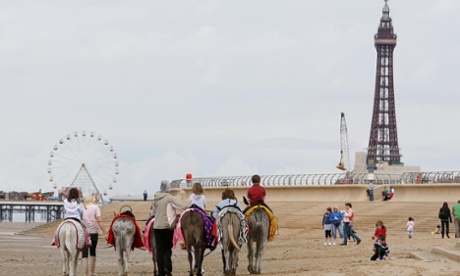
In a classic case of Euro-meddling, those bureaucrats in Brussels want to take away people’s right to swim in human faeces. Since the 1976, various very successful measures have been introduced to reduce the quantity of faecal bacteria – such as E coli – in the waters of European beaches. This culminated in the 2006 Bathing Water Directive, which requires national governments to take regular measurements and publicise the results. Eventually, beaches can even be closed if the water has too much poo in it. Some might say that any feels like too much.
And indeed, although it has improved a lot in recent decades, the quality of water at the UK’s beaches is now being held to significantly higher standards than before, and about 25 beaches – including Margate, Clacton and two in Blackpool – look in danger of failing this year’s tests. Thankfully for British bathers, the Bathing Water Directive is just the kind of irksome red tape that this country can be free from once we leave the EU. Is it really so hard to swim with your mouth closed?