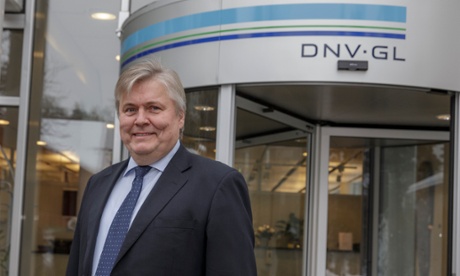
The president and chief executive of risk management giant DNV GL, Dr Henrik O. Madsen, is unequivocal about the role of business in society. The private sector stands to make a critical contribution to developing a safe, sustainable future, he believes, and supporting and scaling this effort is vital.
By joining the board of the UN Global Compact (UNGC) - the world’s largest voluntary corporate sustainability initiative, supported by 8,500 companies – Madsen will reinforce his commitment to accelerating the pace of progress. Through his three-year tenure, he will join business leaders, international labour organisations and NGOs in a collective push to help create an inclusive global economy within the natural limits of the planet. In particular, he will encourage participation, action and collaboration in northern Europe, where DNV GL is headquartered.
“It’s an honour for me to join the UNGC Board and I’m looking forward to working with the other board members to champion its mission,” says Madsen, who joined DNV as a scientist in 1982 and led all its major business areas before becoming CEO in 2006. Madsen has been CEO of the DNV GL group since 2013, following the merger with German classification society Germanischer Lloyd.
Shining a light on pathways to a sustainable future
The UNGC’s 10 guiding principles resonate strongly with the DNV GL group. As a classification and technical assurance business and independent advisor to the maritime, oil and gas and energy industries, its stated purpose is to safeguard life, property and the environment.
Sustainability sits at the core of the group’s activities, Madsen explains, and has been firmly embedded since its beginnings in 1864. In today’s risk-sensitive world, the business is poised to make a positive impact at a global level, including by giving customers a clear, evidence-based perspective on which technical solutions could yield progressive pathways to a sustainable future.
In 2014, its 150th anniversary, DNV GL conducted a review of how each business area could change. For example, the maritime business presented three important recommendations: cutting CO2 by 60%, reducing crew and passenger casualties by 90% and doing this in a cost-effective way. Its practical suggestions to achieve this include hybrid ships, adopting natural gas as an alternative fuel, advanced automation, and training people to manage emerging technologies safely.
Aspiring to a higher purpose
DNV GL’s ownership structure allows the company to make significant strides towards fulfilling its purpose. The majority of the group (63.5%) is owned by the Norwegian foundation Stiftelsen Det Norske Veritas, while the remainder is owned by a German family. The Foundation does not pay dividends but all profits are reinvested in work supporting the purpose. According to Madsen, this means it can work more freely towards its purpose without being held back by the obligation to focus on quarterly results.
“Making a profit is important, but that’s not the main goal,” he says. “We aspire to a higher purpose than profit maximisation – our structure and stable foundation enable us to take a long-term view, to consider how we can contribute to society.”
The open culture of DNV GL helps its 16,000 employees to develop the courage to take part in the journey, Madsen explains. Brave, inquisitive thinking also manifests itself in the group’s ability to challenge industry and help companies think twice about business as usual, for which the group has earned widespread respect.
“By encouraging our people to speak up and share ideas, we are continuously raising the bar and moving further towards fulfilling our purpose,” he says.
One of the company’s latest ideas is to transform a tanker - that might otherwise be used to carry oil - into a floating, wastewater treatment plant. Its engineers predict that the vessel could recycle around 2,100m3 of wastewater per hour for industry and irrigation purposes, and would cost 25% less than building an equivalent on-shore plant.
Continuing the sustainability journey
So what does Madsen see as the key ingredients for a sustainable future and how can we get there?
“We need to find the right pathways, the right technologies,” he says. “And businesses must realise the urgency. It’s simply not an option to make business plans for a three to four degree rise in global temperatures when two degrees is the limit for life on Earth as we know it.”
Madsen is an advocate of framing conversations in positive terms. And, he believes there is reason to be optimistic about the transition to renewable energy, particularly with the cost of solar and wind energy coming down.
“In any transition, there are winners and losers,” he says. “What’s important is encouraging companies to stop perceiving change as a threat. They must be part of the solution, and that’s where we can play an enabling role. Businesses must see that sustainability and profit should be integrated – that they can make more money by being a sustainable business than not.”
Madsen also sees smart regulations (which are currently falling behind what is required, he believes) and education as crucial to the road ahead, as well as a bottom-up push for sustainable investment and progressive policies.
Also through his other roles as UNGC board member, chairman of the Norwegian Research Council and adjunct professor at Denmark’s Technical University, Madsen is active in promoting both sustainable business and education agendas. And with his clear enthusiasm, articulate manner and distinguished experience, there could not be a better person for the job.
Content on this page is paid for and produced to a brief agreed with DNV GL, sponsor of the rethinking prosperity hub