Almost 10 years after he led a U.S. Marine Corps. unit that provided vital assistance to a small Japanese island devastated by the March 2011 tsunami, retired Col. Andrew MacMannis remains proud of one of the most significant missions in his military career and impressed by the kindness of the local residents he met.
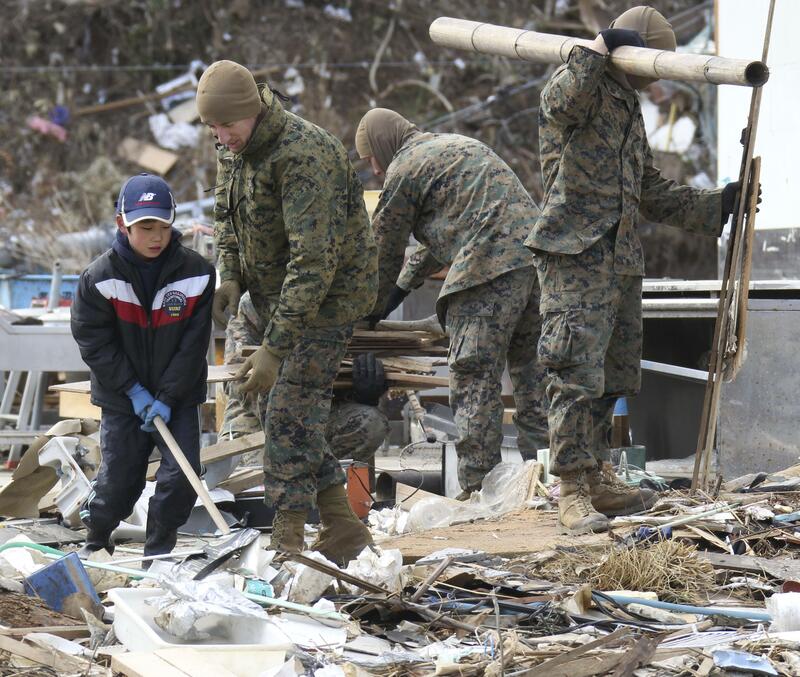
U.S. marines spent about two weeks providing help on Oshima, an island in Kesennuma, Miyagi Prefecture, as part of Operation Tomodachi, an operation to provide humanitarian assistance in areas hit hard by the Great East Japan Earthquake and ensuing tsunami. Before MacMannis' unit arrived, desperately needed help had been slow to reach Oshima. Although the island is within sight of the mainland, there was no bridge in those days and the disaster had damaged ports and beached the island's ferry. Oshima was cut off.
When the massive earthquake struck on March 11, 2011, MacMannis was aboard the amphibious assault ship USS Essex, which was pulling into port in Malaysia after completing a military exercise. Although the Pacific side of Honshu bore the brunt of the disaster, MacMannis' Marine Expeditionary Unit was instructed to head for Honshu's Sea of Japan coast. About a week later, the unit arrived in waters off Akita Prefecture.
"Of course, not a lot happened over there … We're thinking we need to get to the [Pacific] side if we're going to be helpful," MacMannis, 59, told The Yomiuri Shimbun in an interview. "We pass that up [the chain of command] numerous times, that we need to be over there. I don't know what they were all doing above us, but they kept saying 'no,'" he said.
"Initially, they told us … because we had helicopters, we could fly over mountains and get anywhere we needed to get … Helicopters don't like high, cold air. They can do it, but it's difficult."
MacMannis' unit then headed to the waters off Hachinohe, on the Pacific coast of Aomori Prefecture, where they distributed relief supplies and provided other assistance.
Twelve days after the earthquake struck, arrangements were finally put in place for MacMannis' unit to head south to Miyagi Prefecture. They were ordered to transport electric power supply vehicles to Oshima, which had been without power since the quake.
"We have over 100 vehicles on [our three ships]. There's 32 aircraft on there and over 2,000 marines," he said.
"I think we were a little frustrated because we had so much capability and we didn't feel like we're being used well. So as soon as anything would come down, we'd jump all over it and say: 'Yes, we can do it. Let's go do it now.' We were excited to go do that, especially because that was definitely one thing we could do that almost no one else can."
Off the Sanriku coast, house roofs and fridges were among the many items floating on the sea. Finding a child's shoe was heartbreaking for at least one marine.
-- Getting ashore in Oshima
On March 27, 16 days after the catastrophe, an advance team from MacMannis' unit went ashore on Oshima. The island had been cut off, there was no running water, and many residents were living in emergency shelters, including a gymnasium.
The marines used a special landing craft to transport the electric supply vehicles, water trucks, relief supplies and other items to the island. The operation continued into April, as the main force of U.S. personnel continued to distribute emergency supplies, set up showers, clear roads with a bulldozer they took ashore, and clear away debris.
Amid the scenes of devastation, the reaction of the local people amazed MacMannis. "They're the nicest people you've ever met."
"People have died. Everyone's houses are destroyed," he recalled. "But there were people bringing food out to the marines from their own house at lunchtime."
The unit wrapped up its Oshima mission on April 7. As the last boats returned to the U.S. ships, dozens of residents gave the personnel a sendoff from the coast. Children waved handmade American flags. A banner held aloft carried a message in English: "Thank you very, very much."
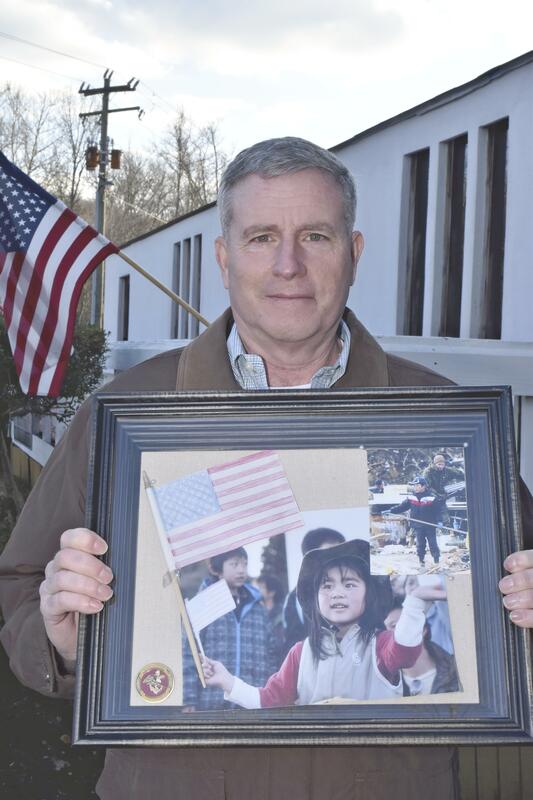
MacMannis retired from the military in 2014 and is now a research fellow at a policy research institute in Virginia. The bonds created during the mission on Oshima remain strong almost a decade on: MacMannis has framed a Stars and Stripes flag that a girl waved on the island, and some of the people who met because of the 2011 catastrophe stay in touch through social media. Even now, the mission on Oshima remains a career highlight for MacMannis.
Noting that marines necessarily spend more of their careers training to do things than actually doing them, MacMannis said: "There's only two events in my entire 30 years [in the Marine Corps] … when we're actually doing something meaningful."
One of those times was when he went to Afghanistan after the Sept. 11, 2001, terrorist attacks on the United States. The other was Operation Tomodachi.
"This is one where we got to do something, and it was helpful."
Makita is a correspondent based in Washington.
Read more from The Japan News at https://japannews.yomiuri.co.jp/