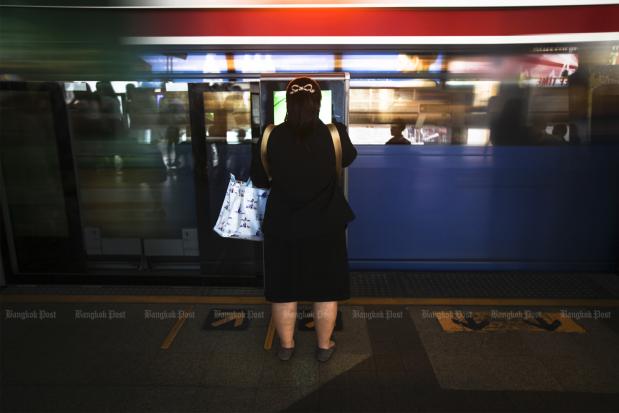
The Thailand Development Research Institute (TDRI) has called on rail authorities to help ease the financial burden on electric train commuters, saying the average ticket price in Thailand is 20% higher than that in Singapore.
"What the Department of Rail Transport (DRT) must do urgently to help the public is to control electric train fares in the capital," said Sumet Ongkittikul, director of the TDRI's Transport and Logistics Policy. "The collected data shows urban electric train fares are too costly for those on low incomes."
According to Mr Sumet, electric trains are mainly used by people with middle or high incomes.
The government can help by adopting the Japanese model which does away with the base fare when making a connection and uses common tickets, which give train passengers a 50% discount on bus fares, he said.
Mr Sumet said the fares on the service should also be tax deductible.
A study found average spending on electric train services is 1,000 baht per person per month and that a 10,000-baht tax deduction is feasible, he noted.
Mr Sumet said he believes a 500-baht monthly stipend for electric train use by holders of welfare cards for low-income earners is not enough, given that commuters spend 30-40 baht a trip on average.
The maximum fare is currently capped at 65 baht a trip.
"The government should consider hiking the monthly assistance to 700-800 baht a month," said Mr Sumet.
Regarding the possibility of lowering ticket prices, he said talks need to be held with the concessionaires.
Sorapong Paitoonphong, deputy director-general of the DRT, said studies are on the cards to figure out what should be done to assist electric train commuters.
Solutions include tax deductions, government subsidies and assistance for major companies that promote the use of electric trains among their employees, he said.
Another idea would be to use the annual automobile tax payment to subsidise electric train fares, Mr Sorapong added.