CHENNAI: Sometime in the late 1950s, DMK president and Kancheepuram MLA C N Annadurai invited his political rival, Congress leader and chief minister K Kamaraj to visit a village in his constituency. They had just fought an election, criticising each other. At the village, Anna told the villagers that CM Kamaraj was interested in their welfare, they may air their grievances to him. After some constructive interaction, the two leaders drove back home.
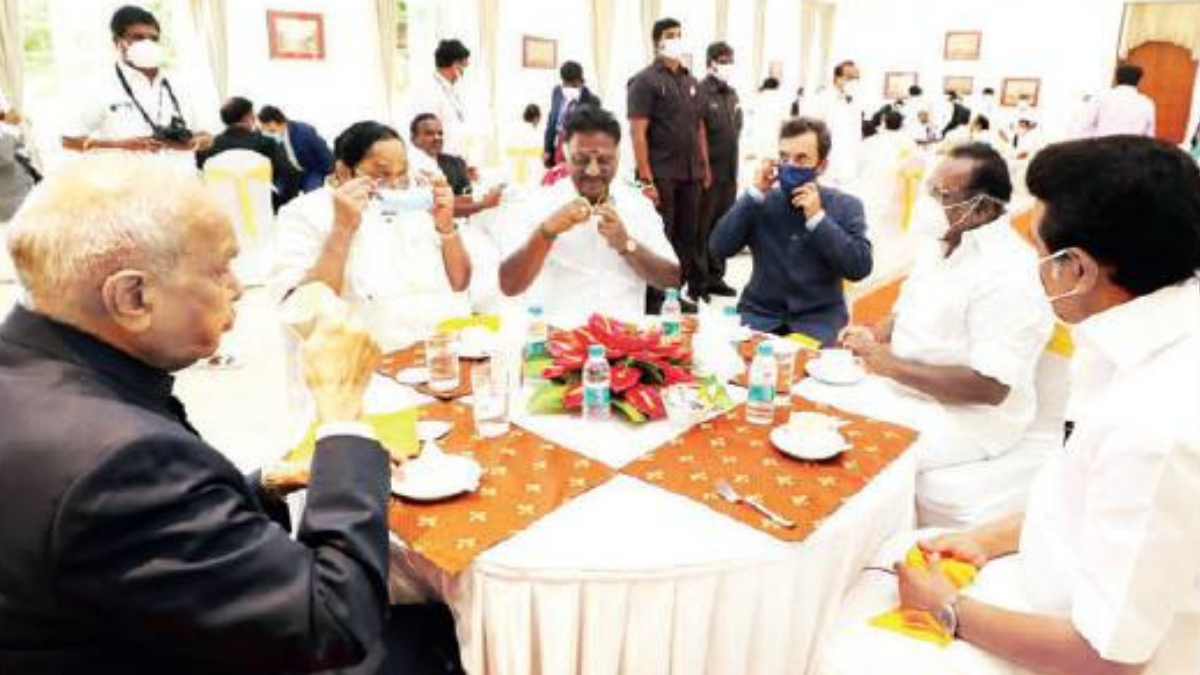
Such camaraderie among Dravidian rivals was missing in the past four decades. And now, M K Stalin appears to be keen on bringing it back. His first act of political civility was to include former health minister C Vijaya Baskar in a Covid-19 management panel. At the funeral of AIADMK presidium chairman E Madhusudhanan recently, Stalin sat between his arch-rivals Edappadi K Palaniswami and O Panneerselvam. At the unveiling of a portrait of M Karunanidhi, the organisers kept a chair on the dais for EPS.
Political observers feel Stalin soaked in Kamaraj and Anna’s embracing culture even during his student days, and leaders like Atal Bihari Vajapyee, whose government the DMK supported in 1999, left an impact on Stalin. Some others think his father, M Karunanidhi, despite his bitterness towards J Jayalalithaa (which was mutual), passed on some traits of reconciliation to Stalin. Karunanidhi and Jayalalithaa refused to see eye to eye, even avoiding assembly sessions when the other was in the house, and got each other arrested on corruption charges.
The Karunanidhi-MGR rivalry, however, was confined to politics.When MGR took ill in October 1984, Karunanidhi penned a touching epistle. Prayer means an appeal and he, an atheist, would ‘pray’ for MGR to recover, Karunanidhi wrote. It was final proof that their friendship had survived. “Kalaignar (Karunanidhi) made an impression on Stalin. It was Jayalalithaa who chose to keep Kalaignar as her enemy as it suited her politics,” said DMK MP and spokesman T K S Elangovan.
Dravidian historian Rajan Krishnan, who is an associate professor at Ambedkar University, New Delhi, says Stalin understands that his father’s politics was much more than rivalry of the past. He recalled how former Odisha chief minister Biju Patnaik almost got the DMK and the AIADMK to merge in 1979. Karunanidhi then said he should be DMK president, while MGR could continue as chief minister. They sat together and MGR agreed to the proposal. But the following day, MGR pulled out. And there ended what could have been a different political saga.
In the years that followed, hate speeches of AIADMK and DMK rivals sowed a new culture. In states like Uttar Pradesh, West Bengal, Andhra Pradesh and now Telangana bipolar politics has been getting bitter. With political dialogues shifting to social media, friendships are tottering, wrecked by trolls, disagreements and bitter exchanges.
Against this background, Stalin’s inclusive style stands out. But will it last? The DVAC searches against two former ministers have shaken the AIADMK leadership. They say Stalin’s politics of civility is only a façade to unleash vendetta politics. And that’s something only Stalin can disprove.