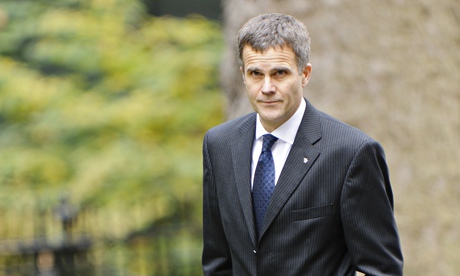
‘Dear Helge, all of us at BG Group think you’re one hell of a guy, which is why we offered you a £12m share award to be our chief executive. Trouble is, some of our shareholders are revolting. They think it’s a little on the generous side. They’ve swallowed some Bolshevik rubbish from the Institute of Directors about BG being a disgrace to capitalism. I know, you’d think these people had never heard of market forces.
“Anyway, it’s getting a little sticky here in London. Our popularity is sinking faster than the price of a barrel of Brent. Could we renegotiate? If we work together, I think we could win over the waverers and I’m sure your magnanimity would be remembered by all our shareholders.
“Have a think. But, please, not for too long. Best wishes, Andrew.”
This is the message (sort of) that one assumes Royal London Asset Management would like Andrew Gould, BG chairman, to convey to Helge Lund. Royal London is a minnow in the ranking of BG investors – it holds just 0.67% of the shares – but it is the first to break cover and say it plans to vote against the share award on 15 December unless BG does “the responsible thing”.
Specifically, the fund manager would like BG to halt the vote and “enter into meaningful discussions with shareholders in order to reach an acceptable outcome which motivates the chief executive and clearly aligns his interests to shareholders’”.
It seems a reasonable request, but BG could do better. It could ask Lund if, in the circumstances, he would waive the £12m golden hello. After all, he could still earn up to £14m a year – not bad, even by the standards of big UK oil companies such as BP and Shell.
At Statoil Lund rubbed along on a fraction of what BG plans to pay him. He is a socially responsible fellow by repute. There’s no harm in asking. That’s especially so, as opinion among fund managers seems to be hardening by the day. Royal London is traditionally noisy on pay issues, but it has captured the mainstream mood.
It would, of course, be highly embarrassing for Gould if Lund volunteered to forfeit the £12m. The chairman would look silly for side-stepping BG’s pay policies and offering the carrot in the first place. But a chairman’s personal embarrassment shouldn’t enter the equation. Gould should make the call to Norway.
Coast-to-coast colleagues
What was it transport secretary Patrick McLoughlin said in the prospectus for the East Coast franchise competition? Oh yes: “We want to see a revitalised east coast railway; one that rekindles the spirit of competition for customers on this great route to Scotland and competes with the west coast on speed, quality and customer service.”
Quite how that ambition for east-west competition squares with the new reality is hard to fathom. The east coast victor is a company 90% owned by Stagecoach and 10% by Virgin. The current west coast operator is a 50/50 joint venture between the same two companies. If this was British Airways with a stranglehold on the London-Edinburgh route in the sky, one Sir Richard Branson might have an opinion or two.
Stagecoach’s share price rose 8%. That’s understandable, of course, as franchise wins are usually greeted with enthusiasm in the City. On this occasion, however, you might think investors might tread more carefully. First, because of the competition angle, Stagecoach-Virgin may be on the back foot when the west coast franchise comes up for grabs in 2017. The monopoly worries would look less serious if the east-west dominance lasts only three years.
Second, the record of east coast operators is horrible. GNER hit the financial buffers and National Express handed back the keys. Stagecoach is a much smarter and more experienced operator. Even so, agreeing to pay £3.3bn over the life of the eight-year contract, or £2.3bn in 2014 prices, strikes many old railway hands as a very high price.
Opec’s well runs dry
Is this the end of Opec’s golden age, asked Barclays’ commodities analysts at the start of the week. The answer seems to be yes. In Vienna the cartel didn’t even bother to agree a cut in production, knowing that any figure wouldn’t be credible. For the time being, market forces will be left to run more freely.
Those forces decided that 7% off a barrel was the correct first-day response. It’s anybody’s guess where prices settle in the medium term. The last time Opec was this weak was the 1990s, before US shale production arrived.
Oil and gas plants, once they are up and running, are expensive to turn off. New projects are another matter, but it takes time for an equilibrium to emerge. The Saudi oil minister expects the market “to stabilise itself eventually”, but “eventually” could mean years.
Barclays’ analysis outlined many of Opec’s challenges. There is a “free-rider” problem, as Libya and Iraq have no quotas. Then there’s the fact that the countries screaming for a cut in production to raise prices are those that haven’t been prepared to cut in the past, such as Venezuela, Iran and Nigeria. And the Saudis, with plump financial reserves, can afford to take some pain.
Cheaper oil will be a useful shot in the arm for a slowing global economy. For Opec, though, this meeting may turn out to have been a landmark moment.