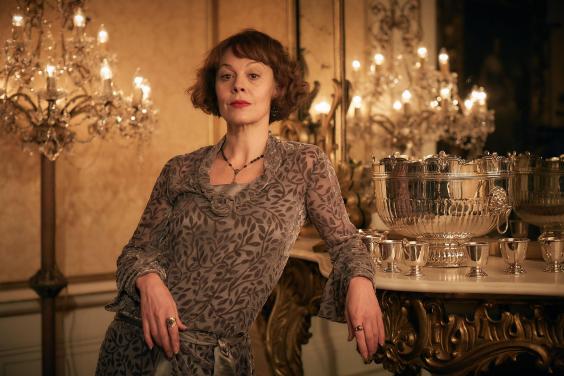
Sitting in the bar at London’s Soho Hotel, casually-dressed with steaming mug of coffee in hand, Helen McCrory looks every bit the down-to-earth mother-of-two and nothing like her intimidating Peaky Blinders matriarch, Polly. Behind her informal appearance and attitude (she pauses our interview after just two minutes to briefly catch up with a co-star) is a formidable character bubbling with intellectually formed opinions; her actor’s voice, as rich and distinctive as a full-bodied Merlot, commanding respect.
McCrory is here to talk about the BBC’s hit 1920s drama, named after a brutal Birmingham gang who sew razor blades into the peaks of their flatcaps and back for its third series in early May. She returned to Peaky Blinders having finished playing the unscrupulously evil Madame Kali in Penny Dreadful, a character skilled in the dark arts with a similar drive for reaching her goals as Polly. This series, she promises, will delve deeper into the emotions and psyche of the characters, especially hers and lead actor Cillian Murphy’s, who plays mob boss Tommy Shelby. “We’re going to places and doing things with the performance that we just haven’t done before,” she says. “It’s quite nerve-wracking as an actor. You feel vulnerable.”
Polly is back, having killed her rapist nemesis, leaving her haunted with self-loathing and a growing longing for peace. “Her conversation and story is much more with herself this series,” McCrory says, hinting that the arrival of a love interest prompts inwards exploration and insight. “To truly be honest with the person you love, you have to be honest to yourself and you have to reveal all. But will you do it or won’t you do it?”
McCrory was born in Paddington, London, to a Welsh mother and Glaswegian diplomat father, both of whom came from working class families. The no-nonsense approach instilled into her as a child means she relates to the "get-on-with-it" attitude the Shelbys display towards mental health. Both Tommy and his brother Arthur suffer from post-traumatic stress after serving in the First World War trenches, but their “stiff upper lip” culture brushes its effects under the carpet or, in Arthur’s case, buries them in line after line of cocaine and shot after shot of whisky.
Obviously it’s all pretend, but it’s much harder to play the bastard, the violent animal, than it is to be the victim
McCrory does not advocate such self-destructive behaviour; but she understands why the men never talk about their experiences. “They would unravel,” she says. “Everybody says it’s wonderful to let it all out – but is it?” McCrory knows she is not a psychotherapist, but during her upbringing there was no “whinging that your granddad was shellshocked and your father was sent off to war and your mum was a cleaning lady and money was tight”. You just got on with it, she says.
Portraying post-traumatic stress disorder is not, McCrory believes, any more tricky than anything else in the refreshingly gritty and layered drama. You always have to rely on the writing as an actress, she says, noting that if complexity is lacking in a drama, it can be hard to save it. “Steve [Knight, the show's creator] has always been very interested in the pressure, the strains and the truth of the situation, how life affects people,” she says, adding that she will always give her full support to writing that has thought behind it. “Whether it’s about sex or violence or being a policeman in Somerset, if it’s not truthful it’s gratuitous,” she says. “Steve shows you the relentless exhaustion of these people’s lives and what a cacophony of pain it is.”
Polly’s rape at the hands of Major Chester Campbell, played by Sam Neill, shocked viewers last series, her subsequent internal struggle as a Catholic set for further exploration in the third. But while Neill did a brilliantly grotesque job in the hard-hitting scene, McCrory found herself reassuring him in the run-up to shooting. “He was very worried about doing it, very wobbly,” she says, insisting that playing the rapist is “much harder” than playing the rape victim. “It’s to do with culpability," she says. "Obviously it’s all pretend, but it’s much harder to play the bastard, the violent animal, than it is to be the victim. No one’s looking at you going, ‘How could you allow yourself to be raped?’ Nobody allows themselves to be raped. But how do you allow yourself to rape? That’s the real question.” Neill’s pre-rape scene jitters are the rule, not the exception, with many actors refusing to play rapists or paedophiles for fear of audience repulsion. “[People] stare at you on the tube,” McCrory says. “They can’t remember why they want to batter you to death, but they just remember that they do, and you’re there going, ‘No! It was a programme!’”
McCrory resists describing Polly as a "strong female character", agreeing with my growing suspicion that the use of the term littering in articles about film and TV articles is, ironically, doing little to bring about equality. “I don’t really have any idea what it means,” she says. “Does it mean slightly stroppy bolshy bint?” What McCrory looks for, and what the acting industry so desperately needs, is complexity. She has no interest in whether whether a woman is seen as strong, weak, empowered or the victim, she says, as long as the part is written with truth and explores what that woman’s position is. “I just want to see what she feels and what she thinks,” she says. “To fill the screens with women who are walking around in six-inch stilettos and telling everyone what to do is as uninteresting to me as filling them with bimbos in bikinis falling into pools and laughing at your jokes. Neither are particularly interesting.”
McCrory has long been eyeing another period of history to explore, one she feels has been sorely misrepresented on screen. She would love to have a thriller commissioned about the suffragettes, she says. It’s an area she has been researching for six years: “It’s incredible the lengths they went to, the different ways that women infiltrated the House of Commons, the extraordinary stories of women who were arrested and continually raped until the police discovered they were ladies and left them to be shut up by their husbands.”
Crucially, McCrory’s vision is far from the realms of romantic drama, “the genre that we like to see women in”. “If we wrote it as a thriller, as opposed to having Gladys looking out of the window saying ‘Will Harold still love me when he knows I’ve been arrested in the square?’, I would love to do that,” she says. “We’ve got the female actresses to do it. Obviously, I will be the lead – that goes without saying.”
It really, really does.
Peaky Blinders returns to BBC2 on 5 May